

Digital advertising offers multiple ways to reach potential customers, but two of the most widely used formats are Search Ads and Display Ads. Both are available through platforms like Google Ads, yet they serve very different purposes in a marketing strategy.
Understanding how these ad types work and when to use each is essential for building an effective full funnel campaign in 2026.
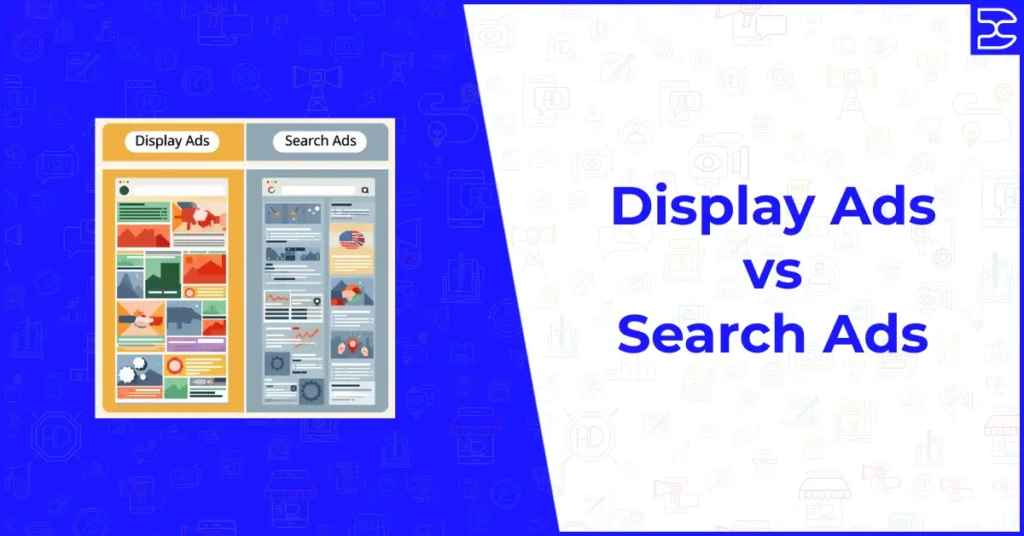
Search ads are text based advertisements that appear on search engine results pages when users type specific queries.
For example, if someone searches for “best SEO agency near me,” paid search ads appear at the top or bottom of the results page.
This may also help you – Why PPC Matters for Your Brand?
Advertisers bid on keywords relevant to their products or services. When a user searches for those keywords, Google runs an auction to determine which ads appear. Rankings depend on bid amount, quality score, and ad relevance.
Search ads are intent driven. They reach users who are actively looking for a solution.
Display ads are visual advertisements such as images, banners, and rich media shown across websites, apps, and platforms within advertising networks like the Google Display Network.
Unlike search ads, display ads do not depend on user search queries.
Display ads target users based on interests, demographics, browsing behavior, or website placements. They appear while users are reading articles, watching videos, or browsing websites.
Display ads are interruption based rather than intent based.
This may also help you – How Google Ads Work?
Search ads target users with strong purchase intent. These users are actively searching for a product or service.
Display ads target users who may not yet be searching. They focus on building awareness and nurturing potential customers.
Search advertising captures existing demand.
Display advertising generates new demand.
Search ads appear on search engine results pages.
Display ads appear across websites, apps, video platforms, and blogs.
Search ads are primarily text based.
Display ads use visuals such as banners, images, and interactive elements.
Visual creatives in display ads allow stronger branding and storytelling.
Search ads often have higher cost per click because they target high intent keywords.
Display ads usually have lower cost per click but may result in lower immediate conversion rates.
However, display ads are cost effective for large scale brand exposure.
Search ads typically deliver higher conversion rates because users are actively looking for solutions.
Display ads generate awareness and assist conversions indirectly through remarketing and brand recall.
Search ads are best suited for:
If your goal is immediate conversions and measurable return on investment, search ads are often the better choice.
Example: A plumbing company targeting “emergency plumber near me” will benefit significantly from search advertising.
Display ads work best for:
Display ads keep your brand visible even when users are not actively searching.
Example: An ecommerce brand retargeting users who visited a product page but did not purchase.
One of the most powerful uses of display ads is retargeting.
Retargeting allows advertisers to show ads to users who previously visited their website. These users are already familiar with the brand, making them more likely to convert.
A common strategy is to use search ads to capture initial traffic and then use display ads to retarget non converting visitors. This approach increases overall conversion rates.
In 2026, digital advertising relies heavily on artificial intelligence driven optimization and audience signals.
Search ads remain dominant for:
Display ads excel in:
Neither format is universally superior. Their effectiveness depends on campaign objectives.
The answer depends on your goal.
If your objective is direct sales or lead generation, search ads typically perform better.
If your objective is brand awareness or nurturing potential customers, display ads are more effective.
Most successful advertisers use both as part of a structured full funnel strategy.
Display ads and search ads serve different but complementary purposes in digital marketing.
Search ads capture demand from users actively seeking solutions. Display ads create demand by exposing audiences to brands through visual placements.
In 2026, the most effective strategy is not choosing one over the other. It is integrating both into a structured and data driven campaign strategy.
Businesses that align ad formats with marketing objectives, audience behavior, and funnel stages achieve stronger and more sustainable advertising performance.
If the goal is growth, the real question is not Display versus Search. The real question is how both can work together to maximize results.
From in-depth discovery to ROI-focused execution, every step is designed to help your business grow smarter, faster, and stronger in the digital space.
Services
Quick Links
Contact Info

Copyright © 2026 XproDigitals.com All rights reserved.