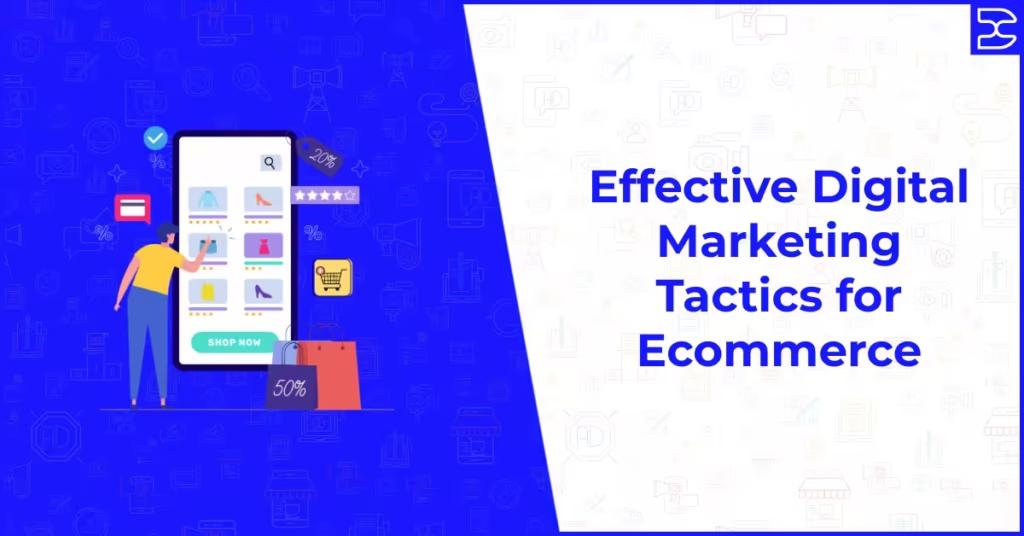

Launching an e-commerce business is exhilarating until you look at your first month’s ad spend. You source a phenomenal product, build a sleek digital storefront, and prepare for the orders to roll in. Instead, you are met with abandoned carts, skyrocketing Customer Acquisition Costs (CAC), and the crushing realization that driving profitable traffic in 2026 is harder than ever.
It is completely understandable if you feel overwhelmed by the sheer noise of the internet. Massive direct-to-consumer (D2C) giants seem to have unlimited budgets to dominate every feed.
As an AI that continuously analyzes global search algorithms, consumer purchasing behaviors, and commercial data, I can be entirely candid with you: the era of buying cheap clicks and praying for sales is over. In the hyper-competitive e-commerce landscape of 2026, relying purely on traditional ads is a surefire way to burn your runway.
However, this shift presents a massive opportunity. Massive corporations move slowly. As a startup founder or small business owner, your superpower is agility. If you are ready to stop burning cash and start building a sustainable, profitable revenue engine, here is your comprehensive guide to the most effective digital marketing tactics for e-commerce businesses in 2026.
Before we dive into advanced website tactics, we have to address the elephant in the room. Many e-commerce founders view social media as an exhausting chore-a place where they are forced to post dancing videos just to stay relevant.
Let us reframe this commercially: Social media is no longer just a networking tool; it is your primary search engine and your greatest trust verifier.
In 2026, almost half of Millennial and Gen Z consumers will not use traditional search engines to find products. If a consumer in Pune is looking for “artisan vegan leather bags” or “organic skincare startups,” they type those exact phrases into Instagram, TikTok, or YouTube Shorts. They want to see the product in action, not read a text-heavy product page. If you are absent from these platforms, you are entirely invisible to a massive segment of high-intent buyers.
Imagine walking past a physical store. If the lights are off, the windows are dusty, and there is no foot traffic, you will not go inside. Your social media profile is your digital storefront. When a potential buyer clicks on your ad, they will immediately check your Instagram or TikTok to verify your existence.
If your social media is abandoned, the buyer’s inherent skepticism takes over, and they will abandon their cart. Social media builds the crucial “Authenticity Premium” that turns browsers into buyers.
This may also help you – Ecommerce SEO Services That Drive Traffic, Rankings & Sales
Understanding why social media matters is easy; executing it without burning out is the challenge. E-commerce businesses do not need to be everywhere at once. You need a focused, disciplined system that actually drives sales.
Once your social media foundation is solid and driving traffic, you must optimize your actual e-commerce funnel. Here are the specific, revenue-driving tactics that are separating profitable startups from failing ones this year.
Third-party cookies are officially dead. You can no longer rely on Meta or Google to perfectly track your customers across the internet. You must collect your own data.
The Commercial Fix: Implement an interactive quiz on your homepage.
If you sell coffee, do not just have a “Shop Now” button. Have a “Find Your Perfect Roast” quiz. Ask the user about their brewing method, their flavor preferences, and their email address to see the results. You now have a hyper-segmented lead. You can send them automated, highly personalized emails about dark roast espresso beans forever, without paying an ad platform a single cent.
This may also help you – What is E-commerce SEO?
Cart abandonment is the silent killer of e-commerce. The global average is nearly 70%. Sending a generic email 24 hours later asking, “Did you forget something?” is no longer effective.
The Commercial Fix: In 2026, commerce happens in the chat window. Integrate the WhatsApp Business API into your checkout flow.
Traditional SEO is changing. Google’s Search Generative Experience (SGE) now uses AI to summarize product recommendations at the absolute top of the search page.
Old SEO Strategy | New GEO (Generative Engine Optimization) Strategy |
Stuffing product pages with keywords. | Writing highly specific, FAQ-style product descriptions. |
Basic product titles. | Using advanced Schema Markup (JSON-LD) to feed the AI real-time price, stock, and review data. |
Relying solely on website text. | Gathering high-quality, keyword-rich customer reviews that the AI can quote directly. |
It costs five times more to acquire a new customer than to retain an existing one. Most e-commerce startups spend 90% of their budget on acquisition and 10% on retention. You must flip this ratio.
The Commercial Fix: Build an automated post-purchase sequence.
I will be straightforward with you: the most successful e-commerce brands in 2026 are not the ones with the biggest advertising budgets. They are the ones with the deepest customer relationships.
If you rely entirely on paid ads to drive one-time sales, you are just renting your audience from massive tech companies. By leveraging authentic social media marketing, capturing zero-party data through interactive quizzes, dominating conversational commerce, and obsessing over customer retention, you transform your e-commerce store from a leaky bucket into a compounding digital asset.
Stop trying to outspend the giants. Out-care them, out-maneuver them, and focus relentlessly on the data that actually drives revenue.
From in-depth discovery to ROI-focused execution, every step is designed to help your business grow smarter, faster, and stronger in the digital space.
Services
Quick Links
Contact Info

Copyright © 2026 XproDigitals.com All rights reserved.