What Is Pay-Per-Click Advertising? A Complete Guide
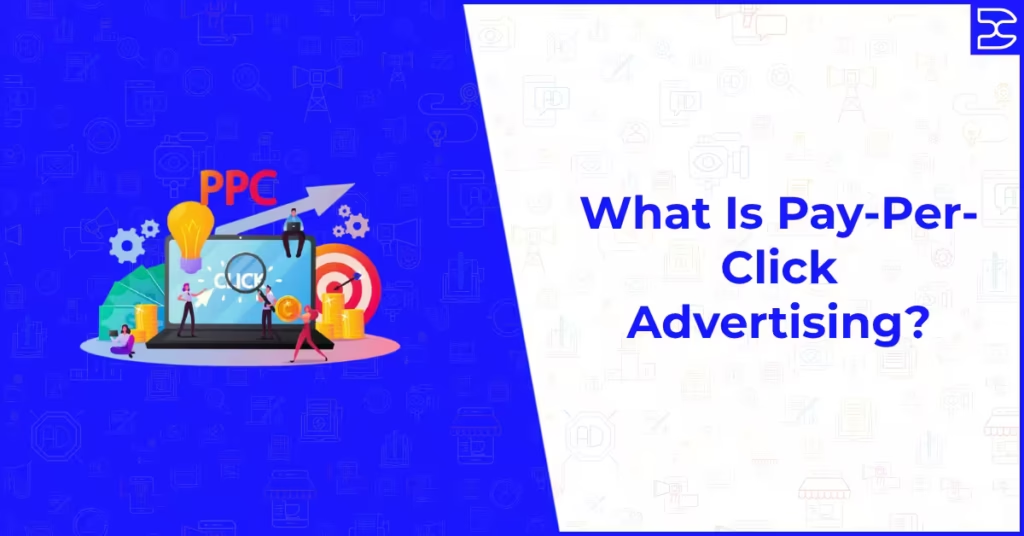
Table of Contents
ToggleWhat Is Pay-Per-Click Advertising? A Complete Guide
If you have ever searched for something on Google and noticed the small ‘Sponsored’ label above certain results, you have already seen pay-per-click advertising in action. PPC is one of the most powerful tools in digital marketing today, and understanding how it works can mean the difference between a campaign that drains your budget and one that consistently brings in qualified leads.
This guide breaks down exactly what pay-per-click advertising is, how the bidding system works, which platforms you can use, and how to make it work for your business.
What Is Pay-Per-Click Advertising?
Pay-per-click advertising is a digital marketing model where advertisers pay a fee each time a user clicks on their ad. Rather than earning traffic organically, businesses essentially purchase visits to their website. The ad only costs money when someone actively engages with it, which makes PPC one of the most accountable forms of advertising available.
Think of it this way. With traditional advertising, you pay a flat fee to get your message in front of an audience, whether they care about it or not. With PPC, you only pay when someone actually wants to know more. That shift in accountability is what has made PPC advertising a central pillar of modern digital marketing strategy.
Search engines like Google and Bing are the most popular platforms for PPC, but the model also applies to social media platforms like Facebook, Instagram, LinkedIn, and YouTube.
This may also help you – Google Ads vs Meta Ads 2026
How Does Pay-Per-Click Advertising Work?
PPC advertising operates through an auction system. When a user types a search query, the ad platform runs a real-time auction to determine which ads appear and in what order. Here is a simplified breakdown of how the process works:
- Keyword Selection: Advertisers choose which keywords they want to trigger their ads. For example, a plumbing business might bid on ’emergency plumber near me’ or ‘burst pipe repair.’
- Bid Setting: Advertisers set the maximum amount they are willing to pay per click. This is called the maximum CPC (cost-per-click) bid.
- Quality Score: Google and other platforms assign a Quality Score based on ad relevance, expected click-through rate, and the quality of your landing page. A higher Quality Score can lower your cost per click significantly.
- Ad Rank Calculation: Ad Rank = Max Bid x Quality Score. This determines your ad position on the results page.
- Ad Display: Your ad is shown when a user searches for your target keyword, and you pay only if they click on it.
This auction happens millions of times every day across billions of searches. The entire process takes milliseconds, and the result is a highly competitive, dynamic marketplace for advertising space.
Types of Pay-Per-Click Advertising
PPC advertising comes in several forms, each suited to different goals and audiences.
1. Search Ads
These are the text-based ads that appear on search engine results pages (SERPs). They are triggered by specific keywords and are highly intent-driven. When someone searches for ‘best CRM software for small businesses,’ they are actively looking for a solution, making search ads extremely effective for conversion-focused campaigns.
2. Display Ads
Display ads appear across the Google Display Network, which includes over two million websites, apps, and videos. These are image or banner-based ads that are great for brand awareness campaigns and retargeting users who have visited your site before.
3. Shopping Ads
Shopping ads are product-based ads that show an image, price, and store name directly within search results. They are particularly powerful for e-commerce businesses because they let shoppers compare products before they even click. These are managed through Google Merchant Center.
4. Social Media PPC Ads
Platforms like Facebook, Instagram, LinkedIn, and TikTok all run on a PPC model. These ads allow precise audience targeting based on demographics, interests, job titles, and behaviors. LinkedIn PPC, for example, is widely used for B2B lead generation.
5. Video Ads
YouTube video ads operate on a PPC or CPV (cost-per-view) basis. Skippable in-stream ads, non-skippable ads, and bumper ads give advertisers flexible options for storytelling and brand building with measurable results.
Have confused which ad type is best for your business – Search Ads or Display Ads, this detailed article is for you.
Key PPC Metrics You Need to Understand
Knowing your numbers is what separates profitable PPC campaigns from expensive ones. Here are the core metrics every advertiser should track:
Metric | What It Means |
CPC (Cost Per Click) | The average amount you pay each time someone clicks your ad. |
CTR (Click-Through Rate) | The percentage of people who see your ad and click on it. Higher CTR usually signals strong ad relevance. |
Conversion Rate | The percentage of clicks that result in a desired action, such as a purchase or form fill. |
CPA (Cost Per Acquisition) | How much you spend on average to acquire one customer or lead. This is the most critical profitability metric. |
ROAS (Return on Ad Spend) | Revenue generated for every dollar spent on ads. A ROAS of 4x means $4 earned for every $1 spent. |
Quality Score | Google’s rating of your keyword and ad relevance on a 1 to 10 scale. It directly impacts your cost per click and ad placement. |
PPC vs. SEO: What Is the Difference?
This is one of the most common questions in digital marketing. Both PPC and SEO aim to get your business in front of people searching for what you offer. The key differences come down to speed, cost, and sustainability.
SEO (Search Engine Optimization) is the process of earning organic search rankings through content quality, backlinks, and technical website performance. It takes time, often months, to see results, but the traffic it generates does not cost you per click.
PPC advertising, on the other hand, puts you at the top of search results within hours of launching a campaign. The trade-off is that visibility stops the moment you stop paying. The smartest digital marketers use both in tandem: PPC for immediate traffic and testing, SEO for long-term sustainable growth.
Benefits of Pay-Per-Click Advertising
PPC advertising offers a range of advantages that make it a preferred choice for businesses of all sizes:
Immediate visibility: Unlike SEO, PPC can place your brand at the top of search results within hours, making it ideal for product launches, seasonal promotions, or new market entry.
Precise audience targeting: You can target users by location, device, time of day, income level, interests, and even previous interactions with your website.
Full budget control: You set a daily or monthly budget cap. There are no surprise bills, and you can pause or adjust campaigns at any time.
Measurable ROI: Every click, conversion, and dollar spent is tracked. This level of transparency is rarely possible with traditional advertising channels.
Scalability: Once you find a winning ad formula, you can scale your budget to increase results proportionally. This makes PPC one of the few channels where growth is genuinely predictable.
Retargeting opportunities: PPC platforms let you show ads specifically to users who have already visited your site or interacted with your brand, keeping you top of mind throughout the buyer journey.
How to Get Started With PPC Advertising
Starting your first PPC campaign does not have to be overwhelming. Here is a practical roadmap to help you launch with confidence:
Define your campaign goal: Are you trying to generate leads, drive e-commerce sales, increase app downloads, or build brand awareness? Your goal shapes every other decision.
Conduct thorough keyword research: Use tools like Google Keyword Planner, Ahrefs, or SEMrush to identify keywords with strong commercial intent. Focus on specificity over volume. Longer, more specific phrases often convert better at a lower cost.
Set a realistic budget: Start small while you gather data. A budget of even $500 to $1,000 per month can yield valuable insights about what works before you scale.
Write compelling ad copy: Your ad headline and description must match search intent and give users a clear reason to click. Include your focus keyword, a value proposition, and a specific call to action.
Build a dedicated landing page: Never send PPC traffic to your homepage. Create a focused landing page that matches the promise of your ad, loads quickly, and makes it easy for users to convert.
Install conversion tracking: Set up Google Ads conversion tracking or integrate with Google Analytics before launching. Without tracking, you are flying blind.
Monitor, test, and optimize: Review your campaigns weekly. Test different headlines, landing page layouts, and bidding strategies. PPC rewards continuous improvement.
This may also help you – How to Choose a PPC Agency in 2026
Common PPC Mistakes to Avoid
Many businesses waste significant budgets on PPC simply by making preventable errors. The most common pitfalls include:
- Bidding on overly broad keywords without using match types to control traffic quality.
- Ignoring negative keywords, which causes your ads to appear for irrelevant searches and drains budget fast.
- Sending traffic to a generic homepage instead of a targeted landing page tailored to the ad.
- Setting and forgetting campaigns without regular monitoring and adjustments.
- Overlooking mobile performance when a significant portion of clicks may come from smartphone users.
- Not A/B testing ad variations to understand which messaging resonates with your audience.
Final Thoughts
Pay-per-click advertising is not a shortcut. It is a skill. When done right, it delivers some of the most trackable, scalable, and immediate results available in digital marketing. When done poorly, it can burn through budgets with little to show for it.
The foundation of any successful PPC strategy is a clear goal, rigorous keyword selection, compelling creative, a high-converting landing page, and a commitment to ongoing optimization. Start small, measure everything, and scale what works.
Whether you are a small business owner running your first Google Ads campaign or a marketing manager looking to sharpen your paid media skills, understanding the fundamentals of PPC advertising is one of the most valuable investments you can make in your digital marketing education.
Frequently Asked Questions About PPC Advertising
Pay-per-click advertising is a model where you pay only when someone clicks your ad. Instead of paying for impressions or airtime, you pay for actual traffic to your website, making it one of the most cost-efficient forms of digital advertising.
PPC costs vary widely based on your industry, competition, and keyword demand. On Google Ads, the average CPC across all industries ranges from $1 to $2 on the Search Network. Competitive industries like legal, insurance, and financial services can see CPCs exceeding $50. However, you fully control your budget, so you can start with as little as a few dollars per day.
Yes, PPC can be highly effective for small businesses when managed correctly. The ability to target local audiences, control spending, and measure results makes it accessible and scalable. Starting with a small, focused campaign on a specific service or product is the smartest approach for businesses with limited budgets.
PPC (pay-per-click) is the advertising model; Google Ads is one specific platform that uses it. Google Ads is the largest and most widely used PPC platform in the world, but PPC advertising also applies to Bing Ads, Facebook Ads, LinkedIn Ads, and other digital advertising networks.
To calculate PPC ROI, use this formula: ROI = (Revenue from PPC - Cost of PPC) / Cost of PPC x 100. For example, if you spend $1,000 on ads and generate $4,000 in revenue directly from those ads, your ROI is 300%. Tracking conversions accurately through Google Ads or Google Analytics is essential for this calculation.
The average CTR for Google Search Ads is around 3% to 5%, though this varies by industry. A CTR above 5% is generally considered strong. For display ads, even a 0.5% CTR can be respectable given the awareness-focused nature of the format.
While it is technically possible to run some ad types without a traditional website, it is not recommended. A dedicated landing page is critical for converting ad clicks into leads or sales. Without a quality landing page, your Quality Score will suffer, your costs will rise, and your results will be significantly weaker.
Our Related Posts