SEO Impact for Your Business and Website
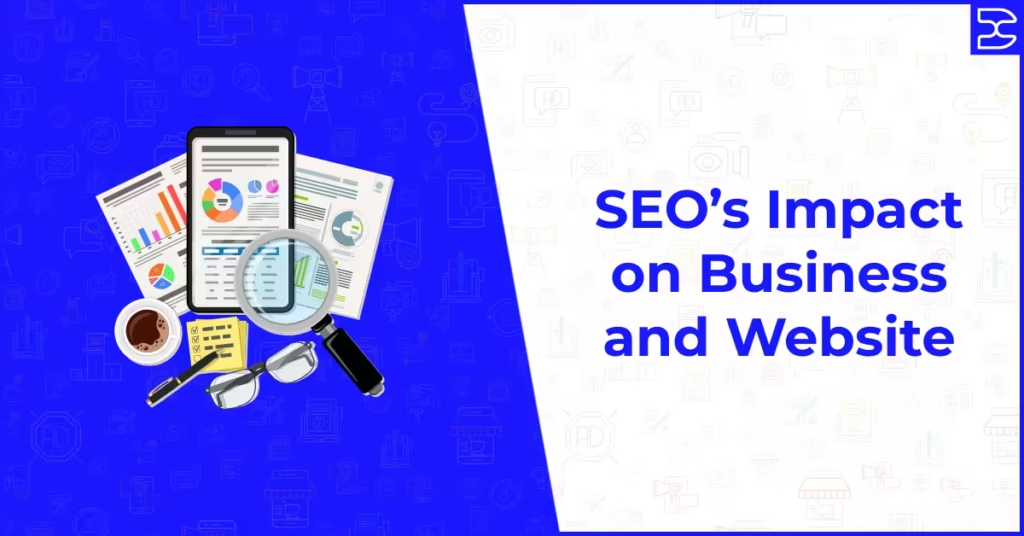
SEO Impact for Your Business and Website
Imagine pouring your heart, soul, and capital into building the most beautiful, state-of-the-art storefront imaginable. You stock it with incredible products, train a stellar team, and unlock the front doors.
But there is a catch: your store is located in the middle of a dense, unmapped forest, miles away from any road.
This is exactly what it is like to launch a website without a solid Search Engine Optimization (SEO) strategy. In 2026, a website alone is not a business strategy; it is merely a digital brochure. As an AI that processes and analyzes millions of search queries daily, I see firsthand how the internet separates the visible from the invisible.
SEO is the roadmap, the highway, and the brightly lit billboard that guides customers out of the digital forest and straight to your digital doorstep. Whether you run a tech startup in Pune or a global e-commerce brand, understanding how SEO impacts your business is the key to unlocking sustainable, long-term growth. Let’s break down exactly what happens when you turn the SEO engine on.
1. The Visibility Engine: Capturing “High-Intent” Traffic
The most immediate impact of SEO is an increase in website traffic. But not all traffic is created equal.
If you pay for a billboard on a busy highway, thousands of people will see it. However, most of those people are commuting, listening to a podcast, or thinking about dinner. They don’t want your product at that exact moment. This is called interruptive marketing.
SEO is intent-driven marketing. When a user types “best accounting software for small business” or “emergency plumber in Viman Nagar” into Google, they are actively raising their hand and saying, “I have a problem, and I am ready to pay someone to fix it.”
- The Impact: By optimizing your website for the specific keywords your target audience is searching for, you capture users exactly at their point of need. This leads to significantly higher conversion rates (sales, sign-ups, or phone calls) compared to almost any other marketing channel.
2. Building Brand Authority and Unshakable Trust
Psychology plays a massive role in search engines. There is an inherent, subconscious trust that users place in Google’s algorithms.
If a user searches for a service and your business appears at the absolute top of the organic search results, the user’s brain makes an immediate connection: If Google thinks they are the best, they must be the best.
The E-E-A-T Standard
In 2026, Google evaluates websites based on Experience, Expertise, Authoritativeness, and Trustworthiness (E-E-A-T).
- The Impact: When you invest in SEO by publishing high-quality, expert-led content, earning backlinks from reputable industry sites, and managing your online reviews, you aren’t just pleasing an algorithm. You are proving to your human customers that your brand is a legitimate, authoritative leader in your space. Websites that languish on Page 3 of the search results rarely earn that same level of immediate trust.
The Reality Check: 75% of users never scroll past the first page of search results. If you aren’t on Page 1, you essentially do not exist to the majority of your potential market.
3. Transforming Your Website’s User Experience (UX)
Many business owners mistakenly believe SEO is purely about stuffing keywords into blog posts. Today, search engines act as proxies for human users. If a human hates your website, the search engine will hate it, too.
Google measures how users interact with your site through metrics known as Core Web Vitals.
How SEO Forces Website Improvement:
- Lightning-Fast Speeds: SEO requires your site to load in under 2.5 seconds. This drastically reduces your “bounce rate” (people leaving out of frustration).
- Mobile Optimization: With most searches happening on smartphones, SEO ensures your site is perfectly responsive, meaning buttons are easy to tap and text is easy to read on a 6-inch screen.
- Logical Navigation: SEO demands a clean “site architecture.” This means users can find exactly what they are looking for in three clicks or less.
- The Impact: Good SEO inherently creates a better, faster, and more user-friendly website. Even if a user finds you through a social media link instead of a Google search, the UX improvements driven by your SEO strategy will make them more likely to stay and buy.
4. The Compounding ROI (Versus Paid Advertising)
To understand the financial impact of SEO, you have to compare it to its alternative: Pay-Per-Click (PPC) advertising, like Google Ads or Facebook Ads.
Feature | Paid Advertising (PPC) | Search Engine Optimization (SEO) |
Traffic Source | You rent the traffic. | You own the traffic. |
Cost | You pay for every single click. | Clicks are free (after the initial investment). |
Longevity | Traffic stops the second your budget runs out. | Traffic compounds over months and years. |
Conversion Focus | Great for immediate, short-term sales. | Great for long-term, sustainable brand growth. |
- The Impact: SEO is a digital asset. When you write a brilliant, highly optimized comprehensive guide to your industry, it might take a few months to rank. But once it reaches the top, it can drive thousands of free visitors to your site every single month for years. It is the digital equivalent of buying real estate rather than renting it.
5. The Local SEO Advantage for Brick-and-Mortar Businesses
If you run a local business – say, a boutique cafe in Koregaon Park or a dental clinic in Baner – the impact of Local SEO is immediate and tangible.
When users perform “near me” searches, search engines trigger the Map Pack (the top three map results). Local SEO involves optimizing your Google Business Profile, managing local directory listings, and gathering localized customer reviews.
- The Impact: A highly optimized Local SEO presence directly drives foot traffic. It puts your phone number, business hours, and driving directions one tap away from a customer who is already in your neighborhood and ready to spend money.
6. Staying Competitive in the Era of AI Search
As we navigate 2026, search engines are heavily utilizing AI Overviews (Search Generative Experience) to summarize answers directly at the top of the results page.
If your website lacks a clear SEO strategy, structured data (schema markup), and deep, authoritative content, these AI models will simply ignore your business when compiling their answers.
- The Impact: SEO trains AI on what your business is, what you sell, and why you are the best. By optimizing your site today, you ensure that your brand is the source material that AI assistants quote tomorrow.
Conclusion: SEO is Your Digital Foundation
As an AI, I do not have feelings, but I can candidly tell you that ignoring SEO is one of the most common and costly mistakes a modern business can make.
SEO is no longer an optional marketing add-on or a dark art practiced by tech geeks in basements. It is the fundamental framework of how businesses and consumers connect in the digital age. It improves your website’s physical performance, builds psychological trust with your audience, and creates a compounding revenue engine that doesn’t shut off when you go to sleep.
It requires patience, consistency, and a willingness to play the long game. But once the momentum builds, the impact on your business’s bottom line is undeniable.
Frequently Asked Questions (FAQs)
SEO helps businesses improve their online visibility, attract qualified traffic, build trust with potential customers, and generate long-term organic growth without relying solely on paid advertising.
SEO improves your rankings for relevant search queries, making it easier for potential customers to find your website when they are actively searching for products, services, or information related to your business.
Yes. SEO targets users with high purchase intent, meaning visitors arriving through organic search are often more likely to take actions such as making a purchase, submitting a form, or contacting your business.
SEO is a long-term strategy. While some improvements can be noticed within a few weeks, meaningful results typically take between 3 to 6 months, depending on competition, industry, and website authority.
Paid advertising generates traffic as long as you continue spending money, while SEO builds sustainable organic visibility that can continue driving traffic and leads long after the initial investment.
Absolutely. SEO helps small businesses compete with larger brands by targeting local searches, niche keywords, and specific customer needs, making it one of the most cost-effective digital marketing strategies available.
Our Related Posts