GBP Posts Guide: What to Post and When
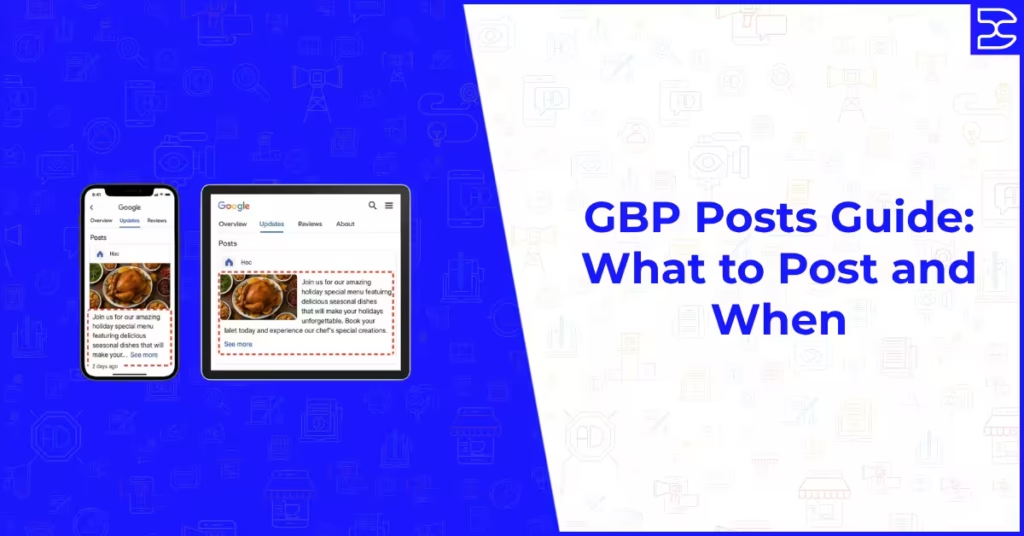
Table of Contents
ToggleGBP Posts Guide: What to Post and When
Google Business Profile Posts are one of the most underused features available to local businesses. While most business owners know they should keep their profile updated, very few use the Posts feature with any consistency or strategic intent. The result is that their listing looks static and inactive compared to competitors who are publishing regularly, and they miss out on a simple, free tool that contributes to both local rankings and click-through performance.
GBP Posts allow you to publish short updates, offers, events, and product highlights directly to your business listing. These posts appear in Google Search and Google Maps when someone views your profile, giving you a direct way to communicate with high-intent local searchers at the exact moment they are evaluating whether to contact you.
This guide covers everything you need to build a consistent and purposeful GBP posting strategy: the different post types available, what content works for each, how often to post, when to post for maximum visibility, and the common mistakes that prevent posts from delivering results.
Why GBP Posts Matter for Local SEO
Google Business Profile activity is a signal of profile engagement, and engagement signals contribute to how Google evaluates your listing’s prominence. A profile that is regularly updated with fresh Posts signals to Google that the business is active, relevant, and paying attention to its online presence. This freshness signal is one of the smaller but consistent factors that separates listings that hold strong local pack positions from those that gradually slip despite having similar review counts and citation profiles.
Beyond the ranking signal, Posts have a direct impact on how searchers interact with your listing. A listing with a current offer, a recent update, or an upcoming event gives searchers more information to engage with and more reasons to choose your business over a competitor whose listing shows nothing recent. Listings that use Posts effectively generate more website clicks, more phone calls, and more direction requests than those that leave the Posts section empty.
Posts also allow you to incorporate keywords naturally into your profile content. When you write a Post about a specific service, a local area, or a seasonal offer, Google indexes that content and it contributes to the relevance signals associated with your listing for related search queries.
GBP Posts are one component of a complete local listing strategy. For a full picture of the signals that determine where your business appears in local search results, our guide to Google Map Pack optimisation strategy covers the complete ranking framework and where Posts fit within it.
The Four GBP Post Types Explained
What’s New Posts
What’s New Posts are the most flexible post type and the one most suited to general business updates, news, and announcements. You can use them to share anything relevant to your audience: a new team member, a service update, a change in your offering, a recent project or client win, a piece of useful advice, or simply a reminder of what you do and who you serve. These posts have no specific structural requirement beyond a 1,500-character text limit and an optional image, button, or link.
What’s New Posts expire from prominent display on your profile after seven days, which means they need to be refreshed regularly to maintain a current and active appearance. This post type is the backbone of a consistent posting schedule and should be your most frequently published format.
Offer Posts
Offer Posts are designed specifically for promotions, discounts, and special deals. They display with a prominent label in your profile and include fields for an offer title, start and end dates, a description of the offer, terms and conditions, and a redemption code or link if applicable. Offer Posts remain active until their end date rather than expiring after seven days, which makes them well-suited to time-limited promotions where ongoing visibility matters.
The offer format naturally creates urgency through the date display, which encourages searchers to act while the promotion is available. Offer Posts are particularly effective for seasonal promotions, new customer discounts, and limited availability services that benefit from a clear deadline and a specific call to action.
Event Posts
Event Posts are used to promote specific events your business is running or participating in, including workshops, open days, webinars, in-store events, community involvement, and similar time-bound activities. They include fields for an event name, start and end date and time, a description, and an optional link for tickets or registration.
Event Posts display until the event end date and then disappear from prominent profile display, which means they are most effective when published well enough in advance to generate awareness and registrations. For businesses that run regular events such as classes, consultations, or community activities, Event Posts are a consistent source of fresh and time-relevant profile content.
Product Posts
Product Posts allow you to showcase specific products with an image, product name, price range, and description. They work best for retail businesses, e-commerce businesses with local presence, and service businesses that want to highlight specific service packages as named offerings. Product Posts do not expire on a fixed schedule, which means they accumulate on your profile and create a catalogue-style display of your offering over time.
Product Posts are particularly effective when combined with a strong image and a specific call to action button such as “Order Online,” “Book,” or “Learn More” that takes the searcher directly to the relevant page on your website.
What Content Works in GBP Posts
Service Highlights and Explanations
Posts that explain a specific service you offer, describe who it is for, and explain what the outcome looks like for the customer perform consistently well. Rather than writing a generic post about your business, focus each post on one specific service and write it from the perspective of the customer need it addresses. A solicitor might write a post specifically about wills and estate planning, what triggers the need for one, and how to get started. A plumber might write about boiler servicing, why annual checks matter, and what the process involves. Specific service-focused posts attract searchers whose queries match that service and contribute to the relevance signal for those terms.
Seasonal and Timely Updates
Posts tied to seasonal events, local happenings, or timely news show that your business is current and engaged with the world beyond its own promotional agenda. A landscaping business posting about preparing gardens for winter, an accountant posting about self-assessment deadline reminders, or a restaurant posting about a local food festival are all examples of timely content that gives searchers a reason to engage with the listing and signals to Google that the profile is actively maintained.
Behind the Scenes and Team Content
Posts that give a glimpse into how your business operates, who your team members are, or what a day in your business looks like humanise your listing and create the kind of familiarity that influences whether a potential customer chooses you over a competitor. A short post introducing a new team member, sharing a recent completed project with a photo, or describing a process your team follows builds trust in a way that purely promotional content cannot.
Customer Stories and Outcomes
Posts that reference positive customer outcomes, without reproducing the full review text or making specific attribution claims that require permission, work as social proof within the post feed. A post that describes the type of problem a customer came in with and the result they achieved, written in general terms, demonstrates real-world value in a way that product descriptions alone cannot. These posts reinforce the review signals on your profile and give searchers additional evidence that your business delivers on its promises.
Customer stories in your Posts work most effectively when your review profile is also strong. Building that review profile through a systematic and ethical approach is covered in our guide to how to get more Google reviews ethically, which explains the process for generating a consistent flow of genuine customer feedback.
How Often to Post on Google Business Profile
The optimal posting frequency for GBP is at least once per week for most local businesses, with twice per week being a realistic target for those with more content to share. The seven-day expiry of What’s New Posts means that posting less frequently than weekly results in periods where your profile appears stale, with no recent update visible to searchers viewing your listing.
Consistency matters more than volume. Posting every day for two weeks and then going silent for a month is less effective than posting once or twice a week without interruption. Google’s freshness signal responds to regular activity over time rather than to bursts of posting followed by inactivity.
A practical approach for most businesses is to prepare a simple monthly content plan that maps one post per week to a specific topic, offer, or event. This removes the need to decide what to write about each week and ensures that seasonal and promotional content is planned in advance rather than created reactively. Batch writing two to four posts at a time and scheduling them across a week or two reduces the ongoing time commitment while maintaining regular publishing.
Planning your GBP Posts as part of a wider content calendar is one of the most effective ways to ensure consistency. The same principles that underpin a well-structured digital marketing content strategy apply to GBP posting, where planning ahead and aligning content with your business goals produces better results than ad hoc publication.
When to Post for Maximum Visibility
GBP Posts do not have a single universally optimal publishing time, but there are patterns worth understanding when planning your posting schedule.
Post Ahead of Peak Search Days
For most local service businesses, search activity peaks on weekday mornings and Saturday mornings, when people are actively planning purchases and appointments. Publishing a What’s New Post or an Offer Post at the start of the week, on Monday or Tuesday, means it is fresh and prominent during the highest-activity search period. Posts published on Friday evening or over the weekend may lose their early visibility window before the highest-activity periods of the following week.
Publish Seasonal and Event Posts Early
Event Posts and seasonal Offer Posts should be published at least two to three weeks before the relevant date to maximise the window during which they are visible and driving action. A Christmas promotion published on 20 December has a fraction of the visibility and conversion potential of the same promotion published on 1 December. Planning seasonal content to go live well before the peak demand period is one of the simplest ways to extract more value from the same Posts.
Respond to Business Cycles
If your business has predictable busy periods, post more frequently in the two to three weeks leading up to those periods to build awareness and capture early-decision searchers. A garden centre posting more frequently in late February and March ahead of the spring planting season, or a tax preparation firm posting regularly through January and February ahead of the self-assessment deadline, captures searchers who are beginning to think about the need before they have made an active purchase decision.
GBP Post Best Practices
Always Include a Strong Image
Posts with images consistently receive more engagement than text-only posts. Use real photographs rather than stock images wherever possible, as authentic images of your premises, team, products, or work build credibility in a way that generic stock photography does not. Images should be at least 720 pixels wide and ideally square or landscape format for best display across both Search and Maps. Avoid heavily branded graphics with excessive text overlays, which can look promotional rather than informative and may reduce engagement.
Include a Clear Call to Action
Every Post should have a clear and specific action you want the reader to take. Google provides built-in CTA buttons including “Book,” “Order Online,” “Learn More,” “Sign Up,” “Get Offer,” and “Call Now.” Choose the button that most accurately reflects the action you want the reader to take and ensure the link it points to delivers on that promise. A Post with a “Book” button that links to a general homepage rather than a booking page creates friction that reduces conversions.
Write Naturally and Avoid Keyword Stuffing
GBP Posts contribute to your profile’s relevance signals when they contain naturally used keywords, but keyword stuffing produces content that reads poorly and may be flagged by Google as low quality. Write your Posts for the reader first, incorporating relevant service and location terms where they fit naturally in the text. A Post about your emergency plumbing service in Sheffield should mention those terms because they are genuinely relevant to the content, not because you have forced them in at the expense of readability.
Track Which Posts Generate the Most Engagement
Google Business Profile Insights shows data on Post views and clicks, which allows you to identify which content types and topics generate the most engagement from searchers viewing your profile. Review this data monthly and use it to refine your content plan. If service highlight posts consistently generate more clicks than promotional offers, increase the proportion of service-focused content in your posting schedule. Data-led iteration produces a progressively more effective posting strategy over time.
Tracking GBP Post performance is one part of monitoring your overall local SEO health. The broader set of metrics worth tracking and how to interpret them is covered in our guide to how Google Maps ranking works, which explains the full range of signals that determine local search visibility and what improvement looks like over time.
Final Thoughts
GBP Posts are a free, flexible, and consistently underused feature that gives local businesses a direct communication channel to high-intent searchers at the exact moment they are evaluating options. The businesses that use Posts consistently and purposefully appear more active, more relevant, and more trustworthy than those whose profiles sit static between occasional profile edits.
Building a simple weekly posting habit, rotating across the different post types available, timing seasonal and promotional content strategically, and reviewing performance data to refine your content over time are the practical steps that turn a rarely used feature into a meaningful contribution to your local visibility and your profile’s conversion performance.
If you want support managing your Google Business Profile, developing a posting strategy, and building the broader local SEO presence that drives consistent enquiries, explore how our local SEO and digital marketing services help local businesses take control of their search visibility from the ground up.
Frequently Asked Questions (FAQs)
At least once per week is the recommended minimum posting frequency for most local businesses. What's New Posts expire from prominent display after seven days, so posting less frequently than weekly means your profile can appear inactive between updates. Twice per week is a strong target for businesses with a variety of content to share. Consistency over time produces better results than occasional bursts of high-volume posting followed by long gaps.
Yes. Regular GBP posting is a positive activity signal that contributes to the prominence component of Google's local ranking algorithm. Posts also incorporate keywords into your profile content, reinforcing your relevance for relevant local searches. The impact of Posts on rankings is modest compared to review signals and citation consistency, but consistent posting is a free and low-effort signal that accumulates value over time and costs nothing beyond the time to create the content.
What's New Posts are prominently displayed for seven days before expiring from the active post feed, though they remain accessible in the full post history. Offer Posts remain active until their specified end date. Event Posts remain visible until the event end date and then disappear. Product Posts do not have a standard expiry and remain in your product catalogue until you remove them. Understanding these expiry patterns is important for maintaining a consistently active profile appearance.
Posts with a "Call Now" call to action button that are focused on high-intent service queries, particularly those related to urgent or time-sensitive needs, consistently generate the most direct phone call engagement. An emergency plumber posting about emergency call-out services, a locksmith posting about 24-hour availability, or a dentist posting about emergency appointments all connect a specific high-intent searcher need with a direct path to calling the business. Pairing a service-specific post with the "Call Now" button and a persuasive one-line reason to call is the most direct conversion path available through the Posts feature.
Google Business Profile does not currently offer a native post scheduling feature. Posts must be published in real time through the Google Business Profile dashboard or the Google Maps app. However, several third-party local SEO and social media management tools offer GBP scheduling functionality, including tools like BrightLocal, Hootsuite, and Semrush. Preparing Post content in batches and using a scheduling tool is the most practical way to maintain a consistent posting frequency without requiring daily attention to the profile.
Yes, but naturally rather than through forced keyword inclusion. GBP Posts are indexed by Google and their content contributes to the keyword relevance signals associated with your listing. Writing Posts that are naturally focused on specific services and locations will incorporate relevant keywords as a byproduct of being specific and informative. Avoid writing Posts whose primary purpose appears to be keyword repetition rather than genuine communication with a prospective customer, as this produces content that reads poorly and may be evaluated negatively.
Our Related Posts