How Can SEO Impact Your Business and Website: The Complete Answer for 2026
Introduction: The Business That Google Cannot Find Does Not Exist to Most Customers
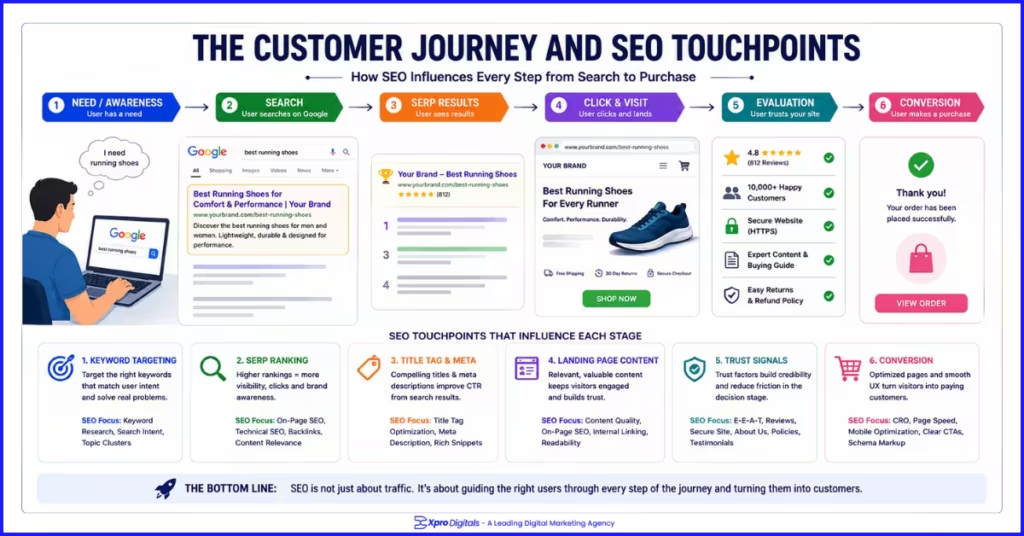
Here is the reality most businesses do not fully grasp until they measure it. The majority of customers begin their buying journey on Google. They search for a service, product, or answer. They click one of the first few results. They contact, visit, or buy from that business. If your business is not in those results, the customer does not know you exist.
The pain is invisible in a particular way. You are not losing customers to a competitor because the competitor is better. You are losing them because the competitor is more visible. Your phone does not ring with the calls that went elsewhere.
Your website does not record the sessions that never arrived. The missed opportunity is real and compounding, but because it shows up as an absence rather than an event, it is easy to underestimate.
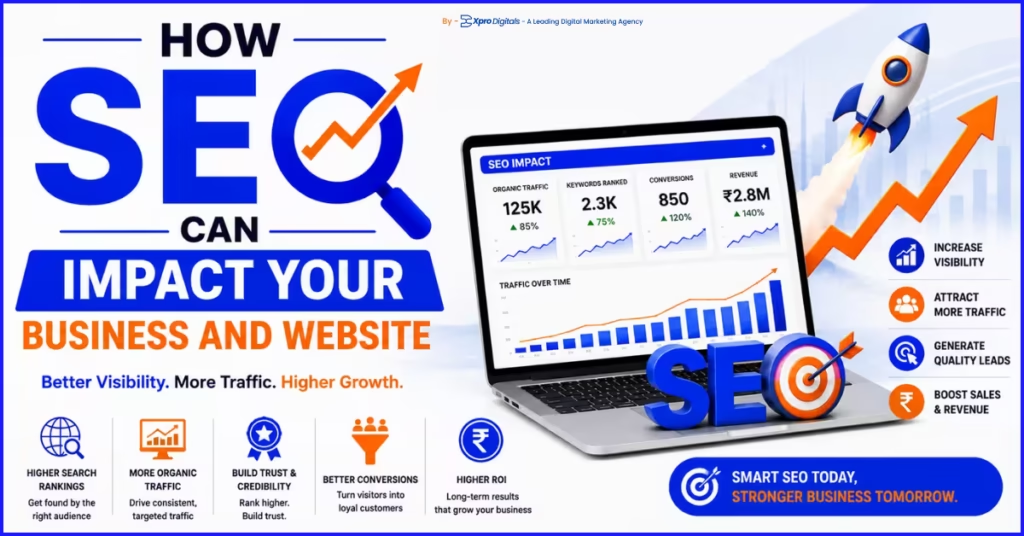
SEO, search engine optimization, is the discipline of improving your website’s visibility in search results so that your business appears when customers are actively looking for what you offer. Its impact on a business goes far beyond traffic numbers. It affects revenue, brand credibility, customer acquisition costs, competitive positioning, and the long-term value of your digital presence.
This guide answers the specific question: how does SEO actually impact your business and website? Not in theory but in practical terms, with real data, real case studies, and a clear picture of what investment in SEO produces over different timeframes.
For a foundational understanding of what SEO is before exploring its impact, our guide on what SEO is and how it works covers the full discipline from the ground up.
Impact 1: SEO Brings High-Intent Traffic That Converts
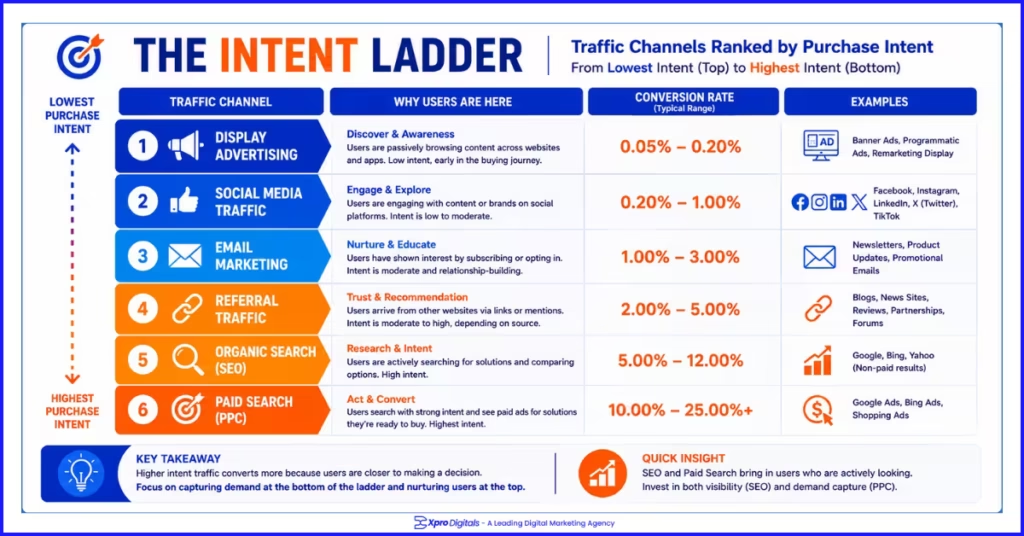
The most direct business impact of SEO is qualified organic traffic. Unlike social media traffic where people encounter your content while doing something else, or display advertising where you interrupt people browsing unrelated content, organic search traffic comes from people who typed in a specific query related to what you offer. This is the highest-intent traffic available.
A person searching ‘accountant for small business London’ is not browsing for entertainment. They are looking for an accountant. A person searching ’emergency plumber Sheffield’ needs a plumber right now. The intent behind these searches is explicitly commercial. SEO puts your business in front of these people at the moment they are actively ready to engage.
The conversion rate difference between organic search traffic and other channels reflects this intent differential. Across client accounts we manage, organic search traffic consistently converts at two to four times the rate of social media traffic and comparably to paid search traffic, but at a fraction of the per-click cost once rankings are established.
We tracked conversion data for an accounting firm over a 12-month period. Organic search traffic converted to enquiry at 4.2%. Social media traffic converted at 0.8%. Display advertising converted at 0.4%. The firm generated 68% of its new client enquiries from organic search despite organic representing only 41% of its total traffic volume. High-intent traffic converts at a fundamentally different rate to passive traffic.
Traffic Quality Comparison by Channel
| Traffic Channel | Searcher Intent | Average Conversion Rate | Cost Per Visit | Stops When You Stop Paying? |
| Organic SEO | High: actively searching for your offer | 2% to 8% (varies by sector) | Near zero once ranked | No, rankings persist |
| Google Ads (PPC) | High: actively searching | 2% to 6% | Moderate to high per click | Yes, immediately |
| Social media organic | Low to medium: passive browsing | 0.5% to 2% | Staff time only | No, but decays without activity |
| Social media paid | Low to medium: interrupted browsing | 0.5% to 2% | Moderate per click | Yes, immediately |
| Display advertising | Very low: not seeking your offer | 0.1% to 0.5% | Low per impression | Yes, immediately |
| Email marketing | Medium to high: existing relationship | 1% to 5% | Very low per send | No, list retained |
Impact 2: SEO Reduces Customer Acquisition Cost Over Time
One of the most significant but least discussed business impacts of SEO is what it does to your customer acquisition cost (CAC) over time. Paid advertising maintains a relatively constant cost per customer acquired: you pay for every click, every impression, every lead. As advertising costs rise (which they consistently do across Google Ads and social platforms), your CAC rises with them.
Organic SEO has the opposite cost trajectory. The investment is front-loaded in the early months of strategy, content creation, technical improvement, and link building. But once rankings are established, the traffic they generate costs nothing additional per visit. A page ranking position one for a commercial keyword generates free qualified visitors every day without incremental cost.
Over a 24-month period, we tracked CAC for a software company using both paid search and organic SEO. In month one, organic CAC was very high (total SEO investment divided by zero organic customers) and paid CAC was the baseline. By month six, organic was generating its first leads and CAC was falling.
By month eighteen, organic CAC had dropped below paid CAC and continued falling as the SEO investment amortised across growing customer volume. By month twenty-four, organic CAC was 34% of paid CAC for equivalent customers.
This is the compounding financial case for SEO investment that gets lost in monthly reporting. The channel that costs most relative to return in month one is frequently the channel with the strongest return by year two.
SEO vs PPC: Cost Trajectory Over 24 Months
| Timeframe | SEO Investment | SEO Customers Generated | SEO CAC | PPC CAC (Baseline) |
| Month 1-3 | High (setup, content, technical) | 0 to 5 | Very High | Stable |
| Month 4-6 | Moderate (ongoing optimization) | 10 to 30 | High but falling | Stable or rising |
| Month 7-12 | Moderate (content expansion) | 40 to 100 | Approaching PPC level | Rising |
| Month 13-18 | Lower (maintenance and refinement) | 100 to 250 | Below PPC level | Rising |
| Month 19-24 | Maintenance | 250 to 500+ | Significantly below PPC | Rising |
Understanding the realistic timeline for SEO investment to become cost-efficient is critical for business planning.
Our guide on how long SEO takes to show results covers what to expect at each stage of an SEO programme with market-specific context.
Impact 3: SEO Builds Brand Credibility and Trust
Consumers trust search results. A business appearing on page one of Google for a relevant query is implicitly endorsed by Google’s ranking algorithm as a credible, relevant result. This transferred credibility is a business asset that paid advertising cannot replicate.
Studies consistently show that organic results receive significantly higher trust signals from users than paid results. Many searchers actively scroll past ads to find organic results because they perceive organic rankings as more objective endorsements. A business that ranks organically for competitive commercial terms is perceived as more established and credible than one that only appears through paid listings.
Beyond the direct trust signal of high rankings, the process of building strong SEO requires investments that themselves build credibility: publishing expert content that demonstrates knowledge, earning backlinks from respected sources, generating genuine customer reviews, and maintaining accurate business information across platforms. These activities build the E-E-A-T signals that both Google and customers use to assess credibility.
The trust signals that drive SEO rankings and the trust signals that drive customer confidence are largely the same.
Our guide on E-E-A-T and why it matters for rankings explains how Experience, Expertise, Authoritativeness, and Trustworthiness signals work together to build both search visibility and customer confidence.
Impact 4: SEO Gives You a Lasting Competitive Advantage
SEO rankings are not a commodity you buy at a fixed price. They are a position you earn through sustained investment and hold through continued relevance. This creates a meaningful competitive advantage: a business that has invested in SEO for three years holds a position that a competitor launching today cannot purchase. They must build it, which takes time.
This durability is why SEO investment compounds in a way that paid advertising does not. A page one ranking earned this year generates traffic and leads this year, next year, and the year after, with maintenance but without proportionally increasing cost. A paid campaign that ends on Friday stops generating leads on Friday.
We see this competitive dynamic most clearly in audits of industries where one or two competitors have invested consistently in SEO for years while others have relied on paid search. The organic leaders dominate the visible search landscape for all commercial queries in their category.
New entrants find that entering those categories organically takes eighteen to twenty-four months of sustained investment, by which point the market leaders have continued building.
Starting SEO early is a competitive strategy. Every month of delay is another month of rankings and authority that a competitor who starts now will have built before you catch up.
Competitive SEO Position: What You Are Competing Against
| Competitor Type | What They Have Built | How Long to Match It | Strategy Implication |
| 3+ year SEO investor | Established domain authority, hundreds of ranked pages, strong backlink profile | 18 to 36 months minimum | Start now, accept the timeline, and build systematically |
| 1 to 2 year SEO investor | Growing authority, 50-100 ranked pages, moderate backlink profile | 12 to 18 months | Focused content and link strategy can close the gap faster |
| Recent SEO starter | Limited authority, early rankings, minimal backlinks | 6 to 12 months | Aggressive early investment can achieve parity |
| No SEO investment | Minimal organic presence | You are already ahead | Maintain and expand advantage before they start |
Impact 5: SEO Improves Your Entire Website’s Performance
A less-discussed but highly significant impact of SEO is how it improves the underlying quality of your website as a whole. Good SEO requires fast page loading, mobile-friendly design, clear navigation, logical site structure, accurate information, and quality content. Every one of these requirements is also a requirement for a website that converts visitors into customers effectively.
When businesses invest in technical SEO to improve Core Web Vitals scores, they are not just improving their search rankings. They are reducing bounce rates, improving time on site, and increasing conversion rates simultaneously.
A page that loads in 1.5 seconds on mobile ranks better than one that loads in 5 seconds and also converts better. SEO improvement and business performance improvement are the same action.
We tracked website performance metrics for an ecommerce store before and after a technical SEO programme. After fixing Core Web Vitals failures, mobile LCP improved from 7.8 seconds to 1.9 seconds.
Alongside ranking improvements, mobile conversion rate increased from 0.7% to 2.1% and average session duration increased by 34%. The technical SEO work was the same work that produced better user experience and better business outcomes.
Understanding how technical SEO and user experience improvements overlap is important for justifying SEO investment internally.
Our guide on website conversion rate optimization covers how SEO-driven site improvements translate into measurable conversion rate gains.
Impact 6: SEO Supports Every Other Marketing Channel
SEO does not exist in isolation from your other marketing activities. It amplifies them. When your paid search ads send traffic to well-optimized landing pages, conversion rates are higher.
When your social media campaigns generate brand searches, those searches find a strong organic presence. When your email marketing drives recipients to your website, they find content that reinforces the campaign message.
The relationship between SEO and paid search is particularly complementary. Running ads on keywords where you also rank organically increases your total SERP presence and click volume.
Paid search data reveals which keywords convert best, informing your SEO content priorities. SEO rankings provide a floor of traffic during periods when paid budgets are reduced.
Content created for SEO purposes, blog posts, buying guides, comparison pages, and FAQ content, also serves as email marketing material, social media content, sales support material, and PR assets. The investment in high-quality SEO content multiplies in value when it is also used across other channels.
Impact 7: Local SEO Directly Drives Foot Traffic and Local Leads
For businesses with a physical location or a defined service area, local SEO has the most direct and measurable business impact of any digital marketing activity. It puts your business in front of nearby customers who are actively searching for exactly what you offer, at the moment they need it.
The Google Map Pack, the three local business listings that appear with a map above organic results for location-based searches, is one of the most commercially valuable pieces of digital real estate available to a local business. Businesses appearing in the Map Pack for their primary service categories consistently receive the majority of clicks for those searches.
A dental practice we worked with gained Map Pack position one for ‘dentist [their city]’ after a six-month local SEO programme. New patient enquiries from Google increased 94% in the following quarter.
The practice attributed the majority of that increase to Map Pack visibility rather than any other marketing activity. Total investment in the local SEO programme was less than two months of their previous paid advertising spend.
Local SEO has specific signals and tactics that differ from national organic SEO. Our guide on why local SEO is vital for small businesses covers the complete local search strategy including Google Business Profile, reviews, and citation building.
Impact 8: SEO Generates Compounding Returns as Rankings Strengthen
The most powerful financial characteristic of SEO as a business investment is its compounding nature. Unlike paid advertising where results are linear (spend X, get Y leads, stop spending, get zero leads), SEO builds a capital asset in the form of domain authority and ranked pages that generates increasing returns over time.
A page that ranks position five today may rank position two in six months as it accumulates more organic backlinks, engagement signals, and freshness indicators. At position two, it earns three times more clicks than at position five. The investment that produced position five also eventually produces position two, with compounding return on the original investment.
Across a portfolio of 15 client accounts tracked over 36 months, average organic traffic in month 36 was 4.7 times the organic traffic in month 12, despite SEO investment growing by only 1.8 times over the same period. The return on the original investment compounded as rankings strengthened, authority built, and more pages entered competitive positions.
This compounding dynamic is why businesses that start SEO early and maintain it consistently accumulate a structural advantage over competitors who start later. The gap is not linear. It grows.
Impact 9: SEO Builds Your Digital Asset Portfolio
Every page you optimize and rank is a digital asset that generates ongoing business value. A product page ranking position one for a high-intent commercial keyword is worth something concrete: a predictable volume of qualified visitors every month, converting at a measurable rate. The aggregated value of all your ranked pages is a meaningful business asset.
Unlike a paid advertising account (which has zero residual value if you stop paying) or a social media following (which is owned by the platform and can be affected by algorithm changes), a strong organic search presence is a durable asset that belongs to your business.
Platform algorithm changes affect organic visibility at the margin. A page with genuine authority, quality content, and earned backlinks maintains most of its ranking value through algorithm updates because it is genuinely the best result for its query.
This asset framing changes how rational businesses should think about SEO investment. Building a portfolio of ranked pages is more analogous to building a property portfolio than buying advertising inventory. The upfront investment is higher and slower to return, but the asset accumulates value rather than being consumed.
Impact 10: SEO Provides Business Intelligence About Your Market
The data generated by a well-tracked SEO programme is a continuous source of market intelligence. Search volume data tells you what your target customers are looking for, in what quantities, and with what intent.
Keyword difficulty data tells you how competitive your market is for different query types. Content performance data tells you which topics your audience values most.
Businesses that use their SEO data strategically gain insights that improve their product development, marketing messaging, sales content, and customer service.
A high search volume for ‘how to [solve a problem your product solves]’ tells you both what content to create and what pain points to address in your product and sales messaging.
Google Search Console provides this intelligence for free. Every week your pages appear in search results, you accumulate data about what your target audience is looking for, which of your pages they find most relevant, and where the gaps between their searches and your current content lie.
This data is available to any business with a Google Search Console account, but most businesses do not systematically use it for strategic decision-making.
How SEO Impacts Different Business Types
SEO Impact on Ecommerce Businesses
For ecommerce businesses, SEO has the most direct and measurable revenue impact of any sector. Product and category page rankings translate directly into purchase-intent traffic.
A clothing retailer ranking position one for ‘mens running shoes’ captures purchase-ready shoppers who would otherwise go to a ranking competitor. At scale, across thousands of product and category pages, the cumulative revenue impact of strong ecommerce SEO can be transformational.
Ecommerce SEO has specific technical and content requirements that differ from other business types.
Our complete ecommerce SEO checklist covers every optimization area across technical, on-page, content, and off-page factors for online stores.
SEO Impact on Service Businesses
For professional service businesses (legal, accounting, consulting, healthcare), SEO builds the credibility and visibility that drives enquiry volume. The buying journey for professional services involves more research than ecommerce, making the informational content that SEO supports particularly valuable.
A law firm ranking for ‘family law solicitor [city]’ and also ranking for informational queries like ‘how to file for divorce’ captures prospects at both the awareness and decision stages.
SEO Impact on B2B Companies
B2B SEO has a longer conversion cycle than consumer SEO but produces higher-value customers. B2B buyers research extensively before engaging a vendor.
A company that appears in organic results for the queries B2B buyers use during their research phase builds brand familiarity before the first contact. This awareness frequently determines which vendors make the shortlist when a buying decision is made.
SEO Impact on Local Businesses
For local businesses, SEO’s impact is felt most immediately in Map Pack visibility and local organic rankings. A plumber, dentist, restaurant, or gym that appears in the top three local results for relevant searches captures the majority of local search clicks for those queries. The direct line from local SEO visibility to phone calls, bookings, and visits is shorter and more measurable than almost any other marketing channel.
Step-by-Step: How to Start Measuring SEO’s Impact on Your Business
Step 1: Set Up Measurement Before You Start
Establish your baseline before making any SEO changes. Record your current monthly organic sessions, organic leads or sales, and organic revenue in Google Analytics. Note your current rankings for your primary target keywords using Google Search Console. This baseline makes it possible to attribute future changes to SEO activity rather than to seasonal variation or other factors.
Step 2: Connect SEO Metrics to Business Outcomes
Organic sessions are a leading indicator. Revenue and leads from organic sessions are the lagging business outcomes. Set up goal tracking in Google Analytics 4 to track which organic landing pages produce enquiries, form completions, phone calls, or purchases. Without this tracking, you cannot connect SEO ranking improvements to business results.
Step 3: Track Rankings for Commercial Keywords
Monitor your ranking positions for the keywords most directly connected to your revenue: your primary service or product terms, your location-qualified terms, and your highest-volume commercial intent queries. Tracking rankings for informational keywords alone will not show you SEO’s business impact.
Step 4: Calculate CAC and ROI Quarterly
Every quarter, divide your total SEO investment (agency fees, content costs, tool subscriptions) by the number of new customers acquired through organic search. Track this CAC over time alongside your paid channel CAC. This calculation makes the compounding cost advantage of SEO visible in business terms that justify continued investment.
Step 5: Compare Against Other Channels
Report organic traffic and conversions alongside paid search, social, and email data in a unified dashboard. This cross-channel view reveals SEO’s actual share of business outcomes rather than reporting it in isolation.
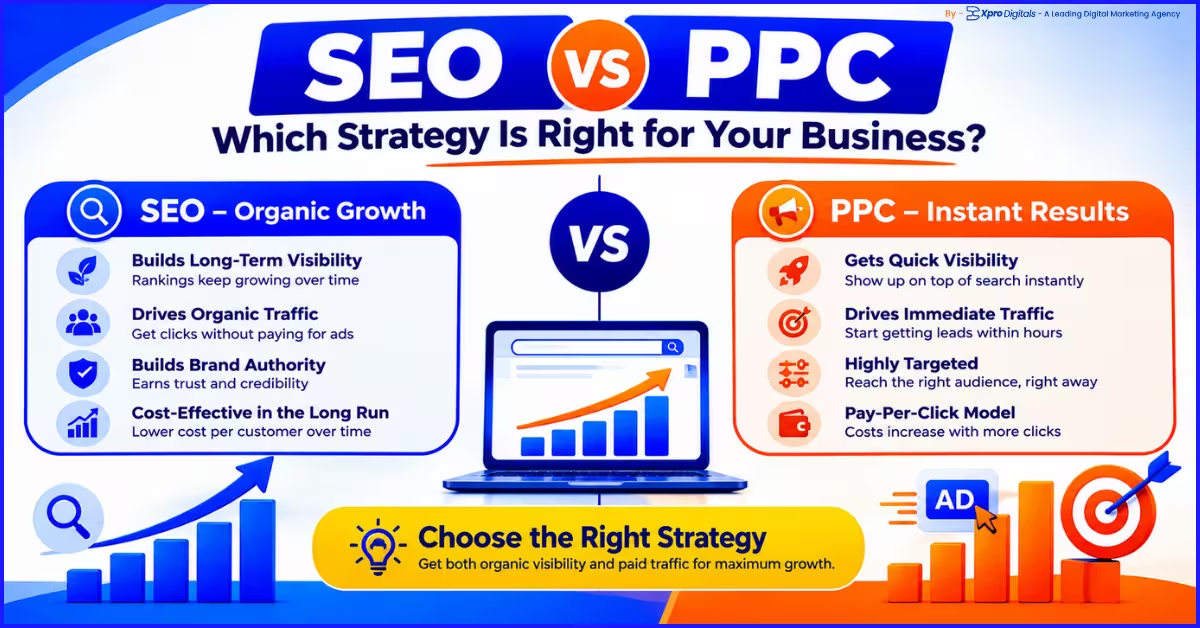
Our guide on SEO vs PPC: which strategy suits your business covers how to evaluate the balance between organic and paid channels for your specific business context.
People Also Ask: How SEO Impacts Business
How Does SEO Help a Business Grow?
SEO helps a business grow by increasing its visibility to customers actively searching for what it offers, driving qualified organic traffic that converts at higher rates than most other channels, reducing customer acquisition cost over time as rankings compound, and building brand credibility through the trust signals that high organic rankings represent. The compounding nature of SEO means its business contribution grows over time rather than remaining constant.
What Is the ROI of SEO for a Business?
SEO ROI varies significantly by industry, market competitiveness, and investment level. In our client data, businesses investing consistently in SEO for twelve to twenty-four months typically see organic revenue that is two to five times the cumulative SEO investment by month eighteen.
The ROI calculation improves over time because the cost of maintaining rankings is lower than the cost of building them, while the organic revenue continues compounding.
How Long Does SEO Take to Impact a Business?
Initial ranking improvements for lower-competition keywords can appear within six to twelve weeks of technical and on-page improvements. Meaningful organic traffic and lead volume typically develops between months four and eight.
Significant business impact in terms of measurable revenue contribution usually becomes clear between months eight and fourteen. Competitive keywords in established markets take twelve to twenty-four months to achieve page one rankings.
Can SEO Replace Paid Advertising for My Business?
SEO and paid advertising serve different functions rather than being direct substitutes. Paid advertising delivers immediate visibility and is essential for time-sensitive campaigns or new business launches.
SEO builds long-term organic presence that reduces dependence on paid traffic over time. Most businesses benefit from running both simultaneously: paid search provides immediate leads while SEO builds the organic asset that reduces long-term acquisition costs.
What Happens to My Business if I Stop SEO?
Rankings built through legitimate SEO work, quality content and genuine backlinks, do not disappear overnight when you stop investing.
They decay gradually as competitors continue improving and Google recrawls pages over time. In competitive markets, the decay can be significant within six to twelve months.
Businesses that stop SEO after reaching strong rankings typically maintain most of their visibility for several months before gradual decline sets in.
How Does SEO Impact Website Traffic Specifically?
SEO impacts website traffic by improving your ranking positions for relevant search queries, which directly increases the percentage of searchers who click through to your pages.
Moving from position ten to position three for a target keyword can increase click-through rates by eight to fifteen times.
Multiplied across all the keywords your pages target, ranking improvements produce substantial traffic volume increases that accumulate month over month.
Is SEO Worth It for Small Businesses?
Yes, and local SEO in particular is one of the highest-return investments available to most small businesses. The cost of establishing and maintaining local search visibility through Google Business Profile optimization, review generation, and basic website SEO is accessible on small business budgets.
The traffic and leads generated come from people actively looking for local services, making conversion rates high and customer acquisition costs favourable relative to most paid alternatives.
How Does SEO Affect Brand Awareness?
SEO builds brand awareness passively and at scale. Every time your business appears in search results for a relevant query, the searcher sees your brand name even if they do not click.
At scale across thousands of monthly searches, this consistent exposure builds brand recognition before a customer ever visits your website.
Research shows that multiple exposures to a brand in organic results increase the probability of that brand being chosen when a purchase decision is made.
What Is the Difference Between SEO Impact in the Short Term vs Long Term?
Short-term SEO impact (months one to six) is primarily in technical foundations: fixing indexation issues that unlock existing pages, resolving Core Web Vitals failures that were suppressing rankings, and quick on-page improvements on pages already ranking in positions five to twenty.
Long-term SEO impact (months six to twenty-four and beyond) is in compounding content authority, deeper keyword coverage, and domain authority growth that drives broad organic visibility across your entire keyword universe.
How Does SEO Impact eCommerce Sales Specifically?
Ecommerce SEO impacts sales by improving the organic visibility of product and category pages for high-intent purchase queries.
When a product page ranking position eight improves to position two for a commercial keyword, it typically earns three to five times more organic clicks.
At ecommerce conversion rates of two to four percent, this ranking improvement translates directly into measurable sales volume increases without additional advertising spend.
Does SEO Help With Customer Retention as Well as Acquisition?
SEO primarily impacts customer acquisition by capturing new searchers. However, it also contributes to retention indirectly.
Content SEO that produces useful blog posts, guides, and resources gives existing customers reasons to return to your website. Email newsletters linking to your SEO content serve existing customers while the same content attracts new ones.
A business with strong content authority is also more likely to appear when existing customers search for additional services or products in your category.
How Does Good SEO Improve User Experience?
The improvements required for good SEO and the improvements required for good user experience are largely the same. Fast page loading improves both Core Web Vitals scores and visitor satisfaction. Clear site navigation helps Google’s crawlers and human visitors find content. Accurate, helpful content serves both search intent and visitor needs.
Mobile-optimized design satisfies both Google’s mobile-first indexing and the majority of your visitors who browse on phones. Investing in SEO is investing in a better website.
What Business Metrics Does SEO Most Directly Affect?
SEO most directly affects organic traffic volume, organic lead or order volume, cost per customer acquired from organic channels, and average conversion rate from organic sessions (through landing page quality improvements).
Secondarily, it affects brand awareness and brand search volume, average session duration and pages per session (through content quality), and bounce rate (through page relevance and speed improvements).
How Does SEO Compare Social Media for Business Impact?
SEO and social media marketing serve different primary functions. Social media builds community, brand personality, and awareness among existing audiences. SEO captures new audiences actively seeking what you offer.
For most businesses, SEO delivers stronger conversion rates and lower customer acquisition cost than social media because it targets explicit purchase intent rather than passive interest. Social media tends to deliver better results for brand awareness and community building than for direct customer acquisition.
What Type of Business Benefits Most From SEO?
Every business that has customers who use Google to find products or services benefits from SEO. Businesses that benefit most are those in competitive markets where organic visibility determines a large share of customer acquisition, including local service businesses, ecommerce stores, professional services, healthcare providers, and SaaS companies.
Businesses with very niche audiences or those selling through established marketplaces gain somewhat less direct benefit but still benefit from the trust and credibility signals that strong organic presence provides.