Website Conversion Rate Optimisation
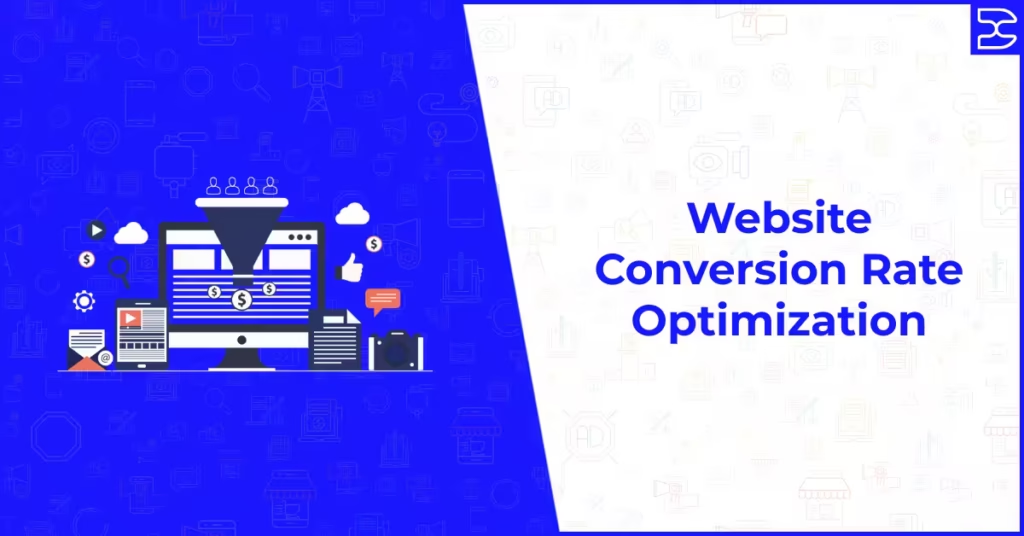
Table of Contents
ToggleWebsite Conversion Rate Optimisation
Every business investing in digital marketing eventually reaches the same realisation: getting traffic to your website is only half the challenge. The other half is converting that traffic into something commercially useful, whether that is an enquiry, a form submission, a purchase, a booking, or a phone call.
Conversion rate optimisation, commonly referred to as CRO, is the discipline of improving the proportion of website visitors who take a desired action. It is not about changing your offer or lowering your prices. It is about removing the friction, confusion, and missed opportunities that cause visitors to leave without doing what you wanted them to do.
For most websites, modest improvements in conversion rate produce dramatic improvements in business outcomes. A website converting at 2 percent that is improved to 4 percent doubles its lead or revenue output from the same traffic volume, without any additional spend on advertising or SEO. This guide covers the principles, process, and practical techniques that make CRO one of the highest-return investments in digital marketing.
What Conversion Rate Optimisation Actually Is
Conversion rate is calculated by dividing the number of conversions by the total number of visitors and multiplying by one hundred to express it as a percentage. If your website receives one thousand visitors per month and generates twenty enquiries, your conversion rate is 2 percent.
CRO is the process of systematically improving that percentage through a structured programme of research, hypothesis development, testing, and implementation. It is not guesswork or aesthetic preference. The most effective CRO programmes are driven by data about how real visitors are behaving on your site, what is preventing them from converting, and what changes are most likely to close the gap between current and potential performance.
It is important to distinguish between CRO and redesign. A website redesign may improve conversion rate, but it is a high-risk, high-cost approach to a problem that targeted, evidence-based optimisation can often solve more efficiently. CRO typically produces results through incremental, tested improvements rather than wholesale changes.
Why Most Websites Convert Poorly
Before jumping into techniques, it helps to understand the most common reasons websites fail to convert the traffic they receive. These patterns appear repeatedly across industries and business types, and recognising them is the first step to addressing them.
Unclear Value Proposition
Visitors arrive on your website with a specific need and a limited attention span. If they cannot immediately understand what you offer, who it is for, and why they should choose you over the alternatives, they will leave. A value proposition is not your tagline or a list of features. It is a clear, direct answer to the question every visitor is silently asking: why should I care about this, and why should I trust this business to solve my problem? Websites that lead with the customer’s outcome rather than the company’s credentials consistently convert better than those that do not.
Too Many Options and Too Much Friction
Every additional choice a visitor faces on a webpage reduces the likelihood that they will take the action you most want them to take. Multiple competing calls to action, long and complex forms, navigation that pulls attention away from the conversion goal, and pages that try to serve too many purposes all dilute conversion intent. The principle of focused simplicity applies to every conversion-oriented page on your site.
Lack of Trust Signals
Most visitors arrive on your website in a state of mild scepticism. They want to buy or enquire but they need reassurance that your business is credible, that others have had good experiences, and that any information or money they share with you is safe. Websites that do not address this scepticism through visible trust signals convert at a fraction of their potential, even when the underlying offer is strong.
Poor Mobile Experience
Over 60 percent of web traffic arrives on mobile devices, and mobile users behave differently from desktop users. They scroll more quickly, tolerate less friction, and have a much lower threshold for abandoning a page that is difficult to use on their screen. A website that converts reasonably well on desktop but provides a poor mobile experience is leaving the majority of its potential conversions on the table.
Mobile experience and page speed are closely connected. The technical factors that affect how quickly your pages load and how smoothly they function on mobile are covered in the context of your broader website health in our guide to the SEO audit checklist for your business, which identifies the technical issues most likely to be suppressing both rankings and conversions.
The CRO Research Process
Effective CRO begins with understanding what is actually happening on your site rather than assuming you know where the problems are. The research phase is where the insights that drive meaningful improvements are found.
Quantitative Research: What Is Happening
Quantitative research uses analytics data to identify where visitors are dropping off, which pages have high bounce rates, which forms are being abandoned, and which traffic sources produce the highest and lowest conversion rates. Google Analytics is the primary tool for this research, combined with Google Search Console for understanding which queries are driving traffic and how that traffic behaves. Heatmaps and click tracking tools such as Hotjar or Microsoft Clarity add visual data about where visitors are clicking, how far they scroll, and which elements they interact with or ignore.
The goal of quantitative research is to identify the pages and points in your conversion funnel where the most significant drop-off is occurring. These become your primary optimisation targets because improving performance at the highest-drop-off points produces the largest overall conversion rate improvement.
Qualitative Research: Why It Is Happening
Quantitative data tells you where visitors are leaving. Qualitative research tells you why. The most useful qualitative inputs are user session recordings, which allow you to watch real visitor journeys on your site and observe the confusion points, missed calls to action, and friction that analytics data suggests but cannot directly show. On-site surveys that ask visitors who are about to leave a single question about what stopped them from completing their goal provide direct verbatim feedback that is often more revealing than weeks of data analysis.
Customer interviews with recent buyers, particularly asking them to describe what almost prevented them from converting, surface the specific objections and concerns that your current website may not be addressing. This is qualitative gold that informs both CRO hypotheses and copywriting improvements.
High-Impact CRO Techniques
Armed with research, the next step is developing and testing specific improvements. The following are the techniques that consistently produce the largest conversion rate improvements across most websites.
Sharpen Your Headlines and Above-the-Fold Content
The headline is the single most important conversion element on any page. It determines whether visitors continue reading or leave within the first few seconds. An effective headline clearly states the primary benefit or outcome the visitor is seeking, confirms that they are in the right place, and creates enough interest to encourage them to read further. Testing headline variations is consistently one of the highest-return A/B tests available because the headline influences everything that follows.
Above-the-fold content, everything visible before a visitor scrolls, should include your headline, a brief supporting statement, a clear primary call to action, and at least one trust signal. This arrangement ensures that a visitor who only sees the first screen of your page has received the core message and a clear invitation to act.
Simplify Your Calls to Action
Every page on your website should have one primary call to action that is visually dominant, clearly worded, and connected to a specific next step. CTA button text that describes what the visitor gets, such as “Get My Free Quote” or “Book a Call Today,” consistently outperforms generic alternatives such as “Submit” or “Click Here.” The colour of your CTA button should contrast with the surrounding page elements so it stands out without being jarring. Repeat your primary CTA at logical points throughout longer pages rather than placing it only at the top or only at the bottom.
Reduce Form Friction
Forms are where many conversions are lost at the final step. Every field in a form is a potential reason to abandon it. Audit your forms against the information you genuinely need at this stage of the customer relationship. For top-of-funnel enquiries, name, email, and a single open question are typically sufficient to initiate a conversation. Longer forms with many required fields are appropriate for high-commitment requests where the additional information is genuinely necessary for you to respond meaningfully.
Multi-step forms, which present questions in sequence across two or three short screens rather than one long page, consistently achieve higher completion rates than equivalent single-page forms. The commitment effect, where a visitor who has answered the first two questions feels invested in completing the process, overcomes much of the friction that a long single-page form creates.
Add and Position Trust Signals Strategically
Trust signals work best when placed close to the moment of decision. A testimonial positioned directly next to your primary CTA button is significantly more persuasive than the same testimonial isolated in a separate section at the bottom of the page. The most effective trust signals for most businesses include specific customer testimonials with names, roles, and where possible photographs, quantified outcome data such as number of clients served or years of experience, recognisable logos of clients or publications that have featured the business, security badges near payment or form elements, and clear contact information that demonstrates a real business is accessible.
Improve Page Speed
Page speed directly affects conversion rate at every stage of the funnel. Research consistently shows that each additional second of load time reduces the probability of conversion. For mobile users in particular, slow pages produce abandonment before the content has even loaded. Compress images, reduce unnecessary scripts, use a content delivery network, and ensure your hosting environment is appropriate for your traffic levels. The investment in page speed improvement pays back through better conversion rates across every campaign and every channel that drives traffic to the improved pages.
The relationship between page speed, user experience, and your ability to convert traffic is also directly connected to the principles of effective landing page design. Our guide to landing page design best practices covers the structural and design decisions that complement the CRO techniques in this article and work together to maximise the proportion of visitors who take the action you need.
A/B Testing: The Engine of CRO
A/B testing is the process of showing two different versions of a page or page element to different segments of your traffic and measuring which produces a higher conversion rate. It is the mechanism through which CRO moves from hypothesis to evidence, replacing opinion about what will work with data about what does work.
What to Test and In What Order
Prioritise tests by the potential impact of the change and the volume of traffic the page receives. High-traffic pages with significant drop-off rates are the best candidates for testing because they accumulate statistical significance faster and any improvement has a larger absolute impact on overall conversion volume. Test one element at a time to ensure that any change in performance can be attributed to the specific change being tested. Changing the headline, CTA, and page layout simultaneously makes it impossible to know which change produced the result.
How Long to Run Tests
A test should run for a minimum of two full business cycles, typically two weeks, and until it has accumulated sufficient data to reach statistical significance. Ending a test early because one version appears to be performing better is one of the most common mistakes in CRO. Early results are frequently misleading due to day-of-week effects, seasonal variation, and the random noise inherent in small sample sizes. Most CRO tools will indicate when statistical significance has been reached, which is the reliable signal that the result is trustworthy enough to act on.
Final Thoughts
Conversion rate optimisation is not about tricks or manipulation. It is about understanding what your visitors actually need, removing the obstacles that prevent them from getting it, and making the path from interest to action as clear and compelling as possible.
The most effective CRO programmes are those grounded in genuine research about real visitor behaviour, focused on the highest-leverage pages and elements first, disciplined about testing one change at a time, and sustained over a long enough period to compound the gains from individual improvements into a meaningfully higher overall conversion rate.
If you want support developing and executing a conversion rate optimisation programme for your website, or if you want to understand how CRO fits within a broader digital marketing strategy covering SEO, paid search, and content, explore how our digital marketing and website optimisation services can help your business convert more of the traffic it is already attracting.
Frequently Asked Questions (FAQs)
Average conversion rates vary significantly by industry, traffic source, and conversion goal. For lead generation websites, industry averages typically sit between 2 and 5 percent, with the top quartile achieving 10 percent or higher. For e-commerce, average conversion rates typically range from 1 to 3 percent. Rather than targeting an industry average, the more useful benchmark is your own historical performance. Any consistent improvement on your current conversion rate, however small, represents a meaningful gain in business output from the same traffic.
Initial CRO improvements from quick-win changes such as simplifying form fields, improving headline clarity, or adding trust signals near CTAs can show measurable impact within two to four weeks for websites with sufficient traffic volume. A full CRO programme involving multiple A/B tests typically runs over three to six months before producing a comprehensive set of validated improvements. The cumulative effect of multiple incremental improvements compounds over time and produces increasingly significant gains the longer the programme runs.
A/B testing requires sufficient traffic to reach statistical significance in a reasonable timeframe. As a rough guide, pages receiving fewer than one thousand visitors per month will take considerably longer to produce reliable test results. However, qualitative CRO research, including heatmaps, session recordings, and customer surveys, is valuable even at low traffic volumes. For lower-traffic websites, focusing on qualitative insights and implementing changes based on evidence rather than testing is often the most practical approach.
Headlines and above-the-fold content have the highest leverage because they determine whether a visitor continues engaging with the page at all. After that, call to action clarity and placement, form simplicity, and trust signal positioning are the elements that most consistently produce significant conversion rate improvements across different industries and business types. Page speed is a foundational factor that affects all of these elements and should be addressed as a prerequisite rather than an optimisation opportunity.
A/B testing is one tool within the broader CRO discipline, not the whole of it. CRO encompasses the research process that identifies where and why visitors are not converting, the development of hypotheses about what improvements would address those issues, the implementation and testing of those improvements, and the analysis of results. A/B testing is the most rigorous method for validating whether a specific change produces the expected improvement, but CRO without testing, relying on qualitative research and best practice implementation, is still a legitimate and often effective approach for lower-traffic websites.
CRO and SEO are complementary disciplines that both contribute to business growth but through different mechanisms. SEO improves the volume and quality of traffic reaching your website through organic search. CRO improves the proportion of that traffic that converts into a commercial outcome. Investing in SEO without addressing conversion rate means more traffic experiencing the same barriers to conversion. Investing in CRO without addressing SEO means optimising a funnel that lacks sufficient traffic volume to produce meaningful scale. The strongest digital marketing programmes invest in both simultaneously and treat them as reinforcing rather than competing priorities.
Our Related Posts