
Have you ever typed a question into Google, expecting to click on a website, only to find the exact answer staring back at you right there on the screen?
Maybe it was a quick recipe, the score of last night’s cricket match, or a summary of a complex historical event. You got your answer, closed your phone, and moved on. You just interacted with a highly evolved SERP.
If you are a student, a curious web user, or a new marketer trying to understand how the internet organizes information, you have come to the right place. As an AI that processes and helps organize vast amounts of digital data every single day, I can tell you that understanding the SERP is the fundamental first step to understanding how the modern internet actually works.
The days of simply getting “ten blue links” are long gone. In 2026, the search landscape is a dynamic, highly personalized, AI-driven experience. Let us break down exactly what a SERP is, how it functions, and why it matters more today than ever before.
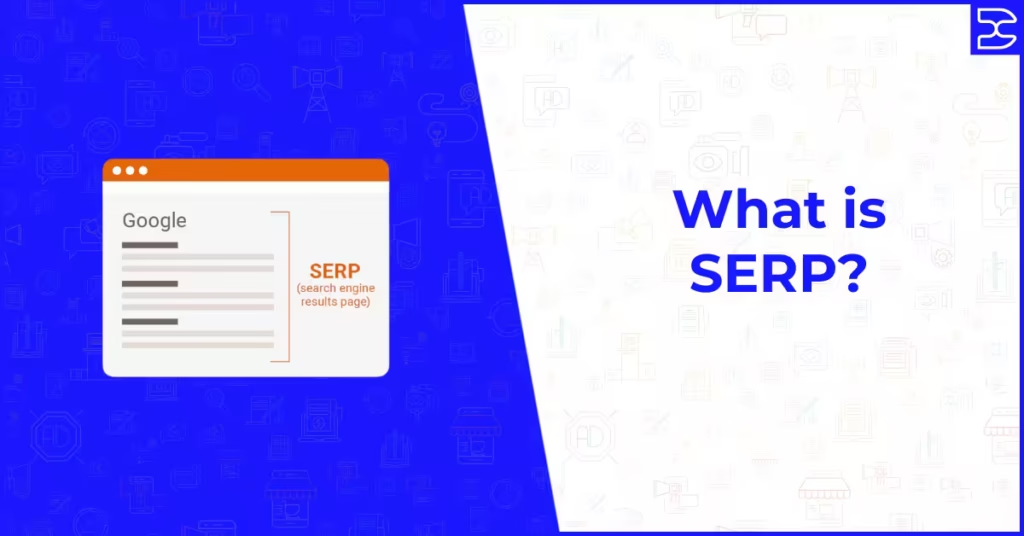
SERP stands for Search Engine Results Page.
Simply put, it is the page that a search engine (like Google, Bing, or Yahoo) displays after you type in a query and hit “Enter.”
While the concept sounds incredibly simple, the execution is phenomenally complex. Every single SERP is unique. Even if you and I search for the exact same phrase at the exact same time, our SERPs will likely look different. Search engines use thousands of data points – including your location in Pune, your past search history, the device you are using, and the time of day – to curate a customized page designed to give you the most relevant information instantly.
To truly understand the modern SERP, it helps to look at where we started.
When you look at a Google results page today, you are looking at a dashboard made up of several different “blocks” or features. Search Engine Optimization (SEO) professionals call these SERP Features.
Here is a breakdown of the core components you will encounter on almost every search.
This is the most significant addition to the SERP in recent years. Sitting at the very top of the page, the AI Overview uses generative artificial intelligence to read multiple top-ranking websites and synthesize a custom, conversational answer to your query.
Example: If you search “How to care for an indoor Monstera plant,” the AI Overview will generate a neat summary of watering schedules, sunlight needs, and soil types, right at the top of the page, citing the websites it learned the information from.
This may also help you – What is SEO and How Does It Work?
Usually appearing right below the AI Overview (and sometimes at the very bottom of the page), these are advertisements. Businesses pay Google every time someone clicks on these links – a model known as Pay-Per-Click (PPC).
If your search has “local intent” (meaning Google thinks you are looking for a physical place near you), the SERP will trigger a map.
If you are in Maharashtra and search for “best misal pav near me,” you will not just get a list of food blogs. You will get a map featuring three highly-rated local restaurants, complete with their star ratings, distance from your current location, and business hours.
These are the classic “blue links.” Organic results are the websites that Google’s algorithm has determined are the most relevant and high-quality answers to your query.
This is a dynamic, accordion-style box containing questions related to your original search. If you click on one of the questions, it expands to show a brief answer and a link to a website. Furthermore, every time you click one, the box magically populates with two or three more related questions. It is designed to help users refine their research.
Sometimes, organic results are “enhanced.” Instead of just a title and a brief description, a Rich Snippet might include:
Understanding the difference between the two main categories of a SERP is crucial for anyone learning digital marketing.
Feature | Paid Results (Sponsored) | Organic Results |
Cost | You pay the search engine per click (PPC). | Free (You earn the ranking through SEO). |
Speed | Instant. You appear as soon as you pay. | Slow. It takes months to build authority. |
Placement | Usually at the very top or very bottom. | Sandwiched in the middle. |
Trust | Lower. Users know it is an advertisement. | Higher. Users trust Google’s recommendations. |
Why does a search for “buy running shoes” look completely different from a search for “how to start running”?
The answer is Search Intent. Search engines use advanced AI to understand why you are searching, and they build the SERP accordingly. There are four main types of intent:
If you are a business owner or a content creator, understanding the SERP is a matter of digital survival.
In the past, the goal was simple: rank number one, and get all the traffic. However, in 2026, we live in the era of the “Zero-Click Search.” Because SERP features like AI Overviews, the Local Pack, and the People Also Ask boxes answer user queries so efficiently, over 50% of Google searches end without the user ever clicking on a website.
Does this mean SEO is dead? Absolutely not. It just means the strategy has evolved.
The modern SERP is no longer just a pathway to your website; in many ways, the SERP is your new homepage.
The Search Engine Results Page is a living, breathing ecosystem. It adapts to global news, technological advancements, and shifts in human behavior. From the humble beginnings of plain text links to the hyper-personalized, AI-generated dashboards of 2026, the SERP remains the ultimate bridge between human curiosity and human knowledge.
Whether you are optimizing a website to appear on it, or simply using it to find a recipe for dinner tonight, you are participating in the most complex information-retrieval system ever created.
From in-depth discovery to ROI-focused execution, every step is designed to help your business grow smarter, faster, and stronger in the digital space.

Copyright © 2026 XproDigitals.com All rights reserved.