Technical SEO Checklist for 2026: Complete Guide
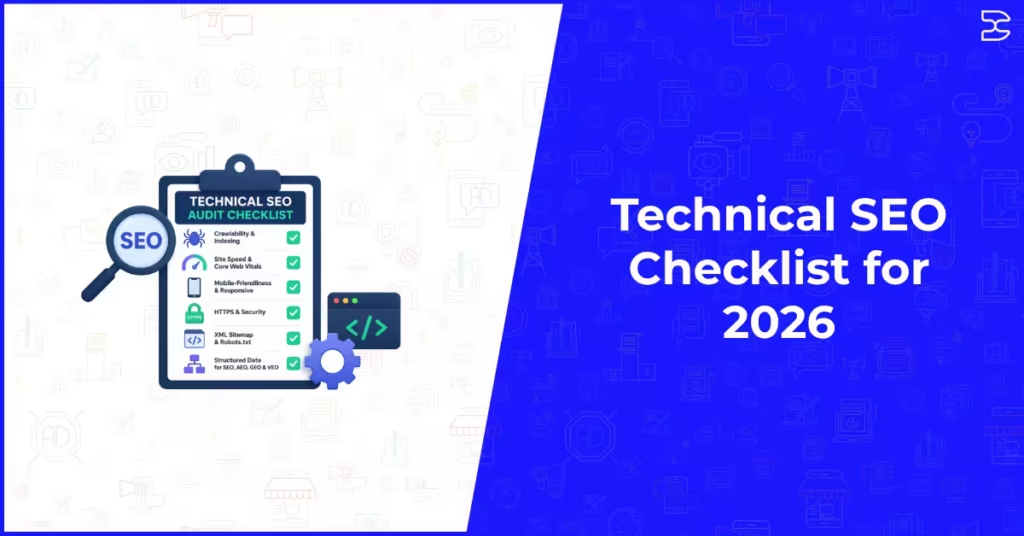
Table of Contents
ToggleTechnical SEO Checklist for 2026: The Complete Guide to Staying Ahead
Search engines in 2026 are smarter, faster, and more demanding than ever. Google’s continued investment in AI-powered ranking systems, its expansion of AI Overviews, and its increasing reliance on page experience signals have fundamentally shifted what it means to do technical SEO the right way. If your website cannot be efficiently crawled, clearly understood, or rapidly loaded, you are not competing, regardless of how strong your content strategy is.
This technical SEO checklist for 2026 covers every critical area you need to audit and optimize, from foundational crawlability to structured data implementation that helps your pages surface in AI Overviews and People Also Ask (PAA) boxes. Whether you are running a solo blog or managing an enterprise site, this guide gives you a clear, prioritized path to better rankings.
This may also help you – The Complete SEO Guide for Businesses in India, Australia & USA [2026]
1. Crawlability and Indexability
Before rankings, before traffic, before conversions, comes crawlability. If Googlebot cannot reach and index your pages, nothing else matters. In 2026, crawl budget optimization has become especially critical for large sites given Google’s selective crawling behavior.
What to Check:
- Verify your robots.txt file is not accidentally blocking critical pages or directories
- Confirm your XML sitemap is current, clean, and submitted to Google Search Console
- Audit for orphan pages that have no internal links pointing to them
- Use log file analysis to understand which pages Googlebot actually visits
- Identify crawl errors in Search Console and resolve 4xx and 5xx status codes
- Remove or consolidate thin, duplicate, or low-value pages that waste crawl budget
One underrated tactic is internal link auditing. A well-structured internal link architecture distributes crawl equity throughout your site and ensures your most important pages get crawled with appropriate frequency. If you want to go deeper, our guide on on-page SEO services covers how content structure and internal linking work together to improve crawl efficiency.
2. Core Web Vitals and Page Experience
Core Web Vitals are not going away. In 2026, Interaction to Next Paint (INP) has fully replaced First Input Delay (FID), and Google continues to weight these metrics heavily in ranking decisions. A slow, unresponsive page is a ranking liability.
Core Metrics to Target:
Metric | Good Score | Primary Fix |
LCP (Largest Contentful Paint) | Under 2.5 seconds | Image optimization, server response time |
INP (Interaction to Next Paint) | Under 200ms | Reduce JavaScript execution, minimize third-party scripts |
CLS (Cumulative Layout Shift) | Under 0.1 | Set image dimensions, avoid dynamic content injection |
Beyond the three core metrics, page experience also includes HTTPS security, mobile-friendliness, and the absence of intrusive interstitials. Run a PageSpeed Insights audit on your top landing pages at minimum once per quarter.
3. Mobile-First Indexing and Responsive Design
Google has been mobile-first since 2019, but plenty of websites still serve a degraded mobile experience without realizing it. In 2026, mobile-first indexing is the only indexing model, which means Google evaluates your mobile version as the primary source of truth for rankings.
Mobile SEO Checklist:
- Ensure content parity between desktop and mobile versions of every page
- Use responsive design rather than separate mobile URLs to avoid duplicate content issues
- Confirm all structured data present on desktop also appears on mobile
- Test touch target sizes and font readability on mobile viewports
- Audit mobile page speed separately from desktop, as scores often differ significantly
This may also help you – How to do keyword research for Indian markets
4. Structured Data and Schema Markup
If ranking in AI Overviews and PAA boxes is a goal (and in 2026, it absolutely should be), structured data is your single most impactful technical lever. Schema markup helps Google understand the context and content of your pages well enough to surface them confidently in featured results.
High-Impact Schema Types for 2026:
- FAQPage schema for any page with question-and-answer sections, this directly feeds PAA boxes
- HowTo schema for step-by-step guides and tutorials
- Article and BlogPosting schema for all editorial content
- BreadcrumbList schema to improve sitelinks and navigational clarity
- Product and Review schema for ecommerce and service pages
- Organization and LocalBusiness schema for brand entity recognition
Pro Tip: Google’s Rich Results Test tool will tell you exactly whether your schema is valid and eligible for rich result features. Test every important page type, not just your homepage. |
Structured data implementation is one of the areas where working with a qualified team pays dividends quickly. Our technical SEO audit services include a full schema review and implementation roadmap tailored to your site architecture.
5. HTTPS, Site Security, and Core Signals
HTTPS is table stakes in 2026, but many sites still have mixed content issues, certificate problems, or legacy HTTP pages indexed. These are not just security issues; they are ranking issues.
Security Checklist:
- Confirm your SSL certificate is valid and renews automatically
- Audit for mixed content warnings where HTTP assets load on HTTPS pages
- Ensure all HTTP URLs redirect cleanly to their HTTPS equivalents via 301
- Review your Security Headers in tools like securityheaders.com
- Check for any recently hacked or flagged pages in Search Console under Security Issues
This may also help you – How long does SEO take to show results
6. URL Structure and Site Architecture
Clean, logical URLs are easier for both users and search engines to understand. In 2026, flat site architecture with clear hierarchy continues to outperform deep, convoluted structures, particularly for crawl efficiency and topical authority.
URL and Architecture Best Practices:
- Keep URLs short, descriptive, and keyword-relevant without stuffing
- Use hyphens to separate words, never underscores or spaces
- Avoid URL parameters for content that should be indexed; use canonical tags where unavoidable
- Design your content architecture around topic clusters to signal topical depth to Google
- Limit folder depth to three or fewer levels for your most important pages
A strong site architecture is inseparable from a strong content strategy. Our post on building a topic cluster strategy walks through how to map content pillars to your URL structure for maximum topical authority.
7. Duplicate Content and Canonicalization
Duplicate content dilutes link equity and confuses search engines about which page to rank. In 2026, with AI-generated content flooding the web, originality signals have become more important than ever, and technical duplicate issues compound the problem.
Duplication Checklist:
- Implement canonical tags on all paginated, filtered, and faceted navigation pages
- Consolidate near-duplicate pages through 301 redirects or content merges
- Ensure your CMS does not produce multiple URLs for the same content (with/without trailing slash, www vs non-www)
- Use hreflang tags correctly if you manage international or multilingual content
8. Image Optimization and Visual Search Readiness
Images remain one of the most neglected areas of technical SEO. Unoptimized images tank page speed and miss out on Google Images traffic, which can be a meaningful secondary source for many niches.
Image SEO in 2026:
- Use next-gen formats like WebP or AVIF for all images where browser support allows
- Always include descriptive, keyword-relevant alt text on every image
- Implement lazy loading for images that appear below the fold
- Use responsive images with srcset attributes so the browser fetches the correct size
- Add ImageObject schema for key visual content to improve discoverability
9. Optimizing for AI Overviews and PAA
AI Overviews now appear at the top of a substantial percentage of Google searches. Getting your content cited in an AI Overview is the new featured snippet, and the principles for achieving it are rooted heavily in technical and structural SEO.
What Helps Content Surface in AI Overviews:
- Concise, direct answers to specific questions within the first 100 words of a section
- FAQPage schema implemented on every page containing Q and A content
- High domain authority and strong E-E-A-T signals (Experience, Expertise, Authoritativeness, Trust)
- Clear, semantically structured HTML with proper heading hierarchy
- Original data, expert quotes, or unique insights that add verifiable value
For PAA domination, structure your content around natural language questions. Use your target keyword variations as H3 subheadings followed immediately by a two to three sentence direct answer. This format matches how Google extracts PAA content.
If your current content strategy is not built to capture these SERP features, our SEO content writing services can help you structure every page to compete for AI Overviews and featured snippets from day one.
Final Thoughts
Technical SEO in 2026 is not just about fixing broken things. It is about building a website infrastructure that actively signals trust, speed, clarity, and authority to the most sophisticated search algorithms ever deployed. The sites that will dominate the next generation of search results are the ones that treat technical SEO as an ongoing discipline rather than a one-time project.
Work through this checklist systematically. Prioritize crawlability and Core Web Vitals first, layer in structured data and schema, and then audit your site architecture and duplicate content. Each item you resolve compounds your ranking potential.
Need a hands-on partner to implement this checklist? Explore our digital marketing services to see how we help businesses turn technical SEO wins into sustained organic growth.
Frequently Asked Questions (FAQs)
A technical SEO checklist is a structured set of audit tasks that ensure a website can be properly crawled, indexed, and understood by search engines. It covers areas including site speed, mobile-friendliness, structured data, URL architecture, security, and duplicate content management.
For most websites, a full technical SEO audit should be conducted quarterly. However, critical areas like Core Web Vitals, crawl errors, and security issues should be monitored monthly or via continuous automated alerts through tools like Google Search Console or third-party crawlers such as Screaming Frog.
While no single factor dominates in isolation, Core Web Vitals and structured data are arguably the most impactful in 2026. Core Web Vitals directly influence page experience rankings, while structured data determines eligibility for AI Overviews, rich results, and PAA boxes that now dominate the top of the SERP.
Yes, technical SEO matters more than ever. With AI-generated content flooding the web, Google relies increasingly on technical trust signals such as E-E-A-T, site speed, structured data, and crawlability to separate authoritative sources from low-quality content farms. Strong technical foundations give your content the infrastructure it needs to compete.
To improve your chances of appearing in AI Overviews, focus on providing clear and direct answers to specific questions, implementing FAQPage and relevant schema markup, building strong domain authority through quality backlinks, and ensuring your content demonstrates real expertise and originality. Technical SEO factors like fast load times and clean site architecture also contribute to how confidently Google cites your site.
Our Related Posts