How to Get More Google Reviews Ethically
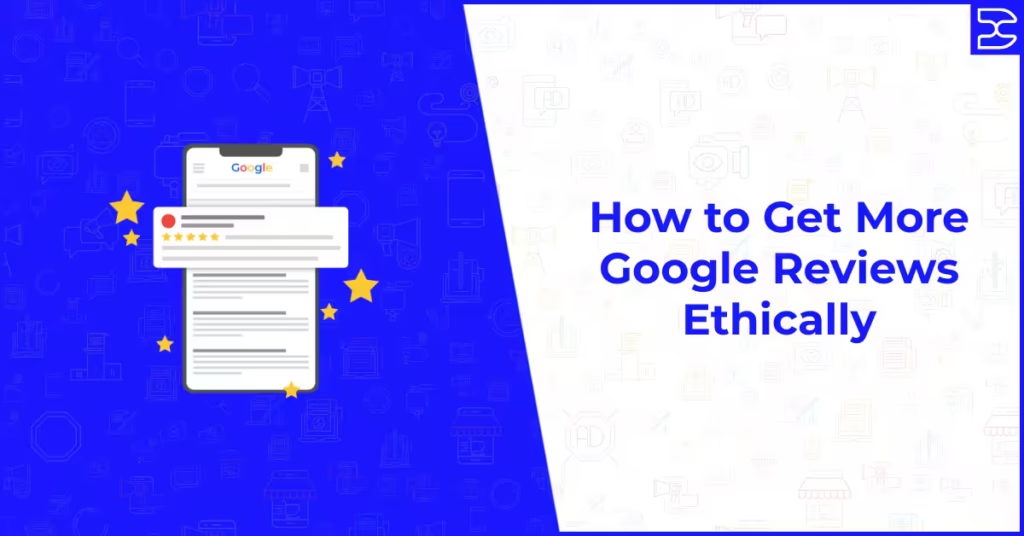
Table of Contents
ToggleHow to Get More Google Reviews Ethically
Google reviews are one of the most powerful trust signals available to any business operating locally or online. They influence where you appear in Google Maps and local search results, how many people click through to your website, and whether a potential customer decides to contact you or keeps scrolling. For most businesses, a strong and growing review profile is not just a nice thing to have. It is a direct driver of enquiries and revenue.
The challenge is that getting customers to actually leave reviews requires a deliberate and consistent effort. Most satisfied customers intend to leave a review and simply never get around to it. Meanwhile, unhappy customers are far more motivated to take action unprompted. Without a proactive strategy, your review profile tends to underrepresent the quality of your actual customer experience.
This guide covers how to build a steady, ethical review acquisition strategy that generates genuine reviews from real customers, improves your local visibility, and builds the kind of trust that compounds over time.
Why Google Reviews Matter So Much for Local Businesses
Google uses reviews as a significant factor in its local ranking algorithm. The number of reviews, the average star rating, the recency of reviews, and the keywords that appear in review text all contribute to how prominently your business appears in the local pack and Google Maps results. A business with fifty recent four and five star reviews will consistently outrank a competitor with ten older reviews, even if other signals are similar.
Beyond ranking, reviews influence behaviour directly. Research consistently shows that the majority of consumers read online reviews before making a purchasing decision, and that most people trust online reviews from strangers as much as personal recommendations. A profile with detailed, recent, positive reviews from real customers generates significantly more enquiries than one with a sparse or dated review history.
Reviews also provide valuable customer insight. The language customers use in reviews, the specific aspects of your service they praise or criticise, and the patterns that emerge across multiple reviews give you a continuous source of feedback that can inform how you improve your offering and how you communicate your value to prospective customers.
Reviews are one of the three core factors Google weighs when determining local rankings alongside relevance and distance. Understanding the full picture of how that algorithm works is covered in our guide to how Google Maps ranking works, which explains the specific signals that determine your position in local search results.
The Ethical Foundation: What You Can and Cannot Do
Before covering how to ask for reviews, it is important to understand the boundaries Google sets around review acquisition. Violating these guidelines risks having reviews removed, your listing penalised, or in serious cases your Google Business Profile suspended.
What Google Prohibits
Google explicitly prohibits incentivising reviews by offering discounts, gifts, payment, or any other benefit in exchange for leaving a review. It also prohibits asking only customers you believe will leave positive reviews while ignoring others, which is known as review gating. Creating fake reviews, paying for reviews, or asking employees to leave reviews about your own business as if they were customers are all violations of Google’s review policies and can result in serious consequences including removal of all reviews and profile suspension.
What Is Acceptable
Asking customers to share their honest experience is entirely acceptable and encouraged. Providing a direct link to your Google review page to make the process easier is acceptable. Following up with customers after a purchase or service delivery to request feedback is acceptable. Responding to existing reviews is acceptable and recommended. The key principle is that your request is genuine, your contact list includes all customers rather than a selected group, and you make no attempt to influence the content or sentiment of what is written.
Building a Repeatable Review Request Process
The businesses that consistently grow their review count are those that have made review requests a systematic part of their customer journey rather than an occasional manual effort. A repeatable process removes the reliance on remembering to ask and ensures that every customer has a consistent opportunity to share their experience.
Identify Your Optimal Ask Moment
The best time to ask for a review is immediately after the customer has experienced the value of what you delivered, when their satisfaction is at its peak. For a restaurant, that might be at the end of the meal. For a trades business, it might be the moment the job is completed and the customer has seen the result. For a professional service firm, it might be at the point of handing over a deliverable or completing a project milestone. Asking at the right moment produces significantly higher response rates than asking days or weeks later when the memory and the emotion have faded.
Make the Process as Simple as Possible
Friction is the enemy of review completion. Every additional step between a customer deciding to leave a review and actually submitting one is an opportunity for them to give up. Your review request should include a direct link to your Google review form that opens immediately on their device without requiring them to search for your business, navigate to the reviews section, or log in to any additional accounts. Google provides a short URL for each business profile that links directly to the review input form. Use it in every request.
Ask in Person Where Appropriate
For service businesses with direct customer contact, a genuine and natural verbal request often produces the best results. Train your team to ask satisfied customers at the right moment, explain why reviews matter to the business, and make the ask feel personal rather than scripted. Following up this verbal request with a text message or email containing the direct link converts the intention into action, because the customer is reminded while their goodwill is still high.
Channels for Requesting Google Reviews
Email Follow-Up
A follow-up email sent within 24 to 48 hours of completing a service or delivering a product is one of the most effective review request channels. Keep the email short, personal in tone, and focused on a single call to action. Explain that you would value their honest feedback and provide the direct Google review link prominently. A subject line that references their specific purchase or service feels personalised rather than generic and achieves considerably higher open rates than a standard email blast.
SMS and WhatsApp
Text-based follow-up via SMS or WhatsApp achieves higher open and response rates than email for many service businesses, particularly those whose customers are more likely to respond to a mobile message than to check an email. The message should be brief, direct, and include the review link as the only call to action. Keep the tone warm and genuine rather than transactional.
If your business already uses WhatsApp for customer communication, sending review requests through the same channel your customers already associate with your brand produces particularly strong response rates. How to structure these messages effectively, including what formats work within the platform’s rules, is covered in our guide to WhatsApp message templates that get approved.
In-Store or On-Site QR Codes
For businesses with a physical premises, a QR code displayed at the point of transaction, on a receipt, on your business card, or on signage near the exit gives customers an immediate and friction-free way to leave a review before they leave your premises. A short piece of accompanying copy explaining that you appreciate honest feedback and that reviews help your team improve makes the request feel genuine rather than just promotional.
Your Website and Email Signature
Including a Google review link on your website, particularly on your thank you or confirmation pages that customers see after a purchase or enquiry, captures customers at a moment of active engagement. Your email signature is another low-effort, high-frequency touchpoint. Adding a short line such as “Happy with our service? Leave us a Google review” with a direct link reaches every customer you communicate with over email without any additional effort per contact.
Responding to Reviews: Why It Matters and How to Do It
Review management is not just about collecting new reviews. How you respond to existing reviews is a signal that Google and your prospective customers both read carefully. Google has confirmed that responding to reviews is a factor it considers in local search rankings. Customers reading your reviews pay close attention to how you handle criticism as much as they notice what satisfied customers say.
Responding to Positive Reviews
Respond to positive reviews with genuine acknowledgement rather than a copy-pasted template. Use the reviewer’s name where it is included, reference specific aspects of their experience if they mentioned them, and express authentic appreciation. A personalised response to a positive review signals to prospective customers that real people are behind the business and that you take individual customer relationships seriously. It also increases the likelihood that the reviewer will recommend your business to others.
Responding to Negative Reviews
A thoughtful response to a negative review is one of the most powerful reputation management tools available to you. Prospective customers read negative reviews specifically to see how the business responds. A response that acknowledges the customer’s concern, apologises where appropriate, explains any relevant context without making excuses, and offers a route to resolution demonstrates professionalism and accountability. Many prospective customers have reported that seeing a business handle criticism well actually increases their confidence in choosing that business.
Avoid responding defensively, disputing the customer’s account publicly, or ignoring negative reviews entirely. Each of these approaches damages your reputation more than the original review itself. Address every negative review promptly, professionally, and with the goal of resolution rather than winning an argument.
How Many Reviews Do You Need?
There is no universal answer to how many reviews constitute an optimal profile, because what counts as strong varies by industry, geography, and the competitive landscape of your specific market. A business in a small local market may be considered well-reviewed with thirty to fifty reviews. A business in a major city competing in a crowded category may need several hundred to stand out.
What matters more than an absolute number is the combination of quantity, recency, and rating. A profile with two hundred reviews but none in the past year sends a different signal than one with fifty reviews, ten of which appeared in the past month. Google’s algorithm weights recent reviews more heavily than older ones, which means review acquisition is not a one-time exercise but an ongoing process that requires sustained attention.
Your review profile is one component of a broader local SEO strategy. Understanding how it fits alongside your Google Business Profile optimisation, citation consistency, and website authority is covered in our guide to local SEO and Google Maps ranking strategies, which gives a complete picture of what it takes to rank prominently in local search results.
Practices to Avoid
Buying Reviews
Purchasing reviews from third-party services is a direct violation of Google’s policies and carries serious consequences. Google actively works to identify and remove inauthentic reviews, and the patterns associated with purchased reviews such as a sudden spike in review volume or reviews from accounts with no history or activity are increasingly detectable. Beyond the policy risk, fake reviews undermine the trust that genuine reviews build. The short-term gain is rarely worth the long-term risk.
Review Gating
Review gating is the practice of filtering customers before asking for reviews, directing only those you believe are satisfied to your review platform while routing dissatisfied customers to a private feedback form instead. Google explicitly prohibits this practice because it distorts the review profile and misleads potential customers. Your review request process must be applied consistently to all customers regardless of your prediction of what they will write.
Pressuring Customers
Sending repeated review requests to customers who have not responded, using language that implies the customer is obligated to leave a review, or applying any form of social or professional pressure to obtain reviews all damage the customer relationship and may generate the opposite of the intended result. One well-timed, genuine request is considerably more effective than multiple aggressive follow-ups.
Final Thoughts
Building a strong Google review profile is one of the highest-return local marketing activities available to most businesses. The effort required is not enormous, but it does require consistency, a systematic approach, and a genuine commitment to making review requests a routine part of how you serve and follow up with customers.
The businesses that lead their local markets in review count and quality are almost always those that have made asking for feedback a natural and regular part of their customer experience, who respond thoughtfully to every review they receive, and who understand that their review profile is a living asset that requires ongoing attention rather than a one-time project.
If you want to build a complete local digital presence where your review profile, Google Business Profile, website, and content strategy all work together, explore how our local SEO and digital marketing services can help your business build the visibility and trust that drives consistent enquiries from the people searching for what you offer.
Frequently Asked Questions (FAQs)
No. Asking customers to share their honest experience in a Google review is entirely within Google's guidelines. What is prohibited is incentivising reviews with gifts, discounts, or payment, asking only customers you believe will leave positive reviews, and creating or purchasing fake reviews. A genuine, consistent, and unincentivised review request process is not only acceptable but encouraged by Google.
You can find your Google review link through your Google Business Profile dashboard. Log in to your profile, look for the option to share your review link or get more reviews, and copy the short URL that is generated. This link opens directly to the review input form when clicked on a mobile device or desktop, removing the need for customers to search for your business or navigate through multiple screens. This link is what you should include in all review request communications.
For most businesses with a consistent and systematic review request process, a meaningful review profile of twenty to fifty genuine reviews can be built within three to six months. Reaching one hundred or more reviews typically takes between six and twelve months of sustained effort. The key is consistency. Asking every customer at the right moment and making the process simple produces a steady accumulation of reviews rather than sporadic spikes and gaps.
Yes. Responding to all reviews, both positive and negative, is considered best practice and is a factor in Google's local ranking signals. Responses demonstrate that your business is actively engaged with customer feedback and takes its reputation seriously. Keep responses to positive reviews personalised and genuine. Keep responses to negative reviews professional, constructive, and focused on resolution rather than defensiveness.
Yes. Google can remove reviews that violate its policies, including fake reviews, reviews left by people who have a conflict of interest, reviews that contain prohibited content such as spam or personal information, and reviews that are flagged and assessed as inauthentic. Reviews that are removed are gone from your profile permanently. This is one of the reasons that building your review profile through genuine customer feedback is the only sustainable approach. Profiles built on authentic reviews are resilient. Those built on manipulated or purchased reviews are vulnerable to sudden and significant loss of social proof.
If you receive a review you believe is fake or violates Google's policies, you can flag it for review directly from your Google Business Profile. Google will assess the flagged review and remove it if it is found to violate the content policy. This process can take time and is not guaranteed to result in removal. In the meantime, responding professionally to the review demonstrates to other readers that you take feedback seriously, even when the review itself appears inauthentic. Avoid responding in a way that escalates the situation or draws unnecessary attention to the review.
Our Related Posts