What Is Conversational Marketing
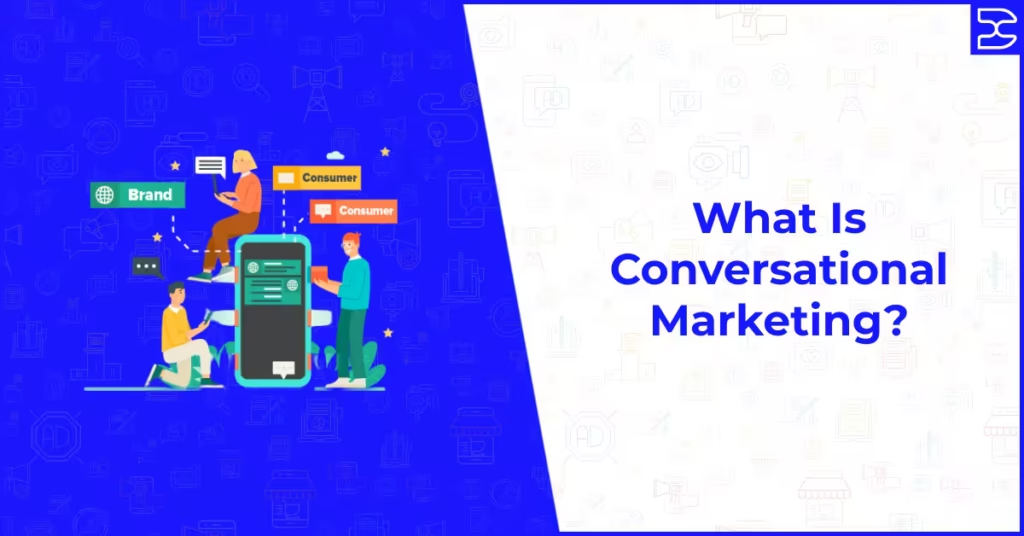
Table of Contents
ToggleWhat Is Conversational Marketing
Traditional marketing is largely one-directional. A business publishes content, runs an ad, sends an email, and waits to see whether anyone responds. The audience is passive. The timing is controlled by the brand. The experience is the same for everyone who receives it.
Conversational marketing works differently. Instead of asking potential customers to consume your content and find their own way to a contact form, it meets them where they already are, opens a two-way dialogue, and moves them through the buying journey at their own pace and on their own terms. The result is a more personal experience, faster qualification, shorter sales cycles, and conversion rates that consistently outperform broadcast-only approaches.
In 2026, as messaging apps account for more daily consumer time than social media feeds and as buyers increasingly expect immediate and relevant responses rather than waiting for a follow-up email, conversational marketing has moved from an emerging trend to a practical necessity for businesses serious about their customer acquisition.
Defining Conversational Marketing
Conversational marketing is a customer engagement approach built around real-time, two-way dialogue between businesses and their prospective or existing customers. It uses messaging platforms, chatbots, live chat, and direct messaging channels to initiate, sustain, and convert conversations that would traditionally have been handled by forms, emails, and delayed phone follow-ups.
The core distinction between conversational marketing and traditional digital marketing lies in the direction of communication and the timing of interaction. Traditional digital marketing is asynchronous: the business publishes, the customer receives, and if they respond there is typically a delay before the business engages. Conversational marketing is synchronous or near-synchronous: dialogue happens in real time or close to it, creating a buying experience that feels like talking to a person rather than completing an administrative process.
Conversational marketing is not just chatbots. It encompasses any use of messaging technology to enable genuine, relevant, two-way communication at scale. This includes WhatsApp campaigns with reply-based flows, live chat on websites, Facebook Messenger strategies, SMS dialogue sequences, and direct message outreach on social platforms. The channel matters less than the principle: replace passive content consumption with active, personalised dialogue.
Why Conversational Marketing Works
The effectiveness of conversational marketing rests on a straightforward insight about human behaviour. People are significantly more likely to engage with, trust, and ultimately buy from businesses that respond to them as individuals rather than treating them as entries in a broadcast list.
Speed to Qualification
In most traditional lead generation models, a prospect fills in a form, receives an automated acknowledgement, and a sales representative picks up the lead within hours or days. By the time the conversation happens, buying intent has often cooled or the prospect has moved forward with a competitor. Conversational marketing compresses this timeline dramatically. A prospect who engages through a WhatsApp campaign or a website chat can be qualified, have their questions answered, and be moved to a booked appointment within minutes of first contact. The conversion happens while buying intent is at its peak.
Personalisation at Scale
The challenge of modern marketing is that audiences expect personalisation but businesses need to communicate with large numbers of people. Conversational marketing resolves this tension through conditional logic and dynamic response flows. A chatbot or a messaging workflow can ask a prospect a series of questions and route them to content, responses, or offers relevant specifically to their answers. From the prospect’s perspective the experience feels personal and attentive. From the business’s perspective it is operating efficiently at scale.
Lower Friction Throughout the Buying Journey
Every step a potential customer must take between first contact and purchase is an opportunity for them to abandon the process. Conversational marketing reduces friction by meeting people in channels they already use habitually, asking fewer and more targeted questions than a traditional form, and providing immediate answers rather than requiring navigation through a website. Lower friction at every stage produces measurably higher conversion rates, particularly for mobile audiences who have limited patience for slow or complex processes.
Stronger Customer Relationships
Conversations build relationships in a way that broadcast content cannot. A customer who has had a helpful, relevant dialogue before making a purchase arrives at the transaction with a different quality of trust than one who simply clicked through an ad. This trust foundation affects not just initial conversion but repeat purchase behaviour, referral likelihood, and the long-term customer relationship that supports sustainable business growth.
The Key Channels for Conversational Marketing
WhatsApp is the dominant conversational marketing channel for businesses targeting consumer audiences across most markets. Its open rates, response rates, and the personal nature of the inbox make it the highest-performing direct messaging channel available for most use cases. Through the WhatsApp Business API, businesses can build sophisticated conversation flows, send triggered messages based on customer behaviour, manage multi-agent team inboxes, and integrate conversation data with CRM systems.
The mechanics of how WhatsApp functions as a marketing platform, including how broadcast lists compare to ongoing dialogue and when to use each approach, are covered in detail in our guide to WhatsApp broadcast lists versus groups.
Website Live Chat
Live chat tools on websites enable real-time conversations with visitors who arrive through organic search, paid advertising, or direct navigation. Unlike a contact form that creates a gap between enquiry and response, live chat allows a visitor with a question to receive an answer immediately, which significantly reduces the proportion of engaged visitors who leave without converting. Most live chat tools support a hybrid model where a chatbot handles initial qualification and common questions and escalates to a human agent for complex conversations, providing genuine responsiveness without requiring constant agent availability.
Facebook and Instagram Messaging
Click-to-message advertising on Facebook and Instagram sends users who click on your ad directly into a Messenger or Instagram DM conversation rather than to a landing page. For businesses where conversation is a natural part of the sales process, this approach consistently outperforms click-to-website advertising on cost per qualified lead, because the dialogue happens immediately while ad-generated intent is strongest.
SMS Dialogue
SMS retains a role in conversational marketing for specific use cases where a short, direct exchange is the appropriate format. Two-way SMS sequences that qualify leads, confirm appointments, or provide time-sensitive responses work well for audiences who are less active on WhatsApp or for businesses where the simplicity of SMS matches the nature of the conversation being facilitated. SMS lacks the rich media capability of WhatsApp but benefits from universal reach, operating on any mobile device without requiring a specific app.
How to Build a Conversational Marketing Strategy
Map Your Customer Journey for Conversation Opportunities
The most effective conversational strategies are built by identifying the specific points in the customer journey where a conversation would add the most value. Look for where potential customers currently experience friction, where questions go unanswered, where delays cause drop-off, and where a real-time exchange would most naturally accelerate progress toward a buying decision. These friction points are where conversational marketing delivers the clearest and most measurable commercial impact.
Design Flows Around Customer Needs, Not Data Collection
A conversational marketing flow should feel genuinely helpful to the person experiencing it. Every question in a flow should serve the customer’s need to receive a relevant response or recommendation. Flows that feel like data capture exercises rather than useful exchanges generate high abandonment rates and leave a negative impression of your brand. Design with the customer experience first and the information you need second.
Integrate With Your Existing Systems
Conversational marketing produces its greatest value when dialogue data flows into the systems that manage your broader customer relationships. A qualified lead generated through WhatsApp should appear in your CRM with qualification context attached. A booking made through a chatbot should update your scheduling system. Without these integrations, conversational marketing becomes an isolated activity that requires additional manual effort rather than reducing it.
Balance Automation With Human Judgement
The most effective conversational marketing systems are neither fully automated nor fully dependent on human agents. Automation handles high-volume, low-complexity interactions such as answering frequently asked questions, qualifying leads, and confirming appointments. Human agents handle complex situations, high-value prospects, and conversations that require genuine judgement. Getting this balance right requires ongoing monitoring of where automated flows are delivering and where they are creating frustration or drop-off.
Building the technical infrastructure that enables conversational marketing at scale, including the WhatsApp Business API and the automation tools that power sophisticated conversation flows, is covered in our practical guide to the WhatsApp Business API setup process.
Conversational Marketing and Traditional Marketing Working Together
Conversational marketing is most effective when it complements rather than replaces existing marketing channels. Traditional digital marketing excels at reaching large audiences, building brand awareness, and creating the initial awareness that makes a prospective customer open to a conversation. SEO-driven content, paid advertising, social media, and email all play important roles in building the familiarity and interest that precedes a dialogue.
Conversational marketing then takes those interested prospects and moves them toward a purchase through personalised, real-time dialogue that addresses their specific situation and concerns. The two approaches work as a system: traditional marketing generates awareness and interest, and conversational marketing converts that interest into qualified leads and sales at a higher rate than static landing pages and form-based lead capture alone.
Understanding how conversational channels fit within a broader acquisition strategy is an important part of building a joined-up content marketing strategy where every element, from organic content to direct messaging, is working toward the same commercial outcomes.
Final Thoughts
Conversational marketing represents a genuine shift in how businesses communicate with potential customers. The move from broadcast to dialogue, from delayed to real-time, and from generic to personalised reflects a durable change in what buyers expect and what technology now makes possible at scale.
Businesses integrating conversational approaches into their marketing and sales are seeing shorter sales cycles, higher conversion rates, and stronger customer relationships than those relying entirely on traditional one-way channels. Starting with one channel, building a genuinely useful conversation flow, and measuring its commercial impact is the most practical path to understanding what conversational marketing can do for your specific business.
If you want to explore how conversational marketing fits within a broader digital marketing approach covering SEO, content, and paid media, explore how our digital marketing and campaign services can help your business build the connected, conversion-focused presence that modern buyers expect.
Frequently Asked Questions (FAQs)
Conversational marketing is a customer engagement approach built around real-time, two-way dialogue between businesses and prospective or existing customers through messaging platforms, chatbots, live chat, and direct messaging channels. It replaces the traditional one-way broadcast model with personalised, interactive communication that moves potential customers through the buying journey faster and with less friction.
Traditional marketing is predominantly one-directional: businesses publish content, run ads, or send emails, and customers receive those communications passively. Conversational marketing is bidirectional: both parties communicate in real time, the customer's input shapes the response they receive, and the interaction is tailored to their specific needs. Conversational marketing produces faster qualification, higher conversion rates, and stronger customer relationships than broadcast-only approaches.
The main channels are WhatsApp through the WhatsApp Business API, website live chat tools, Facebook Messenger and Instagram direct messaging, and SMS dialogue sequences. The most effective channel for any business depends on where its target audience is most active and which channel best suits the nature and complexity of the conversations the business needs to have.
Yes. Small businesses can start with a live chat tool on their website, a WhatsApp Business number with a structured response process, or a basic chatbot that handles frequently asked questions and qualifies leads. The investment required to begin is modest, the technology has become considerably more accessible, and the core principle of engaging people in relevant dialogue does not require large budgets to implement effectively.
No. Conversational marketing is equally effective in B2B contexts where it addresses one of the central challenges of longer sales cycles: maintaining engagement and progressing prospects through a multi-stage buying process. B2B applications include LinkedIn messaging, WhatsApp for relationship-based sales conversations, website live chat for qualification, and personalised outreach sequences that initiate dialogue rather than broadcasting content. In high-consideration B2B purchases, the relationship-building aspect of conversational marketing is often more commercially significant than in B2C contexts.
The primary metrics are response rate from initiated conversations, qualification rate from conversations to qualified leads, conversion rate from conversation to desired outcome such as booked appointment or purchase, time from first conversation to conversion decision, and customer satisfaction scores from post-conversation surveys. These should be tracked alongside the commercial outcomes they drive, including revenue contribution and customer acquisition cost, to evaluate the overall return on conversational marketing investment.
Our Related Posts