Landing Page Best Practices 2026
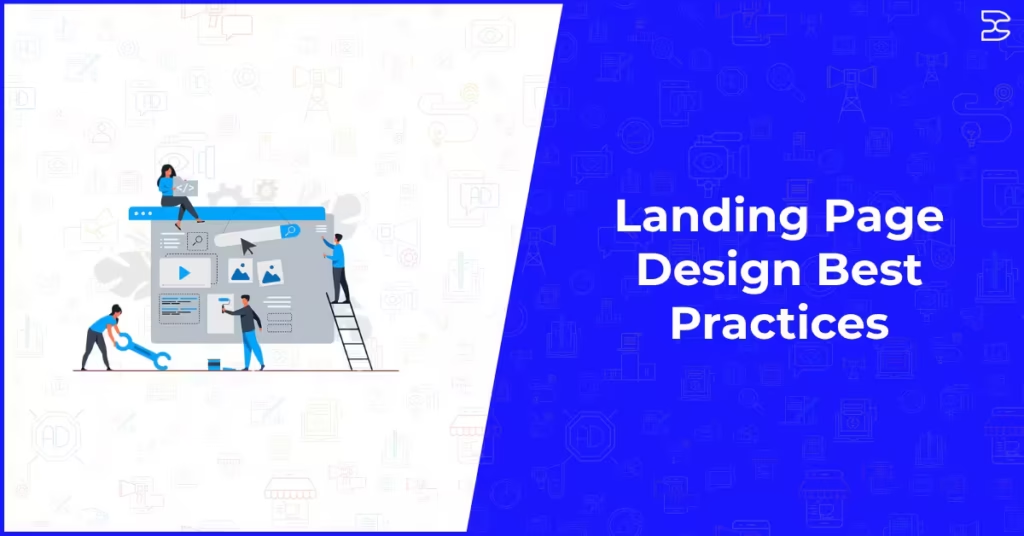
Table of Contents
ToggleLanding Page Design Best Practices 2026: Build Pages That Convert and Rank
Landing pages are one of the highest-leverage assets in any digital marketing strategy. A well-designed landing page does not just look good. It earns trust, communicates value clearly, and turns visitors into leads or customers.
In 2026, the bar has risen considerably. Google’s AI-driven search results, evolving user behaviour, and the shift to mobile-first browsing have all changed what it takes to build a landing page that both ranks and converts. Whether you are running paid campaigns, capturing organic traffic, or nurturing email clicks, your landing page needs to perform harder than ever.
This cluster article walks through the most important landing page design best practices for 2026, structured to help you rank in AI Overviews, appear in People Also Ask results, and build pages your audience actually trusts.
What Is a Landing Page and Why Does Design Matter So Much?
A landing page is a standalone web page built for a single, specific purpose. Unlike a homepage or a service page, every element on a landing page exists to guide the visitor toward one action, such as booking a call, downloading a resource, or making a purchase.
Design matters because it directly shapes behaviour. The layout, typography, colour choices, form placement, and overall visual flow all influence whether a visitor stays, reads, and converts, or leaves within seconds. Poor design creates confusion and friction. Strong design creates clarity and confidence.
In 2026, design also intersects with technical performance. Page speed, mobile responsiveness, and structured content are all part of how Google evaluates your page for both rankings and user experience signals.
Key Landing Page Design Best Practices for 2026
1. Lead With a Headline That Matches Search Intent
Your headline is the single most important piece of copy on the page. It needs to immediately confirm to the visitor that they have landed in the right place.
The most effective headlines in 2026 are benefit-focused and intent-matched. If someone clicked an ad about affordable social media management packages, your headline should reflect that exact promise. Any mismatch between what they expected and what they see will cause them to bounce.
Keep headlines clear and direct. Avoid clever wordplay that sacrifices clarity. A visitor should understand your core offer within the first three seconds of landing on the page.
2. Structure Your Above-the-Fold Section Strategically
Everything visible before a user scrolls is your above-the-fold section. This is where first impressions are formed and decisions are made.
A high-performing above-the-fold layout in 2026 typically includes a strong headline, a one or two sentence supporting statement, a primary call-to-action button, and at least one trust element such as a client logo, a review score, or a short credibility statement.
Resist the urge to add too much here. White space is not wasted space. It helps the eye focus on what matters most, which is your offer and your CTA.
3. Design for Mobile First, Not Mobile Second
Over 60% of web traffic now comes from mobile devices, and that figure is higher still for paid social and email-driven campaigns. In 2026, a mobile-first design approach is not optional.
Mobile-first design means starting your design at the smallest screen size and building upward. This results in tighter layouts, larger tap targets, faster load times, and a smoother experience for the majority of your visitors.
Pay specific attention to CTA button size and placement on mobile. Buttons should be easy to tap with a thumb, clearly visible without scrolling too far, and repeated at sensible intervals throughout the page.
This practice is closely tied to broader conversion rate optimisation strategies, where small mobile UX improvements often produce outsized gains in lead volume and cost per acquisition.
4. Use One Clear Call-to-Action Throughout the Page
Every high-converting landing page has a single, dominant call-to-action. Multiple competing CTAs create decision paralysis and reduce overall conversions.
Choose one action you want visitors to take and reinforce it consistently from top to bottom. The wording on your CTA button matters more than most people realise. Phrases like “Get My Free Audit,” “Start My Trial,” or “Book a Strategy Call” consistently outperform generic options like “Submit” or “Click Here.”
Your CTA button should also stand out visually. Use a colour that contrasts with the background and is distinct from the rest of the page’s palette. Size it generously and give it breathing room with whitespace around it.
5. Add Trust Signals That Remove Hesitation
Visitors arrive at landing pages with a degree of scepticism. Your design needs to overcome that hesitation before asking them to take action.
Trust signals that work well in 2026 include verified customer reviews with names and roles, logos of recognised clients or media mentions, industry certifications or accreditations, specific results data such as “helped 300+ businesses increase conversions,” and clear privacy assurances near any form.
Placement matters as much as presence. A testimonial positioned directly beside your CTA is far more persuasive than the same testimonial buried at the bottom of the page.
6. Optimise Page Speed as a Design Priority
Page speed is no longer just a technical concern. It is a design decision. The images you choose, the fonts you load, the scripts you run, all directly impact how fast your page loads and therefore how many visitors stay long enough to convert.
Google’s Core Web Vitals, specifically Largest Contentful Paint, Interaction to Next Paint, and Cumulative Layout Shift, are active ranking signals. Failing these benchmarks will suppress your organic visibility regardless of how good your content is.
For any agency or business running paid campaigns, slow pages also increase cost per click by lowering Quality Scores. Investing in page speed is investing directly in campaign efficiency.
7. Write Copy That Answers Questions Before They Are Asked
The best landing page copy anticipates objections and answers them proactively. Before a visitor has to wonder about pricing, timelines, what happens after they submit the form, or whether the offer is right for them, your copy should already have addressed it.
Structure your copy in a logical flow: problem, solution, proof, action. Introduce the pain point your offer addresses, explain how you solve it, provide evidence that you can deliver, and then make it easy to take the next step.
This approach also aligns with how Google’s AI Overviews work. Pages that clearly answer questions in a structured, readable format are more likely to be cited in AI-generated search summaries, which increases visibility beyond traditional blue-link rankings.
8. Use an FAQ Section to Target People Also Ask Results
Adding a well-structured FAQ section to your landing page serves two purposes. It addresses remaining visitor objections before they leave, and it gives you a strong opportunity to rank in Google’s People Also Ask boxes.
Write FAQ questions using the exact language your audience uses when searching. Tools like Google Search Console, AnswerThePublic, and even Google’s own autocomplete can surface the questions real users are asking about your topic.
Keep answers concise, direct, and genuinely useful. Thin or evasive answers will not help you rank, and they will not reassure your visitors either.
9. Keep Forms Short and Remove Unnecessary Friction
If your landing page goal is lead generation, your form is the final gateway between a visitor and a conversion. Every unnecessary field is a reason for someone to abandon the page.
In 2026, the highest-converting lead forms typically request three to five fields at most for top-of-funnel offers. Name and email is often sufficient for an initial contact. If you need more information, consider a multi-step form that breaks the process into smaller, less daunting stages.
Label all fields clearly, ensure error messages are helpful rather than frustrating, and make the submit button copy specific to what happens next, such as “Send My Free Report” rather than a generic “Submit.”
10. Align Landing Page Content With Your Broader SEO Strategy
A landing page does not exist in isolation. It should be a natural part of your overall content and SEO architecture. Pages that link to and from relevant service pages, blog posts, and pillar content perform better in organic search because they are embedded in a network of topical authority.
For example, a landing page focused on social media advertising services should connect to related content on paid social strategy, ad copywriting tips, and campaign reporting. This internal linking structure signals relevance to search engines and keeps visitors engaged longer.
Building landing pages as part of a structured digital marketing content strategy, rather than as standalone isolated assets, is one of the most underused advantages available to growing businesses in 2026.
How to Structure a Landing Page for AI Overview Visibility
Google’s AI Overviews pull from pages that provide clear, well-organised answers to user queries. To improve your chances of being featured, structure your landing page content with descriptive H2 and H3 headings, write in short and scannable paragraphs, use specific data points and outcomes where possible, and include an FAQ section that targets common search questions directly.
Schema markup for FAQPage and HowTo content types can also increase your eligibility for rich result features, which further improves click-through rates from search.
Final Thoughts
Building a landing page that ranks and converts in 2026 requires more than a good-looking layout. It demands a clear understanding of your audience, disciplined copy that answers real questions, technical performance that meets modern standards, and a design approach that guides rather than overwhelms.
The businesses that treat their landing pages as living, testable, continuously improving assets will consistently outperform those that build once and forget. Apply the practices in this guide, measure your results, and refine with purpose.
For support building high-performance landing pages as part of a wider digital marketing strategy, explore how our team approaches conversion-focused web design and SEO content planning from the ground up.
Frequently Asked Questions (FAQs)
A high-converting landing page in 2026 combines a clear benefit-driven headline, a single focused call-to-action, fast load times, mobile-first design, and well-placed trust signals such as reviews and certifications. The page should be built around one goal and remove every possible barrier between the visitor and that goal.
A landing page should have one primary call-to-action repeated at multiple points throughout the page. Multiple different CTAs competing for attention reduce conversions by creating confusion. Every element of the page should support the same single action.
Yes. Page speed, mobile experience, structured content, and Core Web Vitals all influence how Google ranks your landing page. A well-designed page that loads quickly, provides a smooth mobile experience, and is clearly structured around a specific topic will rank better than a slow or confusing alternative.
Length should match the complexity of your offer. Simple, low-commitment offers can convert with shorter pages. High-ticket services or products that require more consideration benefit from longer pages that address objections thoroughly. The right length is however long it takes to answer every reasonable question the visitor might have.
A/B testing is the most reliable method. Test one element at a time, such as your headline, CTA button copy, or hero image, and run each test until you reach statistical significance. Regular testing, rather than one-off experiments, is what separates consistently high-performing pages from average ones.
Yes. Landing pages benefit significantly from internal links pointing to them from relevant blog posts, service pages, and pillar content. This strengthens their topical authority in search and keeps visitors moving through your site rather than leaving after one page.
Our Related Posts