SEO-Optimised Website Structure Guide: Build a Site Google Loves
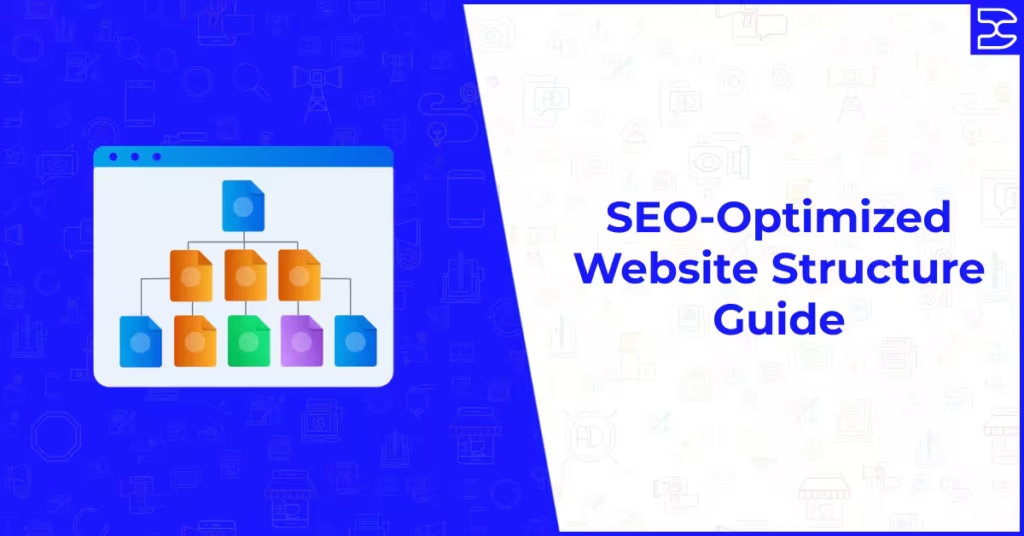
Table of Contents
ToggleSEO-Optimised Website Structure Guide: Build a Site Google Loves
If your website is not ranking despite publishing quality content, your site structure might be the problem. An SEO-optimised website structure is the backbone of any successful organic search strategy. It tells Google which pages matter most, how your content is related, and how easily users can navigate from one section to another.
This guide breaks down everything you need to know about building a website architecture that satisfies both search engine crawlers and real users. Whether you are starting from scratch or auditing an existing site, these best practices will set you on the right path.
What Is Website Structure in SEO?
Website structure, also called site architecture, refers to how your pages are organised, linked, and presented to search engines. A well-thought-out structure ensures that crawl budget is used efficiently, link equity flows to high-priority pages, and users can find information without frustration.
Google’s crawlers follow links to discover content. If your structure is flat, logical, and internally consistent, those crawlers can index your entire site with minimal effort. A poor structure, on the other hand, means orphaned pages, duplicate content issues, and diluted authority across your domain.
The Silo Structure: Foundation of Good Website Architecture
One of the most effective SEO website structures is the silo model. Think of it as organising your site into clearly defined topic groups or silos, where each silo covers a broad category supported by a cluster of related sub-pages.
Here is a practical example for a digital marketing agency:
- Homepage (root level)
- SEO Services (parent page)
- On-Page SEO (child page)
- Technical SEO (child page)
- Local SEO (child page)
- Content Marketing (parent page)
- Blog Writing Services (child page)
- Content Strategy (child page)
This model keeps topically related content grouped together, passes authority down from parent pages, and signals relevance to Google at scale. If you are planning or reviewing your own service pages, our technical SEO audit services can identify structural gaps before they cost you rankings.
URL Structure: Keep It Clean and Descriptive
Your URL structure is a direct SEO signal. Google recommends short, descriptive, and keyword-rich URLs that reflect the page content and its place within the hierarchy.
Best Practices for SEO-Friendly URLs
- Use lowercase letters only
- Separate words with hyphens, not underscores
- Include the primary keyword naturally
- Avoid parameters, session IDs, and long query strings
- Reflect the content hierarchy in the path
A good URL looks like this: yoursite.com/seo-services/local-seo
A poor URL looks like this: yoursite.com/page?id=1234&cat=7
The first version tells both users and search engines exactly what the page is about, reinforces your silo structure, and is far more likely to earn clicks from search results.
Internal Linking Strategy: The Nerve System of Your Site
A strategic internal linking plan is one of the highest-impact, lowest-cost SEO levers available. Internal links pass PageRank (link equity) between pages, establish topical relationships, and help Google understand which pages are most important.
Key Internal Linking Principles
- Link from high-authority pages to pages you want to rank
- Use descriptive, keyword-rich anchor text naturally within the content
- Ensure every page receives at least one internal link
- Avoid linking to the same URL multiple times on a single page
- Prioritise contextual links within body content over footer or navigation links
For instance, if you publish a blog post on on-page optimisation techniques, you should naturally link it to your on-page SEO service page so Google can understand the relationship between your informational content and your commercial offering. This is the bridge between content marketing and direct lead generation.
Navigation Structure: Balancing UX and Crawlability
Your main navigation should reflect your silo structure. Keep it shallow. SEO best practice recommends that any page on your site should be reachable within three clicks from the homepage. This is known as the three-click rule.
Beyond main navigation, implementing breadcrumb navigation is a smart structural move. Breadcrumbs provide secondary internal links, reinforce your hierarchy, and often appear directly in Google search results as rich snippets, increasing click-through rates.
If you are running an e-commerce store or a large informational site, breadcrumbs are especially valuable. Pair them with proper schema markup (BreadcrumbList) to maximise their visibility in AI Overviews and standard results.
XML Sitemap and Robots.txt: Guiding the Crawlers
Even the best site structure needs supporting technical signals to be fully effective. An XML sitemap acts as a roadmap for search engines, listing all the URLs you want indexed with their relative priority and last modified date.
Your robots.txt file, meanwhile, controls which parts of your site crawlers can and cannot access. Blocking crawlers from thin content pages, staging environments, and admin sections conserves crawl budget for the pages that actually matter.
Quick Technical Checklist
- Submit your XML sitemap to Google Search Console
- Exclude paginated, filtered, and duplicate URLs from the sitemap
- Review robots.txt for accidental blocks on important content
- Implement canonical tags to prevent duplicate content issues
- Use hreflang tags if your site targets multiple languages or regions
Getting this right is a core part of any technical SEO strategy. If your crawl coverage is incomplete, even perfectly structured content will struggle to rank.
Page Depth and Crawl Budget Management
Page depth refers to how many clicks it takes to reach a page from the homepage. Pages buried five or more levels deep are crawled infrequently and tend to receive minimal link equity. For larger sites, this is a serious ranking bottleneck.
Crawl budget is especially relevant for sites with thousands of pages. Google allocates a limited number of crawls per site per day. Spending that budget on thin, low-value pages, such as filters, tags, or duplicate parameters, means your best content gets crawled less often.
The fix is a combination of flat architecture, smart canonicalisation, and disciplined internal linking. Large e-commerce and publisher sites should conduct a regular crawl audit to identify and correct depth issues before they compound.
How Website Structure Supports AI Overview Rankings
Google’s AI Overviews pull structured, authoritative answers from well-organised content. To increase your chances of being featured, your site structure needs to reflect topical authority. This means:
- Your pillar pages comprehensively cover a broad topic
- Cluster pages provide deep, specific answers to related queries
- Internal links make the relationship between pages explicit
- FAQ sections use clear question-and-answer formats with targeted keywords
- Schema markup (FAQPage, Article, BreadcrumbList) is implemented correctly
Structured data is not optional if you want to win AI Overview placements. It is what helps Google parse and present your content in new search formats. Pair this with a clean heading hierarchy (H1, H2, H3) and your content becomes significantly more eligible for featured results.
For brands looking to dominate both traditional and AI-powered search, our content strategy services are designed to align your content architecture with how modern search engines extract and rank information.
Common Website Structure Mistakes to Avoid
- Flat taxonomy with no clear topical groupings
- Orphaned pages that receive zero internal links
- Inconsistent URL patterns across categories
- Navigation menus that do not reflect your silo architecture
- Blocking important CSS or JavaScript files in robots.txt
- Duplicate content from parameter-based URLs without canonicals
- Too many levels of depth for cornerstone content
Measuring the Impact of Your Site Structure
Once you implement structural improvements, track these metrics to measure impact:
- Crawl coverage in Google Search Console (Pages report)
- Average click depth using tools like Screaming Frog or Sitebulb
- Internal link distribution and PageRank flow
- Indexed pages vs total pages ratio
- Organic traffic to deep-funnel pages that previously underperformed
Structural SEO changes often take eight to twelve weeks to show measurable results in Google. Patience combined with monitoring is the right approach. Log your changes and correlate them against ranking shifts over time.
Final Thoughts
An SEO-optimised website structure is not a one-time task. It is an ongoing practice that evolves as your site grows, your content expands, and search algorithms mature. The fundamentals remain consistent: logical hierarchy, clean URLs, strategic internal linking, and proper technical signals.
Get the structure right and everything else, including content quality, backlink building, and conversion optimisation, becomes more effective. It is the single most leveraged investment you can make in your organic search performance.
If you are ready to audit or rebuild your website architecture with a proven SEO framework, our team can help. Explore our full range of SEO services for businesses to get started with a free structural review.
Frequently Asked Questions (FAQs)
A WhatsApp chatbot does not replace your SDRs. It handles the top-of-funnel, repetitive qualification work so your SDRs can focus exclusively on high-intent conversations. Think of it as a tireless first filter that makes your human team far more productive by delivering only warm, pre-qualified leads to their queues.
Yes, WhatsApp uses end-to-end encryption for all messages. However, you are still responsible for complying with data protection regulations like GDPR, CCPA, or India's PDPB. Always include an opt-in message and privacy notice at the start of your bot conversation, and ensure your data storage practices meet regional requirements.
For basic lead qualification with low volumes, the WhatsApp Business App may be sufficient. However, for automated flows, CRM integration, multiple agent access, broadcast messaging, and analytics, you need the WhatsApp Business API. It also removes the limitation of managing everything from a single device.
With a no-code platform, a basic qualification bot can be live in as little as 3 to 5 business days after WhatsApp Business API approval. A more sophisticated bot with deep CRM integration, scoring logic, and multi-language support typically takes 2 to 4 weeks to build and test properly.
Real estate, SaaS, EdTech, healthcare, financial services, and e-commerce businesses see the strongest returns from WhatsApp lead qualification. However, any business that receives inbound leads and has a defined sales qualification criteria can benefit from automating this process on WhatsApp.
Costs vary widely depending on the platform. No-code WhatsApp chatbot platforms typically range from $50 to $500 per month based on message volume and features. Custom-built solutions can cost significantly more upfront but offer greater flexibility. Meta also charges per-conversation fees through the WhatsApp Business API, which vary by country.
Our Related Posts