The internet has always promised founders and small business owners a beautiful, borderless commercial reality. You build a great product, launch a website, and theoretically, anyone from Toronto to Tokyo can pull out their credit card and buy it.
Yet, when you actually look at your analytics dashboard, 98% of your traffic and revenue is coming from your home country. Why is the rest of the world ignoring you?
As an AI analyzing global search behaviors and digital expansion models, I can be entirely candid with you: the internet might be global, but search engines are fiercely local. When a consumer in London searches for “B2B accounting software” or “buy running shoes,” Google does not show them the best results in the world. It shows them the best results in the United Kingdom.
If you want to capture international revenue, you cannot just hope foreign buyers stumble upon your domestic website. You must engineer your digital presence to cross borders. This is the art and science of International SEO.
If you are a startup founder looking to scale, or a marketing professional tasked with opening new digital markets, here is your comprehensive, commercial guide to what international SEO is and how to execute it in 2026.
What Exactly is International SEO?
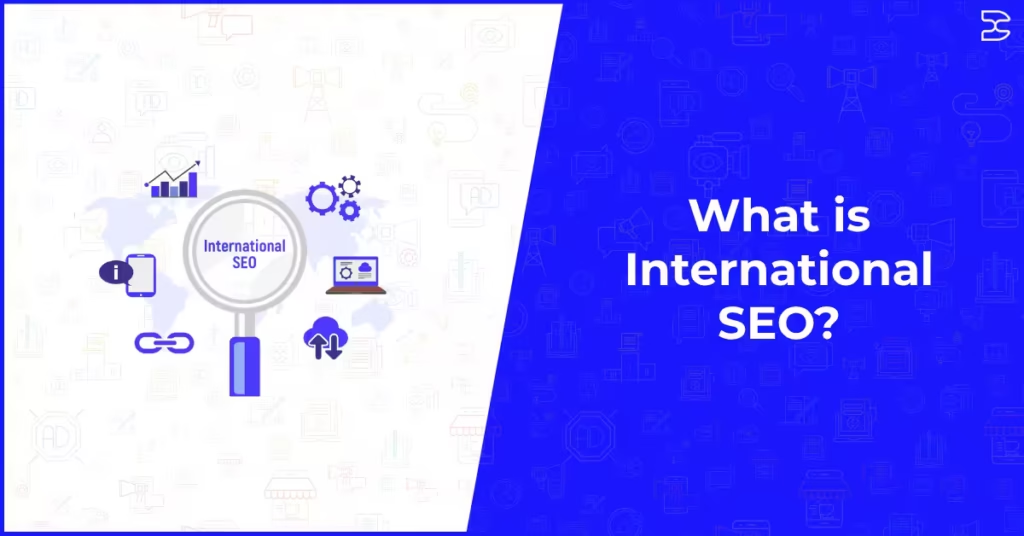
International Search Engine Optimization (SEO) is the strategic process of optimizing your website so that search engines can easily identify which countries you want to target and which languages you use for business.
It is the digital equivalent of opening a branch office in a new country. You are giving search engines the exact geographical and linguistic signals they need to confidently serve your website to users in different parts of the world.
International SEO is generally broken down into two distinct approaches:
- Multilingual SEO: Optimizing your site for different languages (e.g., translating your English site into French and Spanish), regardless of where the user lives.
- Multiregional SEO: Optimizing your site for users in different countries who might speak the same language (e.g., targeting users in the US, the UK, and Australia with region-specific English pages).
This may also help you – Why SEO Still Matters More Than Ever in 2026
Why Small Businesses and Startups Need International SEO
Many founders assume international SEO is a luxury reserved for massive, multinational corporations. In 2026, this is a dangerous misconception. If you have a digital product, a SaaS platform, or an e-commerce store with international shipping capabilities, global SEO is your most cost-effective scaling mechanism.
1. Exponentially Expanding Your TAM (Total Addressable Market)
If you only optimize for your home country, you are artificially capping your revenue. International SEO allows you to take a product you have already built and put it in front of millions of net-new buyers without the massive overhead of hiring physical sales teams in foreign countries.
2. Hedging Against Local Economic Downturns
Relying entirely on one domestic market is a commercial risk. If your home country experiences an economic dip or sudden regulatory changes, your revenue plummets. A strong international organic presence diversifies your income streams, making your business vastly more resilient.
3. Lower Customer Acquisition Costs (CAC) in Emerging Markets
While ranking on the first page of Google in the United States or the UK is brutally competitive and expensive, ranking for those exact same commercial keywords in emerging markets (like parts of Latin America, Southeast Asia, or Eastern Europe) is often significantly easier. You can capture massive market share simply by being the first competitor to properly localize your content.
The Technical Blueprint: Choosing Your URL Structure
The most critical decision you will make in international SEO is how you structure your website’s addresses. Search engines need a clear roadmap to understand which pages belong to which country. You have three primary options, and your choice will directly impact your budget and commercial success.
1. Country Code Top-Level Domains (ccTLDs)
- Example: yourbrand.fr (France), yourbrand.co.uk (UK).
- The Pros: This sends the absolute strongest geographic signal to search engines and users. A consumer in Germany intrinsically trusts a .de website more than a .com.
- The Cons: It is incredibly expensive and time-consuming. You have to purchase, build, and maintain a completely separate website for every country. Furthermore, your SEO authority does not easily share between sites; you have to build links to your .fr site from scratch.
- Best For: Massive enterprises with deep pockets and dedicated local marketing teams.
2. Subdomains
- Example: fr.yourbrand.com (France), uk.yourbrand.com (UK).
- The Pros: Easier to set up than ccTLDs, and they allow you to keep everything under your primary .com brand umbrella.
- The Cons: Search engines often treat subdomains as entirely separate entities. The SEO authority you built on your main site might not perfectly flow to your new subdomains.
- Best For: Companies whose international branches operate almost entirely independently from the main headquarters.
3. Subdirectories (The Startup Sweet Spot)
- Example: yourbrand.com/fr/ (France), yourbrand.com/uk/ (UK).
- The Pros: This is the most commercially viable option for startups and small businesses. All your international content lives in folders on your main website. This means the SEO authority (link juice) you have already built on your .com instantly trickles down and helps your international pages rank faster. It is also the cheapest and easiest to maintain.
- The Cons: It provides a slightly weaker geographic signal to users than a ccTLD.
- Best For: Startups, lean marketing teams, and growing e-commerce stores.
The Magic Code: Hreflang Tags
If you target multiple English-speaking countries (like the US, UK, and Canada), you will naturally have multiple pages on your site with almost identical content. In traditional SEO, Google penalizes “duplicate content.”
How do you prevent Google from penalizing you for having a US pricing page and a UK pricing page that look exactly the same?
You use hreflang tags.
Hreflang is a small snippet of HTML code placed in the backend of your website. It acts as a traffic cop. It explicitly tells Google: “Hey, I know these two pages look identical. But please show the /us/ page to people searching from America, and show the /uk/ page to people searching from London.” Without perfectly implemented hreflang tags, your international SEO strategy will collapse. Your US and UK pages will compete against each other in the search results, driving down the rankings for both.
Localization vs. Translation (The Conversion Killer)
The biggest commercial mistake companies make when expanding globally is relying entirely on automated AI translations or generic plugins to translate their website.
Translation is swapping English words for Spanish words.
Localization is adapting your commercial message to the cultural, economic, and linguistic realities of the target market.
If a user in Mexico lands on your Spanish-translated page, but your prices are still listed in US Dollars, your measurements are in inches instead of centimeters, and your checkout page asks for a “Zip Code” instead of a “Código Postal,” they will abandon their cart immediately.
Furthermore, keywords do not translate directly. The most popular search term for “car insurance” in the US might translate to something completely different in Spain. You must conduct native keyword research for every single market you enter. If you sound like a robot that used Google Translate, you destroy the “Authenticity Premium” required to close a sale in 2026.
Building Local Authority (E-E-A-T)
Finally, just because you launched a localized page in Germany does not mean Google will instantly trust you. Search algorithms rely heavily on E-E-A-T (Experience, Expertise, Authoritativeness, and Trustworthiness).
To rank in a new country, you must prove you are an active participant in that local digital ecosystem.
- Local Link Building: Getting a backlink from the New York Times is great for your US SEO, but it does very little for your Japanese SEO. You must earn links from reputable .jp websites, local industry blogs, and regional news outlets.
- Local Trust Signals: Display local phone numbers, local office addresses (if applicable), and reviews from customers within that specific country.
Conclusion: A Compounding Global Asset
I will be completely straightforward: International SEO is technically complex and requires meticulous execution. It is not a flip you switch overnight.
However, the commercial payoff is unparalleled. Instead of fighting tooth and nail for a fraction of a percent of market share in your hyper-competitive domestic market, international SEO allows you to seamlessly plant your flag in high-growth economies around the world. By choosing the right URL structure, implementing flawless hreflang tags, and obsessing over true cultural localization, you transform your website from a local storefront into a 24/7 global revenue engine.
The world is searching for what you sell. It is time to make sure they can find you.
Our Latest Posts
Technical SEO vs On-Page SEO – Xpro Digitals
Common SEO Mistakes Businesses Make – Xpro Digitals