How Long Does SEO Take to Show Results? The Honest Answer for 2026
Introduction: Why the Most Common SEO Answer Frustrates Businesses
Ask any SEO specialist how long SEO takes to work and you will almost certainly hear the same answer: three to six months. Sometimes twelve months. It depends. This answer is not wrong, but it tells you almost nothing useful about your specific situation and does nothing to ease the pressure of investing in a channel that takes time to prove itself.
The pain is real. You are spending money on SEO every month. Your paid advertising produces leads this week. Your boss or your investors want to see ROI. And your SEO agency keeps talking about patience, foundations, and long-term strategy while the organic traffic dashboard barely moves.
The frustrating reality is that most businesses go into SEO with timeline expectations shaped by marketing materials rather than by the actual mechanics of how search rankings develop. When reality does not match those expectations, it either leads to pulling investment too early (before SEO momentum has built) or continuing investment without the right benchmarks to know whether something is wrong.
This guide gives you the honest, specific answer to how long SEO takes. Not a general range but a framework that explains what determines your specific timeline, what results to expect at each stage of an SEO programme, where the realistic benchmarks are for different business types and competitive contexts, and what you can do to accelerate results without compromising long-term performance.
For the foundational understanding of what SEO actually is before exploring timelines, our guide on what SEO is and how it works gives the complete picture that makes every timeline in this guide more meaningful.
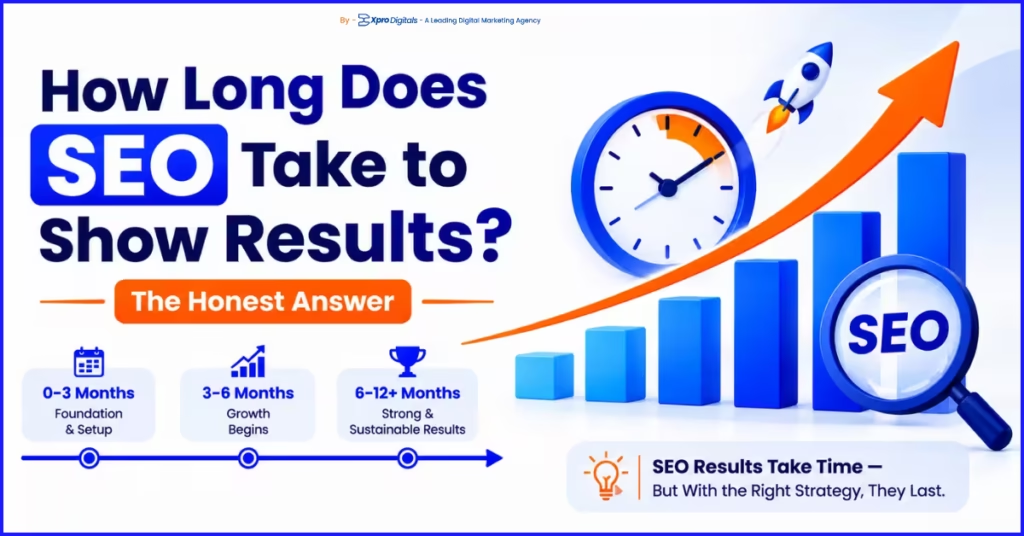
The Honest Answer: SEO Takes 3 to 12 Months for Most Businesses
The three to twelve month range is accurate for most businesses. But that range is so wide it is nearly useless without context. The actual position within that range depends on seven specific factors that determine how fast your rankings develop and when they translate into meaningful business outcomes.
Here is what we have observed across client accounts. Businesses with new domains, no existing SEO foundation, and competitive target keywords sit at the twelve-month end of the range. Businesses with established domains, existing authority, clear technical issues that can be quickly fixed, and lower-competition keywords can see meaningful results in six to eight weeks.
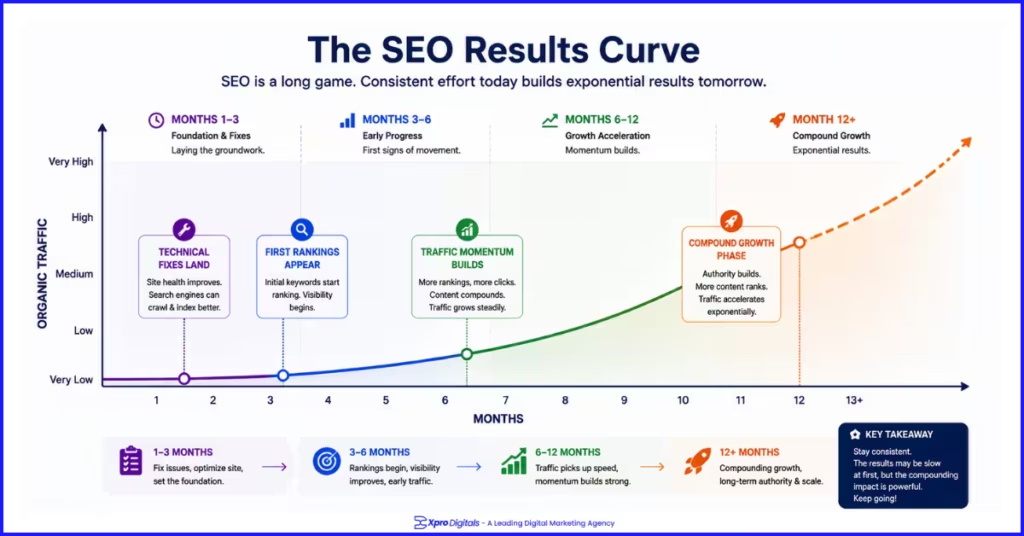
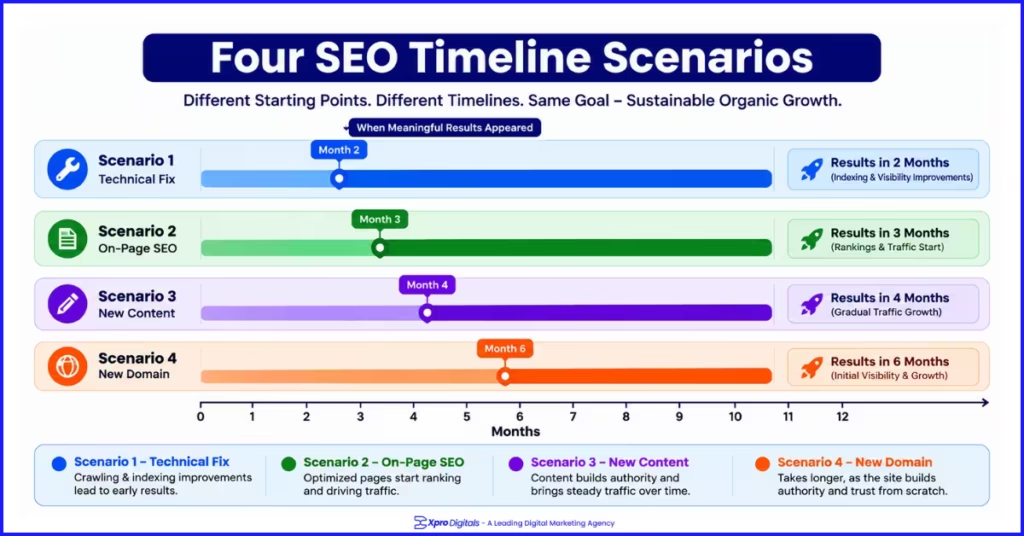
The most important insight is that SEO results do not arrive uniformly. They arrive in stages. Technical fixes land first and often produce rapid early gains. Content improvements on existing pages produce results in four to eight weeks. New content targeting lower-competition keywords produces rankings in six to twelve weeks.
Competitive keyword rankings take three to twelve months depending on the market. Authority-building results through link acquisition take the longest, often six to eighteen months to meaningfully influence competitive positions.
Understanding these stages prevents two of the most common and most costly SEO mistakes: stopping investment during the slow early phase when foundations are being built but results are not yet visible, and having unrealistic expectations about when competitive keyword rankings will materialise.
The Seven Factors That Determine Your Specific SEO Timeline
Factor 1: Domain Age and Existing Authority
A domain with ten years of history, accumulated backlinks, and existing Google trust ranks faster than a new domain for equivalent content and optimization. Google applies additional scrutiny to new domains, sometimes called the Google Sandbox effect, that slows early ranking development even when technical and content quality are strong.
For new domains, expect the first six months to be foundation-building with limited visible ranking gains. From month six onward, rankings typically begin moving more consistently if the investment has been sustained. For established domains with existing authority, even modest on-page improvements can produce ranking gains within weeks because the domain credibility already exists.
Factor 2: Keyword Competition Level
Competition level is the most variable factor in SEO timelines. A local plumber targeting ’emergency plumber [small town]’ faces different competition than an ecommerce retailer targeting ‘mens running shoes’. The first may achieve page one in six to ten weeks. The second may take eighteen months even with substantial investment.
Before starting any SEO programme, understand the competitive landscape for your target keywords. Keyword difficulty scores in tools like Ahrefs or Semrush give an approximate measure. More usefully, look at the domain rating and referring domain counts for the top-ranking pages. If the page one results are dominated by sites with hundreds of thousands of backlinks, earning your own page one position will take proportionally longer.
Factor 3: Technical SEO Starting Point
A site with significant technical blockers, such as important pages set to no-index, crawl budget wasted on filter URLs, or Core Web Vitals failures, can see rapid ranking improvements once those issues are fixed. The underlying content and intent alignment may already be strong. The technical problems are simply preventing Google from accessing, evaluating, and ranking pages at their potential.
We fixed a robots.txt error on a B2B services company that had blocked their entire blog directory for nine months. Within five weeks of removing the block and resubmitting the sitemap, 47 previously invisible posts began ranking. Organic blog traffic went from near zero to 2,800 monthly sessions without publishing a single new post. The fix was technical, not content. The timeline was weeks, not months.
Factor 4: Content Quality and Search Intent Alignment
Pages that genuinely match search intent and cover their topic more completely than competing pages rank faster and hold rankings more sustainably than pages built around keywords without intent research. Content that mismatches intent (informational content targeting transactional keywords, for example) will underrank regardless of technical perfection.
When new content is published with strong intent alignment and genuine depth, rankings for lower-competition keywords can appear within four to eight weeks. For higher-competition keywords, rankings take longer regardless of content quality because authority signals take time to develop through backlink acquisition and engagement data.
Factor 5: Investment Level and Consistency
SEO produces results proportional to investment, up to the point where your market’s competitive ceiling is reached. More content published more frequently builds topical authority faster. More active link building accelerates authority development. More thorough technical optimization removes more barriers to ranking.
Critically, consistency matters more than intensity. A business that invests moderately in SEO every month for twelve months consistently outperforms one that invests heavily for three months and then pauses. Google’s assessment of your domain builds over time through consistent signals. Inconsistent investment produces inconsistent signals and slower compounding.
Factor 6: Competitive Activity
Your ranking timeline is not just about your site. It is about how your site performs relative to competing sites that are also actively investing in SEO. If your competitors are publishing more content, earning more links, and improving their technical quality faster than you, your relative position may not improve even if your absolute SEO quality is rising.
In highly competitive markets, maintaining existing positions requires sustained investment. Growing positions requires outpacing competitors, not just reaching a standard. This is why SEO in competitive markets takes longer and requires higher investment than SEO in less contested spaces.
Factor 7: Google’s Crawl and Index Frequency
Google does not continuously reassess every page on your site. It crawls pages based on their perceived importance (influenced by internal links, backlinks, and publishing frequency) and reassesses rankings on its own schedule.
A technical fix implemented today may not be reflected in rankings until Google next crawls the affected pages, which could be days or weeks depending on your site’s crawl priority.
You can accelerate crawl frequency by submitting updated sitemaps in Google Search Console, building internal links to new or updated pages, and increasing your publishing frequency to signal an active, regularly updated site. These actions encourage more frequent recrawling but cannot guarantee same-day ranking changes.
What to Expect at Each Stage of an SEO Programme
| Stage | Timeframe | What Happens | What to Measure |
| Foundation | Months 1-2 | Technical audit and fixes, keyword research, on-page improvements begin | Coverage errors in GSC, Core Web Vitals scores, crawl report |
| Early Movement | Months 2-4 | Technical fixes land in rankings, first on-page improvements show movement, lower-competition keywords begin ranking | Position changes for target keywords, organic impressions growth |
| Momentum | Months 4-8 | Content compounds, authority builds, medium-competition keywords enter top 20, organic traffic grows meaningfully | Organic sessions, keyword ranking distribution, CTR improvements |
| Growth | Months 8-14 | Competitive keywords move to page one, topical authority established in primary topic areas, organic leads or sales measurable | Organic conversions, organic revenue, competitive keyword positions |
| Compound Returns | Month 14+ | Rankings strengthen without proportional cost increases, new content ranks faster due to established authority | CAC from organic, organic revenue share, returning ranking velocity |
Real SEO Timelines From Client Engagements
Case Study 1: Technical Quick Win (6 Weeks)
A professional services firm had published 60 blog posts over 14 months with almost no organic traffic. Their blog directory was blocked in robots.txt from a staging environment setting carried into production.
We removed the block and resubmitted the sitemap. Within six weeks, 41 posts were indexed. Organic traffic to the blog went from 180 monthly sessions to 4,200 monthly sessions. Zero new content was published. The result was entirely from a technical fix.
Timeline: 6 weeks.
Investment: Technical audit and one robots.txt edit. This is the fastest category of SEO result and occurs only when a technical blocker is discovered that unlocks already-strong existing content.
Case Study 2: On-Page optimization on Existing Pages (8-12 Weeks)
A local accountancy firm had 12 service pages ranking in positions 15 to 30 for their target keywords. We rewrote title tags, updated H1 headings to include target keywords, expanded thin content sections, added schema markup, and built internal links from related blog posts. No new pages were created. Over 10 weeks, 9 of the 12 pages moved into the top 10. Organic enquiry volume increased 68%.
Timeline: 8 to 12 weeks.
This is the second-fastest category: improving existing pages that already have some ranking signal but are held back by weak on-page signals.
Case Study 3: New Content in Medium Competition Market (4-6 Months)
A UK software company entered a new content topic area targeting B2B project management keywords with medium competition. We published eight well-researched long-form guides targeting specific topic clusters. By month four, four of the eight guides were ranking in positions eight to fifteen. By month six, two had reached positions three to five and were generating consistent organic traffic.
Timeline: 4 to 6 months.
Investment: Content strategy, keyword research, eight long-form guides. This is the standard timeline for new content in medium-competition markets on a domain with existing authority.
Case Study 4: Competitive Market with New Domain (14-18 Months)
A new ecommerce store in the sportswear category launched with strong technical foundations and a content-first strategy. By month six, they ranked for 40 long-tail product terms with low competition. By month twelve, they ranked in the top 20 for five medium-competition category terms. By month sixteen, two category pages had reached page one. Organic revenue by month eighteen was 22% of total revenue.
Timeline: 14 to 18 months to meaningful competitive rankings.
Investment: Ongoing technical, content, and link building programme. This is the realistic timeline for new domains entering competitive ecommerce markets.
SEO Timeline by Business Type
| Business Type | Expected First Results | Meaningful Traffic | Competitive Rankings | Key Accelerator |
| Local service business (low competition) | 4 to 8 weeks | 2 to 4 months | 3 to 6 months | Google Business Profile + reviews |
| Local service business (competitive city) | 6 to 12 weeks | 3 to 6 months | 6 to 12 months | Local link building + review volume |
| Small ecommerce (niche market) | 8 to 14 weeks | 4 to 7 months | 6 to 12 months | Product and category page optimization |
| Large ecommerce (competitive market) | 3 to 6 months | 6 to 12 months | 12 to 24 months | Technical SEO + content at scale |
| B2B professional services | 6 to 12 weeks | 3 to 6 months | 6 to 14 months | Thought leadership content + E-E-A-T |
| New domain any sector | 3 to 6 months | 6 to 12 months | 12 to 24 months | Technical perfection from launch |
| Established domain (existing authority) | 2 to 6 weeks | 2 to 4 months | 4 to 10 months | On-page quick wins on existing pages |
What Good SEO Progress Looks Like Month by Month
Month 1 to 2: Foundation Phase
This phase produces almost no visible ranking changes. The right activities are happening but their effects are not yet visible in rankings. Technical audits are running, on-page optimizations are being implemented, keyword research is informing content strategy, and the first pieces of content are being published. The correct metric to track in this phase is not rankings but audit completion and deliverable quality.
What you should see: a technical audit report with prioritised findings, a keyword map with target pages assigned, on-page improvements implemented on priority pages, Google Search Console set up and baseline metrics documented.
Month 3 to 4: Early Movement Phase
Rankings begin to move for lower-competition keywords. Technical fixes that were implemented in months one and two start showing in Google Search Console as pages improve positions or previously excluded pages enter the index.
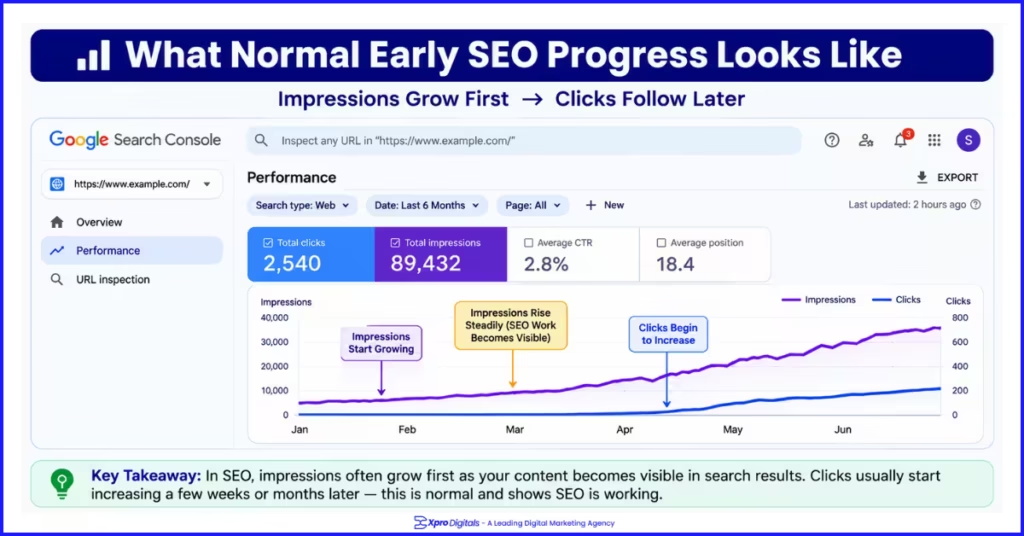
Organic impressions grow in GSC even where clicks remain low, indicating that more queries are finding your pages but positions have not yet reached click-generating territory.
What you should see: 10 to 20% growth in organic impressions in GSC, position improvements on pages where technical and on-page fixes were applied, first rankings appearing for long-tail and lower-competition target keywords.
Month 5 to 8: Momentum Phase
Organic traffic grows noticeably for the first time. Pages optimized in the foundation phase have been recrawled and reassessed. Content published in the early phase is ranking and driving clicks.
Link building activity is beginning to improve domain authority signals. The relationship between investment and visible results becomes clearer in this phase.
What you should see: consistent month-on-month organic traffic growth, multiple target keywords entering positions five to fifteen, first organic leads or sales appearing in conversion tracking, improving CTR on pages where title tags and meta descriptions were optimized.
Month 9 to 14: Growth Phase
Competitive keywords begin entering the top ten. Domain authority has built sufficiently to compete for medium-difficulty queries. The content cluster you have been building generates authority signals that lift all pages in the cluster, not just the individual pages that have earned links. Organic leads and sales are measurable and growing consistently.
What you should see: page one rankings for medium-competition keywords, organic traffic composing a meaningful percentage of total traffic, organic CAC tracking below paid CAC for equivalent customers, organic revenue contributing measurably to business targets.
Month 15 and Beyond: Compound Growth Phase
New content ranks faster than it did in the early months because domain authority is established. Existing ranked pages accumulate additional links and engagement signals, improving their positions further without incremental investment. The cost per organic customer continues falling as the investment amortises across growing traffic and revenue.
This is the phase where SEO’s financial advantage over paid channels becomes most visible. Understanding how SEO investment builds compounding returns is essential for setting long-term budget strategy.
Our guide on how SEO impacts your business and website covers the financial case for sustained SEO investment including the CAC comparison data across channels.
How to Get Faster SEO Results Without Shortcuts
There are legitimate strategies that accelerate SEO results without risking the penalties that come from black hat tactics. These strategies work with Google’s systems rather than against them.
Strategy 1: Fix Technical Blockers First
Identify and fix any crawlability or indexation problems in the first two weeks of an SEO programme. These fixes can produce rapid ranking improvements for content that is already strong but invisible due to technical barriers. This is the fastest SEO return available and should always be the first investment.
Strategy 2: Optimize Existing Pages Before Creating New Ones
Pages that already rank in positions five to thirty have demonstrated enough relevance to compete. Improving their title tags, content depth, schema markup, and internal linking can move them to page one faster than creating entirely new pages targeting equivalent keywords. The existing page has some authority signals already working in its favour.
Strategy 3: Target Lower-Competition Keywords First
Long-tail keywords with three or more words and specific intent have lower competition than broad head terms and produce rankings faster. A new fitness equipment store targeting ‘adjustable dumbbell sets for small home gyms’ will rank faster than one targeting ‘dumbbells’. Lower-competition rankings build domain authority signals that eventually support more competitive keyword rankings.
Understanding how to identify the right keywords for fast early wins requires market-specific research.
Our guide on ecommerce keyword research and finding high-intent product keywords covers the keyword identification process for product-focused businesses targeting early traction alongside longer-term competitive terms.
Strategy 4: Build Internal Links to Priority Pages
Every internal link to a page passes some authority and signals to Googlebot that the page is important enough to crawl more frequently. Building internal links from your highest-authority existing pages to newly published or recently optimized pages accelerates their ranking development. This is free, immediate, and consistently underused.
Strategy 5: Earn Local Links and Reviews Quickly
For local businesses, Google Business Profile reviews and locally relevant backlinks have an outsized impact on local pack and local organic rankings.
A focused 30-day review generation campaign can produce enough new reviews to improve Map Pack positioning within weeks. Local citations from relevant directories provide quick, accessible authority signals.
Local SEO has the fastest results timeline of any SEO category for businesses with a geographic focus.
Our guide on why local SEO is vital for small businesses covers the complete local search strategy with specific timelines for each signal type.
Warning Signs That Your SEO Is Not On Track
Not all flat results mean SEO is working slowly. Some flat results mean SEO is not working at all. Knowing the difference prevents you from continuing to invest in a programme that has a fundamental problem rather than just a normal slow start.
SEO Is Progressing Normally If
| Positive Indicator | What It Means |
| GSC impressions growing even if clicks are flat | Pages are appearing in more searches, positions improving |
| Coverage errors reducing over time | Technical fixes are landing correctly |
| Long-tail keywords showing first rankings | Content is relevant, lower-competition traction developing |
| Core Web Vitals scores improving | Technical performance improvements registering in Google’s field data |
| Organic traffic growing 5-15% month on month | Normal compound growth trajectory in early stages |
SEO May Have a Genuine Problem If
| Warning Sign | Likely Cause | Action Required |
| Zero growth in organic impressions after 3 months | Indexation or crawlability problem | Full technical audit immediately |
| Rankings appear then immediately disappear | Content quality or thin content assessment | Content quality review and improvement |
| Only unrelated or irrelevant keywords ranking | Keyword strategy or intent mismatch | Keyword and content strategy review |
| Technical fixes implemented but nothing changing | Fixes not correctly deployed or Google not yet recrawled | Verify implementation, resubmit sitemap |
| Competitor rankings growing while yours are flat | Outcompeted on authority, content, or technical quality | Competitive analysis and strategy adjustment |
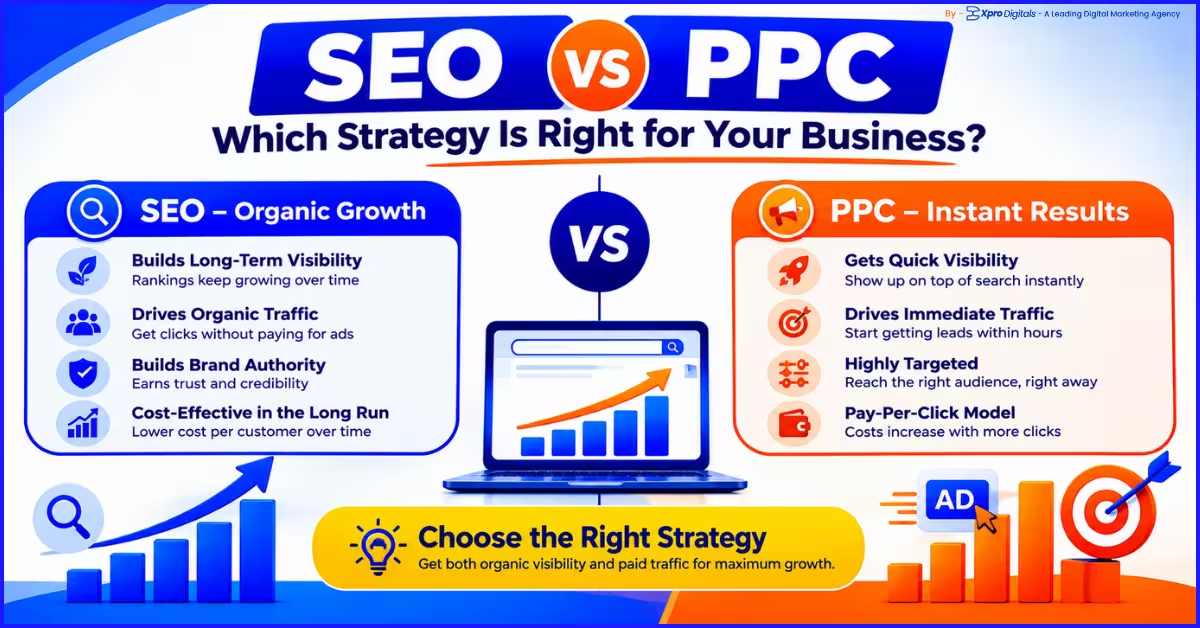
SEO vs PPC: Which Gets Results Faster and When Each Makes Sense
| Factor | SEO | PPC (Google Ads) |
| Time to first results | Weeks to months depending on starting point | Hours to days after campaign launch |
| Cost trajectory | Front-loaded, reduces over time as rankings compound | Fixed or rising cost per click regardless of duration |
| Results when you stop | Rankings persist and decay slowly | Traffic stops immediately |
| Brand credibility signal | Organic rankings build implied trust | Ad labels reduce trust vs organic for many searchers |
| Keyword targeting flexibility | Limited to what you can rank for organically | Immediate targeting of any keyword at any time |
| Best use case | Long-term traffic and lead generation, building brand authority | Immediate traffic, testing, seasonal campaigns, new launches |
| Combined strategy | SEO provides long-term floor, PPC fills short-term gaps | Best outcome when both run simultaneously with shared data |
For a detailed analysis of when to prioritise each channel and how to allocate budget between SEO and paid search, our guide on SEO vs PPC: which strategy is right for your business covers the decision framework with real examples by business type and growth stage.
People Also Ask: How Long Does SEO Take
How Long Does It Take for a New Website to Rank on Google?
A new website typically takes six to twelve months to rank competitively for its target keywords. The first three to four months establish domain credibility with Google.
From month four onward, lower-competition keywords begin ranking as content quality and technical signals accumulate.
Competitive keyword positions on page one generally take twelve to twenty-four months for new domains entering established markets. The timeline shortens significantly if the domain targets low-competition niche keywords from the start.
Can SEO Show Results in 30 Days?
Yes, in specific circumstances. Technical fixes that remove crawlability or indexation blockers can produce ranking improvements within two to four weeks as Google recrawls affected pages.
If a site has previously blocked important pages in robots.txt or had widespread no-index tags applied accidentally, removing those blockers can unlock rankings rapidly. New content does not rank in 30 days in most cases, but existing content freed from technical barriers can.
How Long Does Local SEO Take to Show Results?
Local SEO produces the fastest results of any SEO category. Google Business Profile improvements (adding photos, completing service listings, updating information) can influence Map Pack rankings within two to four weeks.
A focused review generation campaign producing 20+ new genuine reviews can improve local pack position within six to eight weeks. Full local search visibility including local organic rankings typically develops over three to six months.
Is Six Months Enough Time to See SEO Results?
For most businesses, six months of consistent SEO investment produces measurable results: growing organic impressions, first page rankings for lower-competition keywords, and beginning organic traffic volume. Significant organic revenue contribution and competitive keyword rankings typically take nine to fourteen months.
Whether six months is enough to justify continued investment depends on the quality of work done in those months and whether the metrics are on a positive trajectory even if the absolute numbers are still small.
Why Is My SEO Not Working After 3 Months?
Three months is early in an SEO timeline and flat results are often normal rather than indicative of a problem.
However, three specific warning signs suggest something may genuinely be wrong: Google Search Console shows zero growth in organic impressions (not just clicks), the Coverage Report shows new indexation errors rather than improving coverage, or the same issues identified in the initial technical audit are still unfixed.
If any of these apply, request a specific progress review from your SEO provider with evidence of what has actually been implemented.
Does SEO Get Faster Over Time?
Yes. This is the compounding characteristic of SEO that makes it more valuable over time. As domain authority builds, new content ranks faster than early content because Google already trusts the domain as a credible source.
A page published on an established domain with 200 referring domains ranks for its target keyword significantly faster than the same page on a new domain with 5 referring domains. The investment gets more efficient over time rather than less.
What Is the Fastest Way to Rank on Google?
The fastest legitimate path to Google rankings is targeting low-competition long-tail keywords with well-optimized content on an established domain.
For new domains, there is no shortcut past the authority-building phase other than acquiring an established aged domain.
For any domain, fixing technical blockers is the single fastest action because it can unlock existing content immediately without the content creation or authority-building timeline.
How Long Does It Take SEO to Pay Off?
SEO typically crosses the ROI threshold (where cumulative organic revenue exceeds cumulative SEO investment) between months twelve and twenty-four for most businesses. Businesses with lower-competition markets, quick technical wins, or existing domain authority may cross this threshold sooner.
Businesses in highly competitive markets with new domains may take twenty-four to thirty months. After the crossover point, organic revenue continues growing while incremental SEO costs stabilize, producing continuously improving ROI.
How Long Does It Take to Get to Page One of Google?
The timeline to page one depends almost entirely on keyword competition. For low-competition long-tail keywords (keyword difficulty under 20 in Ahrefs), a well-optimized page on an established domain can reach page one within six to twelve weeks.
For medium-competition keywords (difficulty 30-50), six to twelve months is realistic with consistent link building. For high-competition keywords dominated by major brands (difficulty 60+), twelve to thirty-six months of sustained investment is typically required.
Does Blogging Help SEO and How Quickly?
Blogging helps SEO by building topical authority, targeting informational keywords, and creating internal linking opportunities to commercial pages. Individual blog posts targeting long-tail informational keywords can rank within four to eight weeks on established domains.
The cumulative effect of a consistent blogging programme on topical authority and domain authority becomes visible over six to twelve months as Google recognises your domain as a credible source across your topic area.
Can I Speed Up SEO With a Bigger Budget?
Yes, within limits. A larger budget allows more content production, more active link building, and faster technical implementation, all of which can accelerate results. However, budget cannot substitute for time when it comes to building domain authority with a new domain.
Google’s trust in a domain builds over time through consistent signals, not through intensity of investment in a single month. A larger budget accelerates the trajectory but cannot bypass the foundational stages.
What Happens to SEO Results if I Stop?
Rankings built through genuine white hat SEO, quality content and legitimate backlinks, do not disappear overnight. They decay gradually as competitors continue improving. In competitive markets, significant decay can occur within six to twelve months of stopping investment.
In less competitive markets, rankings may hold for eighteen to twenty-four months with minimal maintenance. The rate of decay accelerates if competitors are actively investing while you are not.
How Long Does It Take for Google to Index New Content?
New content on established, frequently crawled domains can be indexed within hours to days of publication. New content on less frequently crawled sites may take one to four weeks.
Submitting the page URL directly through Google Search Console URL Inspection and requesting indexing is the fastest way to trigger crawling. Including the new page in your XML sitemap and building at least one internal link to it from an existing crawled page also accelerates discovery.
Is There a Difference Between SEO Results for Small vs Large Businesses?
Yes, primarily in timeline and investment requirements. Small businesses often have the advantage of targeting less competitive local or niche keywords where results develop faster. Large businesses targeting national or global competitive terms face longer timelines and higher investment requirements.
However, large established brands with strong domain authority rank new content faster than small businesses because domain trust is already established. The competitive context and target keyword set matter more than business size in determining SEO timeline.