What is SEO?
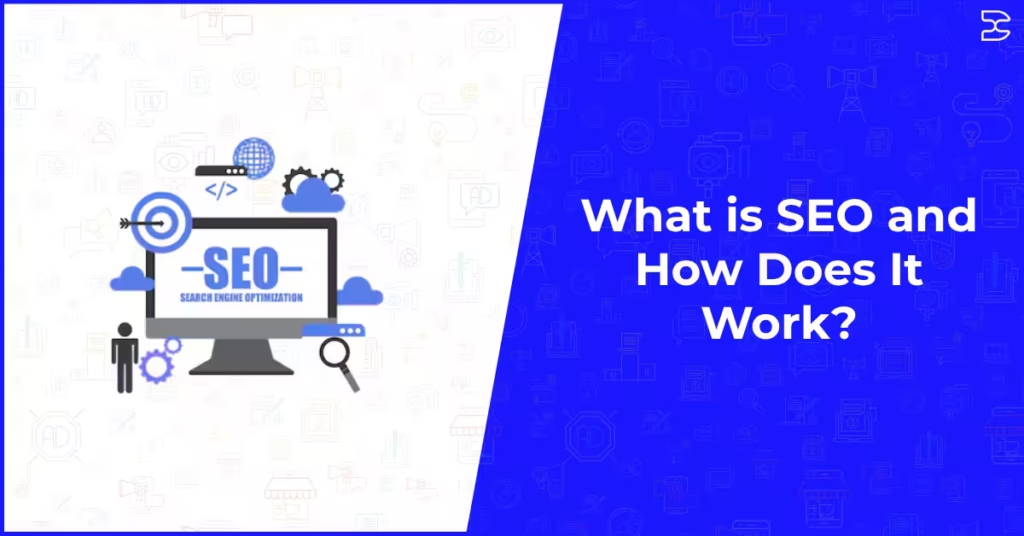
SEO (Search Engine Optimization) is the process of optimizing a website and its content to rank higher in unpaid search engine results pages (SERPs), with the goal of attracting more relevant organic traffic from Google, Bing, and other search engines.
Think of SEO as the art and science of speaking Google’s language. Every time someone searches for something online, search engines scan billions of web pages and decide – in milliseconds – which results best answer the query. SEO is about making sure your page is one of those top answers.
Unlike paid advertising (PPC), where visibility disappears the moment you stop spending, SEO builds a long-term traffic asset. A well-optimized page can generate consistent organic visits for years, delivering compounding ROI that no paid channel can match.
The term was first coined in the mid-1990s as the commercial internet exploded. Today, with Google processing over 8.5 billion searches per day, SEO has become one of the most powerful digital marketing channels on the planet.
This may also help you – Technical SEO vs On-Page SEO
How Does SEO Work?
Search engines have one goal: to provide users with the most relevant, trustworthy, and useful result for any given query. To do this, they follow a three-stage process before your page ever appears in results.
Stage 1: Crawling
Search engines deploy automated programs called crawlers (or spiders) that continuously browse the web, following links from page to page. Google’s primary crawler, Googlebot, discovers new and updated content by following links, processing sitemaps, and revisiting known URLs. A page that cannot be crawled simply does not exist in Google’s eyes.
Stage 2: Indexing
Once a page is crawled, Google analyzes its content – text, images, structured data, metadata – and stores it in its massive search index (essentially, a copy of the web). Not every page gets indexed; Google filters out duplicate content, thin pages, pages blocked by no-index directives, and content it deems low-quality.
Stage 3: Ranking
When a user submits a query, Google’s algorithm evaluates every relevant indexed page against 200+ ranking factors – content quality, backlinks, page experience, E-E-A-T (Experience, Expertise, Authoritativeness, Trustworthiness), and more – and returns results in order of relevance and authority. SEO is the practice of optimizing for these factors.
The Three Pillars of SEO
Modern SEO breaks down into three interconnected disciplines. Neglect any one of them and your organic growth will hit a ceiling.
1. On-Page SEO
On-page SEO starts with keyword research – understanding exactly what words and phrases your target audience types into Google. Tools like Google Keyword Planner, Ahrefs, or Semrush reveal search volume, competition level, and user intent for any keyword.
Once you identify your target keywords, weave them naturally into your page: the title tag (ideally within the first 60 characters), the H1 heading, the first 100 words of your content, subheadings, image alt text, and the URL slug. But keyword stuffing is counterproductive – Google’s algorithms are sophisticated enough to understand semantic relevance, rewarding content that thoroughly covers a topic.
Pro Tip: Target one primary keyword per page, but support it with 4–6 semantically related terms (LSI keywords). This signals topical authority to Google and helps you rank for dozens of related long-tail queries simultaneously.
This may also help you – White Hat vs Black Hat SEO
2. Off-Page SEO
A backlink – a link from another website pointing to yours – is still one of the most powerful ranking signals Google uses. Quality always trumps quantity. A single backlink from a high-authority domain like Forbes, a university website, or an industry leader carries more weight than 100 links from obscure directories.
Earning quality backlinks requires creating genuinely link-worthy content – original research, in-depth guides, data-driven studies, free tools – and promoting it through digital PR, guest posting on reputable sites, and relationship-building within your industry.
3. Technical SEO
You can write the best content in the world, but if your site takes 8 seconds to load or is not mobile-friendly, Google will deprioritize it. Google’s Core Web Vitals – measuring Largest Contentful Paint (LCP), Interaction to Next Paint (INP), and Cumulative Layout Shift (CLS) – are direct ranking factors that measure real-world page experience.
Technical SEO also encompasses structured data markup (Schema.org), which helps Google understand your content type – whether it’s a recipe, article, FAQ, or product – and powers rich results like star ratings, FAQ dropdowns, and recipe cards in the SERPs.
Key Google Ranking Factors in 2026
While Google keeps its exact algorithm confidential, years of studies, experiments, and the 2024 Google API leak have given SEOs a clear picture of what moves the needle most. The following factors carry the highest weight:
- Content Quality & Depth – Cover topics comprehensively; satisfy user intent fully.
- Backlink Authority – Earn links from high-authority domains in your niche.
- E-E-A-T Signals – Author bios, credentials, citations, and trust signals.
- Core Web Vitals – LCP under 2.5s, INP under 200ms, CLS under 0.1.
- Mobile-Friendliness – Responsive design; mobile-first indexing compliance.
- Keyword Relevance – Natural integration in title, H1, URL, and body.
- Internal Linking – Distribute link equity and aid crawl depth.
- HTTPS / Security – SSL certificate installed; no mixed content.
This may also help you – What is SERP?
Why SEO Matters More Than Ever in 2026
With the rise of AI Overviews in Google Search, some marketers wondered whether SEO was losing relevance. The reality is the opposite. AI Overviews pull from authoritative, well-structured content – meaning that sites with strong SEO are more likely to be featured, not less. Appearing in an AI Overview is essentially a top-of-SERP placement with zero ad spend.
Consider the economics: the average organic click-through rate for position #1 is around 27–39%. Paid ads typically see 2–5% CTR for the same queries. SEO delivers dramatically more qualified traffic per dollar invested – and unlike PPC, that traffic does not stop when you pause your budget.
For businesses in competitive markets, SEO is a long-term moat. Brands that have invested in domain authority, content libraries, and technical infrastructure for years are extremely difficult to displace. Starting your SEO journey today means building that competitive advantage before your rivals do.
This may also help you – SEO vs PPC
How to Get Started with SEO: A Practical Roadmap
You do not need a six-figure budget or a team of 20 to start seeing SEO results. Here is a proven, beginner-friendly roadmap:
Step 1: Conduct a Technical SEO Audit
Use free tools like Google Search Console and Screaming Frog (free up to 500 URLs) to identify crawl errors, indexing issues, broken links, and pages missing title tags or meta descriptions. Fix the foundation before building on it.
Step 2: Build a Keyword Strategy
Map out 10–20 target keywords that align with your business goals. Prioritize long-tail keywords (3+ words) with clear commercial or informational intent. These have lower competition and convert better than single broad terms.
Step 3: Create Pillar Content and Topic Clusters
Build comprehensive pillar pages for your core topics, supported by cluster content targeting related subtopics. This architecture signals topical authority to Google and creates powerful internal linking opportunities.
Step 4: Earn High-Quality Backlinks
Start with linkable assets – original data, tools, or definitive guides in your niche. Reach out to industry publications with guest post pitches. Monitor competitor backlinks using Ahrefs to find link-building opportunities they have already validated.
Step 5: Measure, Iterate, and Scale
Track rankings in Google Search Console and analytics tools. Monitor organic sessions, click-through rates, and conversion events. Double down on what is working. SEO is a continuous process – the brands that win are the ones that keep optimizing.
Final Thoughts
SEO is not a one-time project – it is an ongoing investment in your digital presence. The brands that consistently show up at the top of Google search results are not there by accident. They have invested in high-quality content, earned the trust of authoritative websites, and built technically sound infrastructure that search engines can easily navigate.
Whether you are a complete beginner or a marketer looking to sharpen your skills, the foundation always remains the same: understand your audience, create content that genuinely answers their questions, earn trust through quality backlinks, and make your website technically accessible to both users and search engines.
The best time to start SEO was five years ago. The second best time is today.
Frequently Asked Questions
What is SEO in simple terms?
SEO (Search Engine Optimization) is the practice of improving a website’s visibility on search engines like Google so it ranks higher in unpaid (organic) search results. It involves optimizing your content, website structure, and earning backlinks to attract relevant traffic without paying for ads. In simple terms: SEO helps the right people find your website when they search for topics you cover.
How does SEO work step by step?
SEO works in three fundamental stages: (1) Crawling – search engine bots (like Googlebot) discover and read your webpages by following links. (2) Indexing – Google stores your content in its massive database. (3) Ranking – Google’s algorithm evaluates 200+ factors including content quality, backlinks, page speed, and user experience to determine where your page appears for a given search query. Your job as an SEO practitioner is to optimize all three stages.
How long does SEO take to show results?
Most websites begin to see measurable SEO results within 3 to 6 months. Highly competitive keywords can take 6 to 12 months or longer. New domains often experience the Google Sandbox effect – a period of 3–6 months where Google limits organic visibility while it builds trust in your domain. Low-competition, long-tail keywords can sometimes rank within 4–8 weeks with a well-optimized, authoritative page.
What are the three types of SEO?
The three main types of SEO are:
(1) On-Page SEO – optimizing individual pages through keyword usage, content quality, title tags, meta descriptions, heading structure, and internal linking.
(2) Off-Page SEO – building authority through backlinks, digital PR, and brand mentions from other websites.
(3) Technical SEO – improving website infrastructure including page speed, mobile-friendliness, crawlability, structured data, and site architecture. All three must work together for maximum organic performance.
Is SEO still relevant in 2026?
Yes – SEO is more strategically valuable than ever. Google processes over 8.5 billion searches per day, and organic results (including AI Overviews) continue to receive the vast majority of clicks. In 2026, with AI Overviews prominently featuring authoritative content, strong SEO is the primary way to be cited in AI-generated answers. Businesses that invest in SEO build a compounding, durable traffic asset that paid advertising cannot replicate.
What is the difference between SEO and SEM?
SEO (Search Engine Optimization) focuses exclusively on earning organic (unpaid) search rankings through content, technical improvements, and backlinks. SEM (Search Engine Marketing) is a broader umbrella term that encompasses both organic SEO and paid search advertising (Google Ads / PPC). The key distinction: SEO builds long-term equity and traffic that compounds over time; paid SEM delivers immediate visibility but stops generating traffic the moment you pause your spend. Most sophisticated digital strategies use both in tandem.