WhatsApp vs SMS vs Email Marketing in 2026
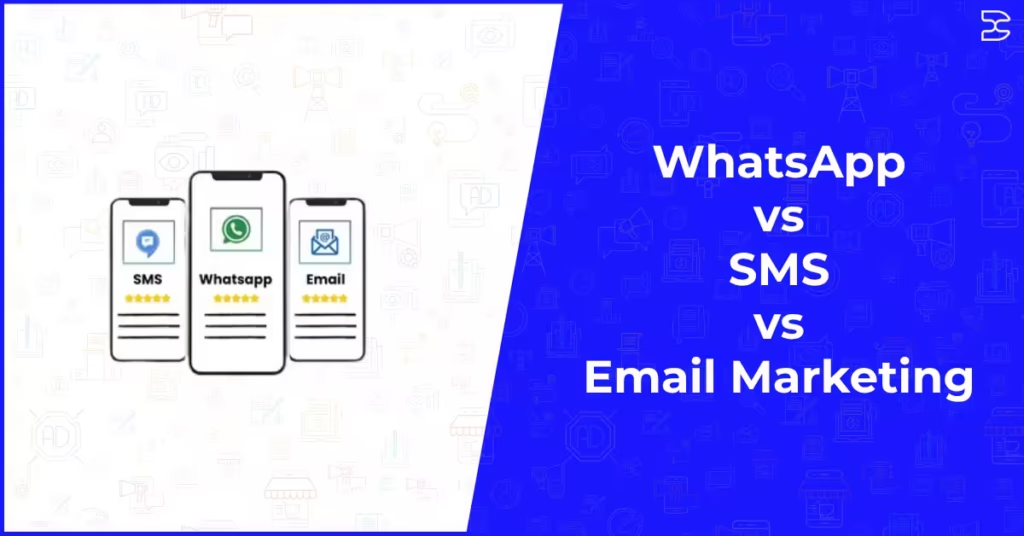
Table of Contents
ToggleWhatsApp vs SMS vs Email Marketing: Which Channel Is Right for Your Business
Choosing the right direct communication channel is one of the most consequential decisions in any digital marketing strategy. Get it right and your messages land at the right moment, in the right context, with the right audience. Get it wrong and you spend time and money on communications that go unread, generate low engagement, or feel out of place to the people receiving them.
WhatsApp, SMS, and email are the three dominant direct messaging channels available to businesses today. Each has genuine strengths, specific use cases where it excels, and limitations that make it less suited to certain types of communication. The question is not which one is universally best but which one is right for the specific message you want to send, to the specific audience you are trying to reach, and for the outcome you are trying to produce.
This guide breaks down each channel clearly across the dimensions that matter most for business use, from open rates and engagement to cost, content capability, compliance requirements, and the situations where each channel produces the strongest results.
Understanding the Three Channels
WhatsApp Marketing
WhatsApp marketing uses the WhatsApp Business Platform to send messages directly to customers and prospects who have opted in to receive communications from your business. For proactive outbound messages, businesses must use pre-approved message templates and access the platform through the official WhatsApp Business API. Messages arrive in the recipient’s personal WhatsApp inbox, where they sit alongside messages from friends and family, creating a context of personal, direct communication.
WhatsApp supports rich message formats including text, images, documents, videos, audio, and interactive buttons. It enables genuine two-way conversation, not just broadcast delivery, which makes it suitable for customer service, sales conversations, and relationship-building communication as well as for campaigns.
SMS Marketing
SMS marketing sends text messages directly to customers’ mobile phone numbers without requiring an internet connection or a specific app. Messages are delivered through mobile networks and appear in the standard messages application on any phone. SMS is universally accessible because it works on every mobile device regardless of whether it is a smartphone, what apps are installed, or whether data is enabled.
SMS is limited to 160 characters per message segment, supports only plain text in standard form, and does not natively support rich media without conversion to MMS. Its strength lies in its universality, its immediacy, and the fact that it reaches recipients without requiring any specific platform adoption on their part.
Email Marketing
Email marketing sends messages to subscribers via their email address. It is the most established digital marketing channel and supports the widest range of content formats, from short plain-text messages to richly designed HTML newsletters with embedded images, calls to action, and personalised content blocks. Email is suited to longer-form communication, nurture sequences, content delivery, and detailed promotional messaging.
Email is asynchronous by nature. Recipients check email on their own schedule, often hours or days after delivery, which means email is not the right channel for time-sensitive or urgent communications. It is, however, excellent for content-rich communications that benefit from being read at the recipient’s own pace.
Open Rates and Engagement: How the Numbers Stack Up
Open rate is the most commonly cited metric when comparing these three channels, and the differences are substantial enough to be commercially significant.
WhatsApp Open Rates
WhatsApp messages achieve open rates of between 90 and 98 percent, with the majority of messages read within five minutes of delivery. This is the highest open rate of any direct marketing channel available at scale. The personal inbox context, the notification behaviour of the platform, and the habitual daily use of WhatsApp by most recipients all contribute to this exceptional read rate. Response rates average around 40 percent, making WhatsApp the highest-engagement channel for two-way communication.
SMS Open Rates
SMS achieves open rates of between 85 and 95 percent, making it the second-highest performing channel by this measure. Like WhatsApp, SMS benefits from mobile notification behaviour and the habit of checking messages promptly. The main limitation is response rates, which are lower than WhatsApp because SMS does not facilitate natural conversation as smoothly, and because many recipients are less comfortable replying to a business text than to a WhatsApp message from the same sender.
Email Open Rates
Email open rates average between 20 and 30 percent across most industries, though this varies considerably by sector, list quality, and subject line quality. Email inboxes are crowded, competitive, and filtered by spam and promotional folder sorting that reduces deliverability to the primary inbox. Despite this, email remains valuable because it reaches a large audience at very low cost per message and is well suited to content that benefits from detailed presentation and longer form reading.
Understanding how these engagement benchmarks translate into real business returns is closely connected to the broader question of channel-level return on investment. The principles covered in our guide to ROAS benchmarks by industry apply to direct messaging channels as much as to paid advertising, since the commercial efficiency of any channel depends on matching the right message to the right audience in the right context.
Content Capability and Message Format
WhatsApp Content Capability
WhatsApp supports the richest message format of the three channels. Text messages can be formatted with basic styling. Images, short videos, documents, and audio files can all be sent. Interactive buttons allow recipients to take specific actions such as visiting a link, calling a phone number, or replying with a predefined response without typing. Message templates can include personalisation variables that address the recipient by name and reference their specific account, order, or interaction history. This richness makes WhatsApp well suited to communications where visual appeal, interactivity, or specific calls to action are important.
SMS Content Capability
SMS is strictly limited in content format. Standard SMS supports plain text up to 160 characters per segment, with longer messages split across multiple segments that are charged individually. MMS extends this to support images and short videos but is less universally available and carries higher costs. The brevity of SMS forces message clarity, which can be a strength for time-sensitive communications where a short, direct message is more effective than a longer one. It is a significant limitation for communications that need context, detail, or visual presentation.
Email Content Capability
Email offers by far the greatest content flexibility. HTML emails can include multiple sections, branded design, images, calls to action, video thumbnails, personalisation blocks, dynamic content, and attachments. There is effectively no length restriction, allowing for detailed newsletters, long-form nurture sequences, and comprehensive product announcements. This flexibility makes email the right channel for content-rich communications where the recipient is expected to read at their own pace and where visual presentation reinforces brand identity.
Cost Comparison Across Channels
WhatsApp Costs
Accessing the WhatsApp Business API requires a platform subscription and a per-conversation or per-message fee set by Meta. Conversation-based pricing means that multiple messages within a 24-hour window are charged as a single conversation rather than per message, which makes WhatsApp cost-effective for businesses that have extended interactions with customers. Costs vary by country and message category, with marketing conversations priced higher than utility or authentication conversations. For most markets the cost per conversation is comparable to or slightly higher than equivalent SMS, but the engagement rate differential typically produces a lower cost per response or conversion.
SMS Costs
SMS costs are charged per message segment, typically ranging from a fraction of a penny to a few pence per message depending on the provider, volume, and destination country. There are no platform subscription costs for basic SMS sending through most providers. For large volume sends SMS can be very cost-effective in absolute terms, though the lower response rates mean cost per engagement is often higher than WhatsApp when measured on a like-for-like basis.
Email Costs
Email is the lowest-cost channel per message at scale. Most email marketing platforms charge on a subscriber or send volume basis, with costs of a fraction of a penny per message at meaningful volumes. For businesses with large, well-maintained lists, email provides the lowest cost per delivery of any direct channel. The cost per engagement is higher than its per-message cost suggests because of lower open and click rates, but for content nurture and brand communication at scale it remains the most cost-efficient option.
Compliance Requirements
WhatsApp Compliance
WhatsApp marketing requires explicit prior consent from each recipient, with the consent specifically naming WhatsApp as the communication channel. Businesses must use the official WhatsApp Business API for compliant large-scale marketing and must comply with Meta’s own platform policies on top of GDPR and PECR requirements. All marketing messages must include an opt-out mechanism. The consent standard is higher than for email but the platform infrastructure of the API provides built-in compliance tools that make management straightforward when set up correctly.
The full compliance framework for WhatsApp marketing, including what valid consent looks like and what data obligations apply, is covered in detail in our guide to WhatsApp marketing legality and GDPR compliance.
SMS Compliance
SMS marketing in the UK requires consent under PECR, with explicit opt-in required for individuals and sole traders. Corporate recipients have slightly different requirements. Opt-out must be provided in every marketing message, typically through a STOP keyword. SMS is regulated by the same ICO framework that covers email and WhatsApp, and the consequences of non-compliance including unsolicited bulk SMS are enforced through the same channels.
Email Compliance
Email marketing is governed by GDPR and PECR. For B2C email marketing to individuals, explicit opt-in is required. For B2B email to corporate contacts, a soft opt-in may be permissible in certain circumstances for existing customers. Every marketing email must include an unsubscribe mechanism, your business name and address, and must not use misleading subject lines. Email compliance is well-established and most reputable email platforms provide built-in tools for list management, consent recording, and unsubscribe processing.
When to Use Each Channel
Use WhatsApp When
WhatsApp is the strongest choice for time-sensitive communications where near-immediate read rates matter, such as flash promotions, appointment reminders, booking confirmations, and delivery updates. It is also the right channel for two-way customer communication where conversation is part of the process, for high-value or high-consideration services where a personal communication tone builds trust, and for audiences who are highly active on WhatsApp in your target geography.
If you are new to WhatsApp as a business channel, understanding the tools available and how to access the Business API is the starting point. Our guide to the best WhatsApp marketing tools and platforms covers the options across different business sizes and use cases.
Use SMS When
SMS is the right choice when universal reach matters more than rich content, particularly when your audience includes people on basic handsets or in areas where data connectivity is unreliable. It is effective for very short, time-sensitive messages such as verification codes, urgent alerts, and brief reminders where the 160-character constraint is not a limitation. SMS is also a reliable fallback for businesses whose audiences are not consistently active on WhatsApp.
Use Email When
Email is the right choice for content-rich communications where the recipient is expected to read in their own time, for long-form nurture sequences that develop over days or weeks, for detailed newsletters and product announcements, for B2B communications where email remains the professional standard, and for any campaign where visual design and brand presentation contribute meaningfully to the message. Email is also the right channel for content that benefits from being saved, forwarded, or returned to later.
Using All Three Channels Together
The most sophisticated and effective direct marketing strategies do not choose a single channel and ignore the others. They use each channel in the role it is best suited to within a coordinated customer communication architecture.
A practical multi-channel approach might use email for a monthly newsletter and content nurture sequence, SMS for urgent transactional alerts and short time-sensitive promotions, and WhatsApp for high-value customer conversations, appointment management, and personalised follow-up after a purchase or enquiry. Each channel handles what it does best without competing with or duplicating the others.
The key to making this work is having a clear understanding of your audience’s channel preferences, maintaining clean and consented contact lists for each platform, and measuring the performance of each channel independently so that your investment decisions are based on evidence rather than assumption.
Coordinating these channels as part of a joined-up approach connects directly to how a well-structured digital marketing content strategy should function, where each channel serves a defined purpose within a coherent plan rather than operating in isolation.
Final Thoughts
WhatsApp, SMS, and email are not competing alternatives where one replaces the others. They are complementary channels with distinct strengths that serve different communication purposes within a well-designed marketing strategy. WhatsApp delivers the highest engagement for personal, time-sensitive, and conversational communications. SMS delivers universal reach for brief, urgent messages. Email delivers cost-efficient content-rich communication for audiences who read in their own time.
The businesses that communicate most effectively with their customers are those that understand these distinctions, match each channel to the right message type and audience context, and measure the performance of each independently so they can continue to refine where they invest their time and budget.
If you want to build a direct messaging strategy that makes intelligent use of all three channels as part of a wider marketing approach, explore how our digital marketing strategy and campaign services can help you design and execute a channel mix that drives consistent and measurable results for your business.
Frequently Asked Questions (FAQs)
WhatsApp has a significantly higher open rate than email. WhatsApp messages are opened by 90 to 98 percent of recipients, with most read within five minutes of delivery. Email open rates average between 20 and 30 percent across most industries. SMS achieves open rates comparable to WhatsApp at 85 to 95 percent. For time-sensitive communications where read rate is a priority, WhatsApp and SMS both substantially outperform email.
For most business marketing use cases in markets where WhatsApp is widely adopted, WhatsApp offers significant advantages over SMS. WhatsApp supports rich message formats including images, videos, and interactive buttons, enables genuine two-way conversation, achieves higher response rates, and typically provides a lower cost per engagement. SMS retains an advantage in universal reach, requiring no app or data connection, which makes it the better choice for audiences on basic devices or in areas with limited connectivity.
Yes. Email remains one of the most cost-effective direct marketing channels available despite the rise of messaging platforms. Its strength lies in its ability to deliver content-rich, long-form communications at very low cost per message, its suitability for nurture sequences and newsletter-style communication, and its universal adoption across professional and personal contexts. The businesses that perform best with email in 2026 are those with well-segmented, consented lists, strong subject line and content quality, and a clear strategy for what email does within their broader channel mix.
Yes, and for many campaigns a coordinated multi-channel approach produces better results than any single channel alone. A product launch, for example, might use email for a detailed announcement, SMS for a short urgent reminder on the launch day, and WhatsApp for personalised follow-up with high-value customers. The key is using each channel for what it does best rather than sending identical messages across all three, which dilutes impact and risks appearing intrusive.
The channel with the best return on investment depends on your audience, your average customer value, and how each channel fits into your specific sales process. For local service businesses with a WhatsApp-active audience, WhatsApp consistently delivers strong ROI through high response rates and the ability to move from message to booked appointment quickly. Email delivers strong ROI for businesses with larger audiences and a content-led customer journey. SMS works well for businesses needing universal reach at low cost. Many small businesses find the best overall ROI from using two channels together rather than committing exclusively to one.
Yes. Under UK GDPR and PECR, all three channels require some form of consent before sending marketing messages to individuals. WhatsApp requires explicit prior consent that specifically names WhatsApp as the communication channel. SMS requires explicit opt-in for marketing to individuals. Email marketing to B2C contacts requires explicit consent, while B2B email to corporate contacts may in certain circumstances qualify for a soft opt-in under existing customer relationships. The specific rules differ slightly between channels, but the principle of permission-based marketing applies consistently across all three.
Our Related Posts