What Is International SEO? The Complete Global Growth Guide for 2026
Introduction: The Global Visibility Problem Most Growing Businesses Hit
Here is a situation that catches growing businesses off guard. They build a successful website in their home market. Organic traffic is solid. Rankings are strong. Then they decide to expand internationally. They launch in a new country, sometimes with a translated version of their site, and expect the same organic results to follow.
Six months later the international pages are invisible. The translated content either sits unindexed, ranks in the wrong country, or competes with the English version creating duplicate content problems that suppress both. The business has invested in translation, new product listings, and international marketing, but organic traffic from the target country is near zero.
The pain here is significant. International expansion is expensive. If organic search, the channel that delivers the most cost-efficient traffic in your home market, fails to perform in new markets, the acquisition cost of international customers spikes and the business case for expansion weakens.
The problem is almost always the same: treating international SEO as translation rather than as a discipline with specific technical, structural, and strategic requirements.
International SEO is not translating your existing pages. It is building a search presence that tells Google precisely which version of your content is intended for which country and language, and then optimizing that content for how people actually search in each target market.
By the end of this guide you will understand exactly what international SEO is, how to choose the right URL structure, how to implement hreflang correctly, how to research keywords for new markets, and how to build the authority needed to rank competitively in each target country.
This guide focuses on the specific discipline of international SEO. For foundational context on how SEO works before applying these principles across markets, our guide on what SEO is and how it works gives the grounding that makes every section of this guide more actionable.
What Is International SEO?
| International SEO is the process of optimizing your website to rank in search engines across multiple countries or languages. It addresses the specific technical and content challenges that arise when a single website needs to serve different audiences in different locations, in different languages, or with different product and pricing contexts. |
Standard SEO assumes one audience, one language, and one geographic market. International SEO manages the complexity that arises when those assumptions no longer hold. It tells Google which pages are intended for which audiences, prevents duplicate content issues between market versions, ensures the right content appears for users in each country, and builds the authority needed to compete in markets where you are a relatively unknown domain.
International SEO is relevant for any business that generates traffic or sales from multiple countries, operates websites in multiple languages, has different product catalogues or pricing by region, or is actively expanding into new geographic markets. It is not just for large enterprises. Many ecommerce stores, SaaS companies, and professional services firms reach international audiences from relatively early in their growth.
International SEO vs Standard SEO: Key Differences
| Factor | Standard SEO | International SEO |
| Audience | Single country or language | Multiple countries and/or languages |
| Content strategy | One set of pages optimized for one market | Separate pages or sites per market, localised for each |
| Technical complexity | Standard crawl, index, and rank signals | Hreflang, geo-targeting, URL structure, duplicate content across languages |
| Keyword research | One market’s search behaviour | Market-specific keyword research per language/country |
| Link building | Single domain authority building | Authority building separately for each market version |
| Duplicate content risk | Standard on-site duplication | Same content in same language across multiple URLs |
| Primary tool | Google Search Console standard | GSC with international targeting settings per version |
| Timeline to results | 3 to 12 months for new pages | 6 to 18 months for new market entry |
Why International SEO Matters More in 2026
Three changes in the global search landscape have made international SEO more strategically important in 2026 than at any previous point.
First, cross-border ecommerce has accelerated significantly. More consumers than ever before are comfortable purchasing from international retailers, particularly in markets where local options are limited or prices are higher. Businesses that appear organically in those markets capture this demand without paying per click for every acquisition.
Second, Google’s ability to evaluate content quality in non-English languages has improved substantially. Pages in German, French, Spanish, and dozens of other languages are now evaluated with the same sophistication as English content, including E-E-A-T signals, content depth, and search intent alignment. This raises the bar for international content quality but also means high-quality localised content is rewarded more consistently than it was previously.
Third, the expansion of Google AI Overviews into multiple language markets creates a new visibility channel for businesses with strong international content signals. Being cited within an AI Overview for a high-intent query in a target market delivers brand visibility that organic rankings alone do not replicate. Winning that visibility increasingly depends on entity and structured-content signals as much as traditional rankings – see our guides on AEO/GEO for global markets and entity SEO for international brand consistency.
Step 1: Choose the Right International URL Structure
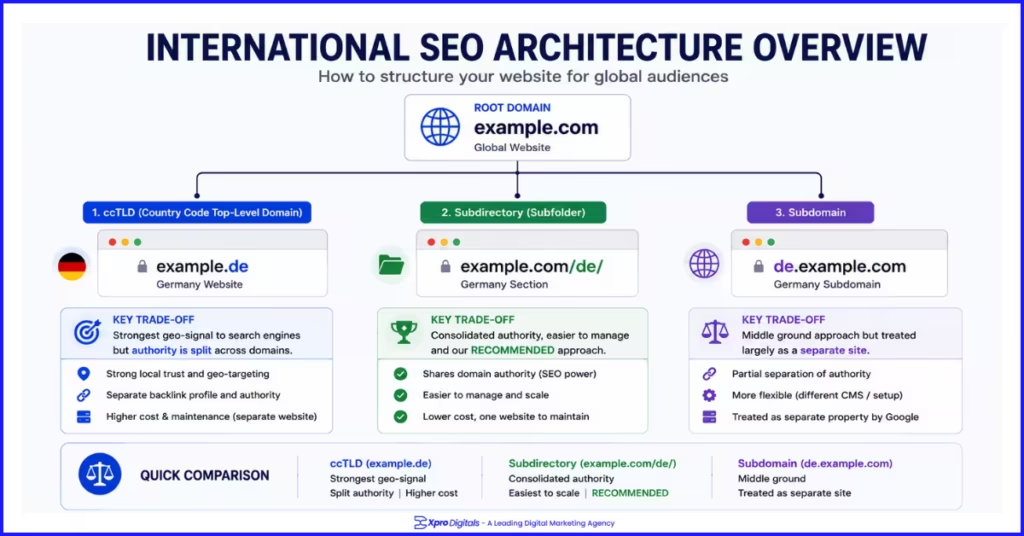
The URL structure you use for international versions of your site is one of the most consequential technical decisions in international SEO. It affects domain authority distribution, crawl efficiency, geo-targeting signal strength, and the complexity of your ongoing technical management. Choose it based on your business model and resources, not on what is easiest to implement.
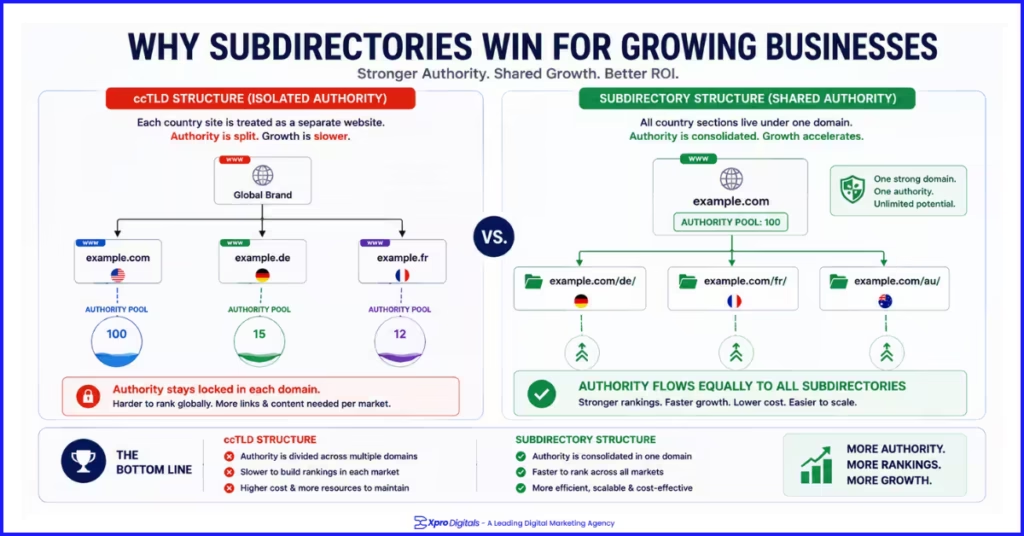
Google explicitly recommends subdirectories for most businesses expanding internationally. The primary reason is domain authority consolidation – all the links and authority signals your domain earns in your home market benefit every subdirectory version of your site. With ccTLDs, each country’s domain must build its authority independently from zero.
We worked with a UK software company that launched separate ccTLDs for Germany, France, and Australia simultaneously. After 12 months, their UK domain had strong rankings while all three ccTLD domains had negligible organic visibility despite substantial content investment. Migrating the content to subdirectories under their main domain produced meaningful German and French rankings within six months, leveraging the authority already built on the primary domain.
For most growing businesses, that makes subdirectories the recommended default – subdomains are typically only worth the trade-off when platform constraints rule out a subdirectory. For the full trade-off comparison across geo-signal strength, authority impact, and management complexity, see our guide on ccTLD vs Subdirectory vs Subdomain for International SEO.
Step 2: Implement Hreflang Correctly
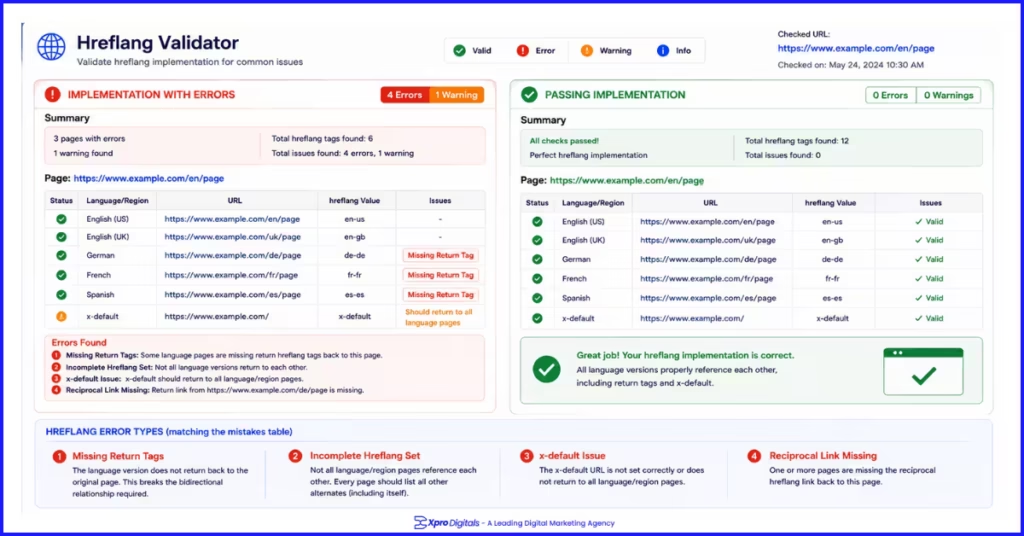
Hreflang is the HTML attribute that tells Google which language and country each version of a page is intended for. It is the most technically critical element of international SEO and the one most frequently implemented incorrectly. A single hreflang error can cause Google to ignore the entire implementation across your site.
Hreflang tags are placed in the head section of each page and reference every alternate version of that page across all languages and countries. Each page must include its own self-referencing tag plus a tag for every other version, and all referenced pages must reciprocate.
Basic format: <link rel=”alternate” hreflang=”en-gb” href=”https://example.com/en-gb/product-page/” />
Language only: <link rel=”alternate” hreflang=”de” href=”https://example.com/de/produktseite/” />
x-default (fallback): <link rel=”alternate” hreflang=”x-default” href=”https://example.com/” />.
See x-default hreflang: when and how to use it for edge cases.
The single most damaging mistake is a missing return tag – if any referenced page doesn’t reciprocate, Google may discard the entire hreflang set across every page in the group, not just the broken one. Our Hreflang Implementation Guide covers every common mistake – from missing self-references to hreflang applied at the domain level instead of the page level – with fixes for each. If you’re weighing hreflang against canonical tags on same-language pages, see Hreflang vs Canonical: Resolving Conflicts.
Step 3: How Google Determines Geographic Targeting Today
Geographic targeting today is inferred entirely from signals Google can already read: hreflang annotations are the strongest lever you control directly; ccTLDs are an automatic, hard signal if you use one; and secondary signals – local currency, address information, the geographic spread of your backlink profile – reinforce both. There’s no longer a manual setting to compensate for a broken hreflang implementation, which raises the stakes on getting it right the first time.
In practice: audit hreflang regularly using the URL Inspection tool or a third-party validator (this now does the job the old International Targeting report used to do), and treat local backlinks as a geotargeting signal, not just an authority one. See Geotargeting in Google Search Console (and What It No Longer Does) for the full picture.
Step 4: Conduct Market-Specific Keyword Research
One of the most common international SEO failures is translating your home market keywords into the target language rather than researching how people in that market actually search. Direct translations often produce keywords that are grammatically correct but do not reflect natural search behaviour in the target country.
We ran keyword research for a UK homeware retailer entering the German market. Their primary UK keyword was ‘velvet sofa’. Direct translation produced ‘Samtsofa’. The research showed German shoppers actually used ‘Samtcouch’ (40% more volume), ‘Couch Samt’ (higher commercial intent), and ‘Sofa aus Samt’ as the dominant search patterns. Building content around the translated term would have targeted a fraction of the real demand.
The process – mapping your home-market keyword groups, researching each target market natively, analysing local competitor rankings, and validating with in-market autocomplete – is covered step by step in our International Keyword Research guide. For ecommerce-specific keyword mapping, see our ecommerce keyword research guide. Once you know where demand exists, prioritizing which markets to enter first comes down to existing traffic, market size, and entry cost – see How to Prioritize International Markets for Expansion.
Step 5: Localise Content, Do Not Just Translate It
Translation and localisation are different activities with different SEO outcomes. Translation converts words from one language to another. Localisation adapts content to reflect the cultural context, buying behaviour, terminology preferences, and trust signals that make content feel native to an audience in that market.
A UK estate agent using the phrase ‘property chain’ in German market content produces a term that doesn’t exist in the German property market. An Australian retailer using ‘jumper’ for a knitwear product in a US market targets a term Americans associate with a dress, not a sweater. These aren’t translation errors – they’re relevance failures that reduce both rankings and conversion rates.
Localisation for SEO specifically requires:
- Using the search terms people in that market actually use
- Adapting cultural references to the target market context
- Using local currency, units of measurement, and date formats
- Addressing market-specific trust concerns – local payment methods, delivery information, customer service contact details
For the full comparison of how translation vs. localisation affects keyword relevance, trust signals, and AI Overview eligibility, see Localization vs Translation vs Transcreation. If you’re managing both language and country variants at once – say, German content plus separate US and UK English versions – that’s a distinct problem covered in Multilingual SEO vs Multiregional SEO.
Step 6: Build International Link Authority
Backlinks from websites in your target country carry stronger geographic relevance signals than links from your home market. This is often the most overlooked factor in why international pages fail to rank despite good technical implementation and localised content.
A German-targeted subdirectory with correct hreflang, localised content, and clean geotargeting signals will still struggle to rank for competitive German keywords if all its backlinks come from UK websites. Google’s local relevance assessment includes the geographic distribution of a page’s backlink profile – links from German publications, directories, and partner sites reinforce every other international SEO element you’ve put in place.
We cover all seven link-building strategies – from local directories to country-specific digital PR, with difficulty and signal-strength ratings for each – in our International Link Building guide, including how to source relevant links market by market in Local Backlink Sourcing by Region.
International SEO for Ecommerce Stores
Ecommerce stores face specific international SEO challenges beyond those affecting content sites. Product catalogues create content at scale, and managing that content across multiple languages and countries requires careful structural decisions to avoid duplicate content problems that can suppress entire market versions simultaneously.
The most common ecommerce international SEO problem is using automated translation for product descriptions across multiple market subdirectories. Machine-translated product descriptions frequently produce near-identical content across markets in different languages, which triggers duplicate content signals because Google’s multilingual processing can identify when the semantic content of pages is identical even across language differences. Our ecommerce SEO checklist includes a hreflang audit section covering how to identify and fix errors across large catalogues efficiently.
For ecommerce stores, combining correct hreflang implementation with genuinely localised product and category content, market-specific schema markup, and local pricing signals in structured data is the standard for competitive international product rankings. Our guide on international ecommerce SEO and ranking in multiple countries covers the full technical and content requirements for cross-border ecommerce organic growth, including regional marketplace SEO for stores selling through Amazon and other regional marketplaces, and schema markup for multi-region businesses for pricing and availability signals by market.
International SEO Technical Checklist
Run through this checklist for a fast self-audit. Where a check has a full walkthrough elsewhere in this cluster, the check name links to it.
| Technical Check | What to Verify | Tool | Done? |
| URL structure chosen and consistent | Subdirectory, subdomain, or ccTLD applied consistently | Screaming Frog crawl | |
| Hreflang tags on all pages | All language/country versions tagged, all return tags present | Hreflang validator, Screaming Frog | |
| Self-referencing hreflang on every page | Each page references itself in the hreflang set | Hreflang validator | |
| x-default tag implemented | Fallback hreflang tag present on all pages | Hreflang validator | |
| Geotargeting set in GSC | Each international property/subdirectory has country target set | Google Search Console | |
| No duplicate content across markets | Pages in same language for different countries have sufficient differentiation | Siteliner, manual review | |
| International pages indexed | All market versions appear in GSC Coverage as indexed | Google Search Console | |
| Canonical tags not conflicting with hreflang | Self-canonicals on each market version, not pointing cross-market | Screaming Frog | |
| Page speed adequate in target markets | Core Web Vitals pass when tested from target country | PageSpeed Insights, WebPageTest | |
| CDN configured for international delivery | Static assets served from geographically distributed servers | WebPageTest, CDN provider | |
| Schema markup includes market-specific data | Currency, price, availability correct per market in structured data | Rich Results Test | |
| International XML sitemap submitted | Separate sitemap or sitemap index submitted per market in GSC | Google Search Console |
International SEO Mistakes That Cost Rankings
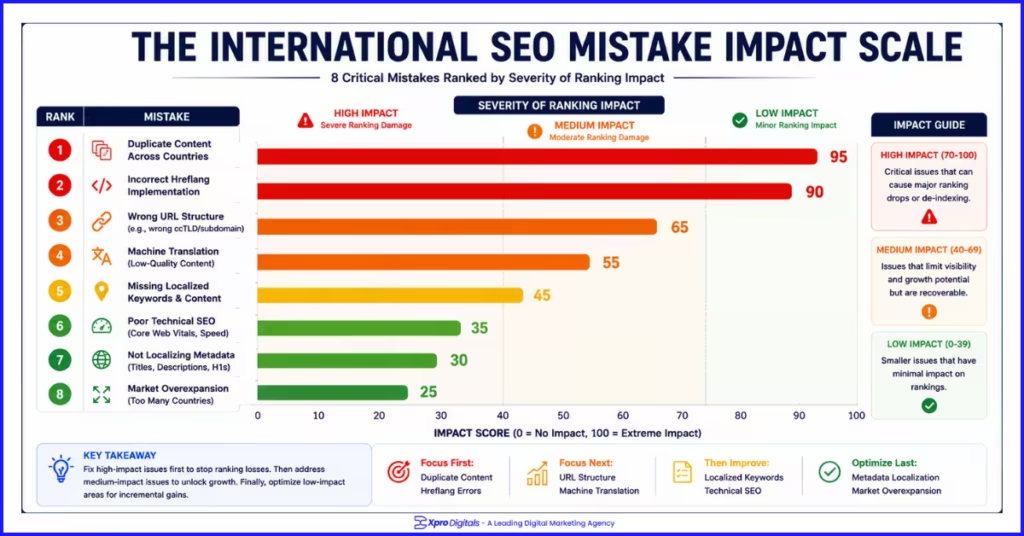
Most international SEO problems fall into a small number of repeating patterns. Understanding these mistakes before you encounter them prevents the months of diagnostic work required to identify them after your international pages fail to rank.
The Most Costly International SEO Mistakes
| Mistake | What It Causes | Fix |
| Direct translation without keyword research | Content targets low-volume translated terms, not actual search patterns | Research keywords natively in each target market |
| Hreflang with missing return tags | Google ignores the entire implementation | Every referenced page must contain a matching return tag |
| Same content in same language for different countries | Duplicate content suppresses both versions | Differentiate en-US and en-GB content or use canonical tags |
| No geotargeting in GSC | Google defaults to the wrong market for subdirectory content | Set country target in GSC for each international property |
| Building links only in home market | International pages lack local authority signals | Build locally relevant links in each target market separately |
| Using automated machine translation for all content | Near-identical semantic content across markets despite language difference | Invest in human localisation for priority pages |
| Launching too many markets simultaneously | Authority spread too thin to rank competitively in any market | Enter one or two markets at a time and establish authority before expanding |
| Ignoring local search engine relevance | Missing significant search volume in Yandex (Russia), Baidu (China), Naver (Korea) | Research dominant search engine per market before targeting |
International SEO for Non-Google Search Engines
Google dominates search in most Western markets but is not the primary search engine everywhere. Targeting some markets requires understanding a completely different set of ranking signals, technical requirements, and content standards.
Key Market Search Engines
| Market | Primary Search Engine | Google Market Share | Key Differences for SEO |
| Russia | Yandex | Around 40% | Yandex favours sites with .ru domains and Russian-hosted content |
| China | Baidu | Around 75% | Requires Chinese domain (.cn), Chinese hosting, and simplified Chinese content |
| South Korea | Naver | Around 55% | Blog content on Naver’s own platform influences rankings significantly |
| Japan | Around 75% | Google dominates but Japanese search behaviour and keyword patterns differ significantly | |
| Czech Republic | Seznam | Around 15-20% | Local search engine with separate ranking algorithm |
| USA, UK, Australia, India | 90%+ | Standard Google SEO applies |
For most businesses entering international markets, Google SEO covers the majority of search volume in most target countries. However, if your target market includes Russia, China, or South Korea as significant opportunities, the search engine landscape requires specific technical and content strategies beyond standard Google international SEO – covered in full, including domain and hosting requirements per engine, in International SEO for Non-Google Search Engines.
Measuring International SEO Performance
Measuring international SEO requires segmenting your performance data by market. Aggregate organic traffic figures hide the performance differences between markets and make it impossible to identify which market versions are working and which need attention.
International SEO Measurement Framework
| Metric | How to Measure | Tool | Review Frequency |
| Organic sessions by country | GA4 filter by country dimension | Google Analytics 4 | Monthly |
| Organic revenue by country | GA4 ecommerce reports filtered by country | Google Analytics 4 | Monthly |
| Indexed pages by market version | GSC Coverage filtered by URL prefix | Google Search Console | Monthly |
| Click-through rate by market | GSC Performance filtered by country | Google Search Console | Monthly |
| Rankings by country and keyword | Rank tracker with country-specific settings | Ahrefs, Semrush, SERPWatcher | Monthly |
| Hreflang errors | International targeting report in GSC | Google Search Console | Monthly |
| Core Web Vitals by market | GSC Core Web Vitals filtered by country | Google Search Console | Monthly |
| Referring domains by market | Backlink report filtered by source country | Ahrefs or Semrush | Quarterly |
For the full walkthrough of setting up country/language segmentation in GA4 and Search Console, see Segmenting GA4 and Search Console by Country and Language.
People Also Ask: What Is International SEO
What Is International SEO in Simple Terms?
International SEO is the process of optimizing your website to appear in search results in multiple countries or languages. It uses specific technical signals like hreflang tags to tell Google which version of your content is intended for which audience, and requires market-specific keyword research and content localisation to ensure your pages are relevant to how people in each target country actually search.
What Is Hreflang and Why Is It Important?
Hreflang is an HTML attribute that tells Google which language and country each page on your site is intended for. It prevents international duplicate content issues by telling Google that multiple pages covering similar content are not duplicates but are intended for different audiences. Without hreflang, Google may serve the wrong language version to international visitors or choose one version to suppress in favour of the other. See our Hreflang Implementation Guide for the full setup.
Should I Use ccTLD, Subdirectory, or Subdomain for International SEO?
For most growing businesses, subdirectories are the recommended choice. They consolidate all domain authority under one domain, are simpler to manage technically, and are explicitly recommended by Google for most businesses. ccTLDs provide the strongest geographic signal but require building authority independently for each country domain, which is expensive and slow. Subdomains sit between the two and are typically chosen only when platform constraints prevent subdirectory use. Full comparison: ccTLD vs Subdirectory vs Subdomain.
How Do I Tell Google Which Country My Website Is Targeting?
Use two signals in combination. First, implement hreflang tags on every page specifying the language and country target. Second, if your domain strategy uses country-specific domains, a ccTLD automatically signals geographic targeting. Google Search Console no longer offers a manual country-targeting setting – that tool was deprecated in 2022 – so hreflang and ccTLD now carry that signal directly, with local currency, address details, and backlink geography as supporting evidence. See Geotargeting in Google Search Console (and What It No Longer Does) for how to audit this.
Does International SEO Require Separate Websites?
No. Separate websites (ccTLDs) are one option but not the only or recommended one for most businesses. Subdirectories (example.com/de/) allow you to manage all market versions within a single website under one domain, consolidating authority and reducing technical management complexity. Most businesses entering international markets for the first time should use subdirectories – see ccTLD vs Subdirectory vs Subdomain for how to decide.
How Long Does International SEO Take to Show Results?
International SEO typically takes longer to show results than domestic SEO because you are building authority in a market where your domain is relatively unknown. Technical fixes like correct hreflang implementation can show rapid improvements in the pages Google associates with each market. Meaningful organic traffic in a new country typically develops between months four and eight of an active international SEO programme. Competitive keywords in established markets take nine to eighteen months.
What Is the Difference Between Multilingual SEO and Multiregional SEO?
Multilingual SEO targets audiences that speak different languages, such as English, German, and French versions of the same content. Multiregional SEO targets audiences in different countries that may speak the same language but have different search behaviour, cultural context, and buying preferences, such as US English and Australian English versions of a site. Many international SEO programmes require both. See Multilingual SEO vs Multiregional SEO for the full breakdown, including which technical setup each one needs.
How Do I Handle Duplicate Content in International SEO?
Hreflang tags are the primary mechanism for signalling to Google that pages covering similar content in different languages are intended for different audiences rather than being duplicates. For same-language different-country pages (such as en-GB and en-US), you must differentiate the content enough for Google to treat them as distinct, or use canonical tags to point one version to the preferred version. See Managing Duplicate Content Across Language Versions for the full decision framework.
Should I Translate My Website or Localise It for International SEO?
Localize it. Translation converts words. Localisation adapts the content to reflect how people in the target market actually search, what cultural context makes sense, which trust signals they respond to, and which terminology they use for the same products or services. Machine-translated or directly translated content frequently targets keywords that do not reflect actual search patterns in the target market. Full comparison: Localization vs Translation vs Transcreation.
What Is x-default Hreflang and When Should I Use It?
x-default is a special hreflang attribute that designates which page to show visitors whose country or language does not match any other hreflang tag in your implementation. It acts as a fallback. Use it on your main homepage or a global version of your page for any visitor from a market you have not explicitly targeted. See x-default hreflang for implementation edge cases.
How Does Page Speed Affect International SEO?
Page speed affects international SEO the same way it affects domestic SEO: failing Core Web Vitals scores apply a page experience penalty. However, international audiences accessing your site from distant servers may experience slower load times than your home market audience. A content delivery network (CDN) distributes your site’s static assets from servers geographically close to each international audience. See Server Location, CDN & Core Web Vitals for Global Audiences.
Do I Need Different Content for Each Country That Speaks the Same Language?
You need different content for the same language in different countries if those countries have meaningfully different search behaviour, terminology, cultural references, or buying contexts. English content for the UK and the US frequently needs differentiation in product terminology, pricing context, cultural references, and spelling conventions. This is the multiregional half of the multilingual vs multiregional distinction – without differentiation, you risk duplicate content issues and reduced relevance for each market’s specific search patterns.
How Do I Find Keywords for International Markets?
Research keywords natively in each target language and market, using tools set to the specific country and language, and validate with in-market autocomplete. Analyse the top-ranking local competitors in each market to see which keywords drive their traffic. Never assume that translating your home market keywords produces the correct terms for another market. Full methodology: International Keyword Research.
What Is the Most Common International SEO Mistake?
Missing hreflang return tags is technically the most common error that causes immediate ranking problems – see the Hreflang Implementation Guide for every variant of this mistake. But the most strategically damaging mistake is translating content without conducting market-specific keyword research, covered in International Keyword Research. Grammatically correct translated content targeting the wrong search terms produces pages that are well-executed but invisible in the target market.
How Do I Audit My International SEO?
Run the international checklist above against your current setup. Use Screaming Frog to crawl your site and check hreflang implementation for missing return tags, incorrect language codes, and self-referencing errors. Compare your organic traffic and ranking data filtered by country to identify which markets are performing below potential. Commission a market-specific keyword audit to check whether your content targets actual local search patterns.
Frequently Asked Questions About International SEO
How Much Does International SEO Cost?
International SEO costs vary by scope. Adding a single new market subdirectory to an existing site with correct hreflang implementation typically costs 2,000 to 5,000 USD for the technical setup. Ongoing content localisation costs 1,000 to 3,000 USD per month per market depending on content volume. International link building adds 1,000 to 3,000 USD per market per month. Full-service international SEO management for multiple markets typically ranges from 3,000 to 15,000 USD per month depending on scope. See our full pricing breakdown for scenario-based estimates.
Can I Use Google Translate for My International Pages?
No. Machine-translated content produces grammatically adequate but semantically flat pages that frequently target the wrong keywords, use unnatural phrasing, and fail to build the trust signals that convert international visitors. Google can identify machine-translated content and applies lower quality assessments to pages that read as automated translations. Use human translators with subject matter knowledge – see Localization vs Translation vs Transcreation for what genuine localisation requires instead.
Do I Need to Build Separate Backlinks for Each International Market?
Yes. For subdirectory structures, links built to the root domain benefit all subdirectories, but links from locally relevant websites in each target market are a separate and important signal. A German-targeted subdirectory benefits from links originating from German websites in addition to any links your root domain receives. For ccTLDs, this is even more critical because each domain must build its backlink profile independently. See Local Backlink Sourcing by Region for market-by-market tactics.
What Languages Should I Prioritise for International SEO?
Prioritise languages based on your business data rather than language population size. Check your Google Analytics data to identify which countries already send organic traffic to your site without any international SEO effort – these represent demand you’re already partially capturing. See How to Prioritize International Markets for Expansion for the full three-factor framework.
Can International SEO Work Without Hreflang?
Technically yes, but with significant limitations. Without hreflang, Google makes its best guess about which version of your pages to show international users. For small sites targeting only one additional market, Google often gets this right. For sites targeting multiple markets or with same-language different-country variations, the absence of hreflang consistently causes wrong-market indexation and lower rankings than a correctly implemented hreflang set – see the Hreflang Implementation Guide.
How Do I Prioritise Which Markets to Enter First?
Prioritise based on three factors: existing demand (check GSC for countries already sending traffic), business potential (market size, product relevance, competitive landscape), and entry cost (languages you already produce content in, markets where your domain already has some authority). Entering English-speaking markets like Australia or Canada first is typically lower cost than entering markets requiring a new language. Full framework: How to Prioritize International Markets for Expansion.
How Do I Track International SEO Without Confusing Domestic Data?
Segment your Google Analytics 4 data using country dimensions and create separate GA4 explorations or reports for each target market. In Google Search Console, add each international subdirectory as a separate property and track its performance independently from your root domain. See Segmenting GA4 and Search Console by Country and Language for the full setup.
What Happens to International SEO if I Change My URL Structure?
Changing your URL structure after international pages have established rankings is high-risk and requires careful planning. Every URL change must be accompanied by 301 redirects from old URLs to new ones, updated hreflang tags referencing new URLs, updated sitemaps, and close monitoring in Google Search Console for indexation drops and ranking changes in each target market. Our guide on migrating international URL structures covers the full process; for structural changes generally, see technical SEO vs on-page SEO.