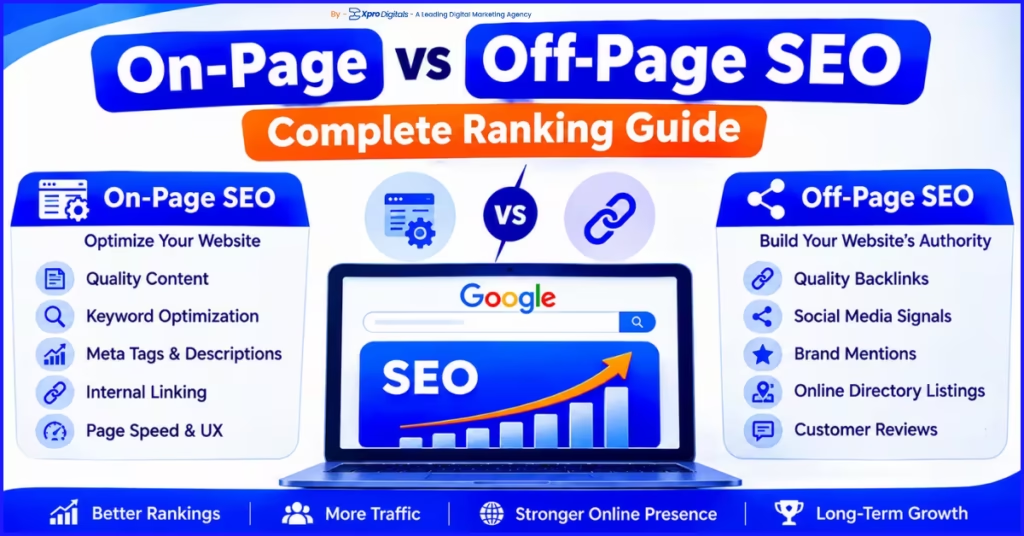
On-Page vs Off-Page SEO: Complete Ranking Guide
Written by
Xpro Digitals
Published on
August 22, 2026
Read Time
Table of Contents
ToggleOn-Page and Off-Page SEO: Complete Guide to Ranking Higher in 2026
Introduction
You publish a blog post. You wait. Weeks pass. The post sits on page three or page five, bringing in almost no traffic. You read that you need better content. Then you read that you need more backlinks. Then someone says technical SEO is the real issue. The advice points in three directions at once, and none of it tells you clearly what to fix first.
This is the most common SEO frustration for business owners and marketers. The problem is not that the advice is wrong. The problem is that on-page SEO and off-page SEO are two separate systems, and most guides talk about them together as if they are interchangeable. They are not. They do different jobs, affect ranking in different ways, and require different skills to execute.
This guide separates them clearly. You will learn exactly what on-page SEO covers, what off-page SEO covers, how much each contributes to ranking, which to prioritise first based on your situation, and how the two work together to produce compound ranking growth. Everything here is grounded in real campaign data and current Google best practices for 2026.
What You Will Learn: Every on-page SEO factor with implementation steps, every off-page SEO signal with acquisition strategy, a direct comparison of both, case study evidence, prioritisation guidance, and a complete action checklist for both.
What Is On-Page SEO?
| On-page SEO refers to every optimization you make directly on your website and its individual pages to help search engines understand what each page is about and to help users get value from it. It is sometimes called on-site SEO, though on-page SEO more precisely refers to individual page-level work while on-site covers site-wide technical elements too. |
On-page SEO is entirely within your control. You write the title tags, you structure the headings, you choose the keywords, you write the content, you build the internal links. No external party needs to take any action for your on-page SEO to improve. This makes it the right place to start for any new website or underperforming page.
What Does On-Page SEO Include?
| On-Page Element | What It Does | Priority |
| Title tag | Tells Google and users what the page is about; appears in SERPs as the clickable headline | Critical |
| Meta description | Summarises page content in SERPs; affects CTR but not directly rankings | High |
| H1 heading | Primary page heading; should contain the main keyword once | Critical |
| H2 and H3 subheadings | Organise content structure; include secondary and semantic keywords naturally | High |
| Keyword usage in body content | Helps Google confirm relevance to target queries; must be natural, not forced | Critical |
| URL structure | Short, descriptive URLs with keywords outperform long, parameter-heavy URLs | High |
| Image alt text | Describes images to search engines; ranks in image search; supports accessibility | Medium |
| Internal linking | Distributes authority across the site; helps Google crawl and understand page relationships | High |
| Content depth and quality | Google rewards comprehensive, accurate, useful content over thin or duplicated content | Critical |
| Page experience signals | Core Web Vitals, mobile friendliness, HTTPS, and safe browsing | High |
| Schema markup | Structured data that helps Google understand entities, products, reviews, and events | Medium-High |
| Keyword density and LSI terms | Natural use of primary keyword plus semantically related terms signals topical depth | Medium |
What Is Off-Page SEO?
| Off-page SEO refers to every action taken outside your own website that influences your search engine rankings. These are signals that tell Google how other people, businesses, and websites perceive your content and authority. You cannot fully control off-page SEO because it depends on third parties taking actions that reference or endorse your site. |
Off-page SEO is primarily about building authority and trust in the eyes of Google. A website with strong on-page SEO but no off-page authority struggles to rank for competitive keywords. A website with high off-page authority but weak on-page SEO leaves ranking potential on the table. Both systems need to work together for maximum ranking impact.
What Does Off-Page SEO Include?
| Off-Page Signal | What It Does | Priority |
| Backlinks from other websites | The primary off-page ranking signal; links from authoritative sites transfer ranking power | Critical |
| Link quality and relevance | Links from topically relevant, trusted domains carry more weight than random links | Critical |
| Anchor text of inbound links | The clickable text of an inbound link sends relevance signals to Google | High |
| Domain authority and domain rating | Overall strength of a website’s backlink profile as measured by tools like Ahrefs and Moz | High |
| Brand mentions (linked and unlinked) | Google uses brand signals to assess real-world authority and recognition | Medium |
| Google Business Profile signals | Reviews, citations, and engagement; critical for local off-page SEO | High (local) |
| Social media presence and shares | Indirect signals; social profiles rank for brand terms and drive content discovery | Low-Medium |
| Digital PR and media coverage | Earns high-authority editorial links and brand signals simultaneously | High |
| Guest posting and editorial content | Builds topic authority and backlinks through third-party publication | High |
| Local citations (NAP consistency) | Name, address, phone number consistency across directories; critical for local ranking | High (local) |
| Review signals across platforms | Reviews on Google, Trustpilot, and industry sites support E-E-A-T and local prominence | Medium |
On-Page vs Off-Page SEO: A Direct Comparison
| Factor | On-Page SEO | Off-Page SEO |
| Control | Full control; you make all changes | Partial; depends on third-party actions |
| Speed of implementation | Immediate; changes live as soon as you publish | Slower; link acquisition and authority building take time |
| Primary Google evaluation | Content relevance, structure, and page experience | Authority, trust, and external endorsement signals |
| Where to start | Always start here; foundation must be strong first | Build after on-page is solid; amplifies existing relevance |
| Ranking impact timeline | 4 to 12 weeks for optimized pages to show movement | 3 to 12 months for authority to build and compound |
| Skills required | Copywriting, keyword research, technical HTML knowledge | Outreach, PR, relationship building, link analysis |
| Maintenance required | Regular content updates and internal link audits | Ongoing link acquisition and toxic link monitoring |
| Tools used | Google Search Console, Screaming Frog, Surfer SEO | Ahrefs, Semrush, Moz, BuzzStream, HARO |
Key Point: On-page SEO is the foundation. Off-page SEO is the amplifier. A page that Google cannot understand through on-page signals will not benefit from backlinks. Always optimize on-page first, then build off-page authority on top of a strong base.
On-Page SEO: Every Factor Explained in Detail
Title Tags: The Single Most Important On-Page Element
Your title tag is the clickable blue headline that appears in Google search results. It is the clearest signal you can send to Google about what a page covers. Include your primary keyword near the beginning of the title tag. Keep it under 60 characters to avoid truncation in SERPs. Write it for the user first, keyword second. A title that earns a click is worth more than a technically perfect title that nobody clicks on.
Title tag formula that works:
- Primary Keyword: Benefit or Qualifier | Brand Name
- Example: “On-Page SEO Checklist: 12 Steps to Rank Higher | Xpro Digitals”
- Example: “Emergency Plumber in Manchester | 24-Hour Service”
Avoid duplicate title tags across pages. Each page must have a unique title that reflects its specific content. Pages sharing the same or very similar title tags confuse Google and split ranking signals between pages.
Meta Descriptions
Meta descriptions do not directly affect Google rankings, but they heavily affect click-through rate from SERPs. A higher CTR on a given keyword sends a behavioural signal that reinforces ranking. Write meta descriptions between 140 and 160 characters. Include the primary keyword naturally, state a clear benefit, and end with a call to action where relevant. Google often rewrites meta descriptions, but well-written ones are used more consistently than poorly written ones.
H1, H2, and H3 Headings
Every page should have exactly one H1 heading that includes the primary keyword. This is the on-page heading that appears visually at the top of the page content, not the title tag. Use H2 headings for main sections and H3 headings for subsections within those. Include secondary keywords and semantic variants naturally in H2 and H3 headings. Never use multiple H1 tags on a single page.
URL Structure for SEO
Clean, keyword-rich URLs are a confirmed on-page SEO signal. Short URLs that describe the page content perform better than long, parameter-heavy URLs. Include your primary keyword in the URL and use hyphens to separate words. Avoid dates in blog URLs unless recency is a core part of the content’s value.
URL comparison:
- Poor: /blog/post?id=2841&category=seo&date=20260118
- Good: /on-page-seo-checklist
Once a URL is indexed and has backlinks pointing to it, do not change it without implementing a 301 redirect from the old URL to the new one. Broken URLs lose all their accumulated ranking signals.
Content Quality and Topical Depth
Content quality is the most influential on-page ranking factor. Google’s Helpful Content system evaluates whether content demonstrates first-hand expertise, serves the user’s actual search intent, and provides a better answer than what already ranks. Word count alone is not a quality signal. A 600-word article that fully answers the query outperforms a 2,000-word article padded with filler.
Topical depth matters. A single definitive guide that covers a topic comprehensively builds more topical authority than 10 thin posts on related subtopics. Include primary keywords, secondary keywords, semantic variants, and entity references throughout the content to signal full topic coverage.
For a clear explanation of how topical authority and content depth connect to E-E-A-T, read our guide on E-E-A-T and why it matters for your rankings.
Keyword Placement: Where Keywords Go on the Page
| Location | Keyword Type | Importance |
| First 100 words of content | Primary keyword | Critical |
| Title tag | Primary keyword | Critical |
| H1 heading | Primary keyword | Critical |
| H2 subheadings | Secondary keywords, semantic variants | High |
| Image alt text | Descriptive keyword phrase | Medium |
| URL slug | Primary keyword (shortened) | High |
| Meta description | Primary keyword naturally placed | Medium |
| Last paragraph or conclusion | Primary keyword or close variant | Medium |
| Internal link anchor text | Keyword-rich but varied | High |
Internal Linking Strategy
Internal links connect your pages to each other and distribute ranking authority across your site. A strong internal linking structure helps Google discover new pages faster, understand the hierarchy of your content, and determine which pages are most important based on how many internal links point to them.
Use descriptive, keyword-rich anchor text for internal links. “Click here” and “read more” waste the SEO value of internal links. Instead, link using phrases that describe the destination page, such as “our complete guide to technical SEO” or “local SEO ranking factors”. Audit your internal links quarterly to ensure new content is linked from relevant existing pages.
For a structured approach to internal link planning, see our guide on internal linking for ecommerce SEO, which covers the same structural principles used across any site type.
Schema Markup for On-Page SEO
Schema markup is structured data code added to your HTML that tells Google exactly what type of content is on the page. Types relevant to most websites include Article, FAQPage, HowTo, LocalBusiness, Product, BreadcrumbList, and Review. Schema does not directly boost rankings, but it enables rich results in SERPs (star ratings, FAQ dropdowns, HowTo steps) that significantly increase CTR.
Use Google’s Rich Results Test to validate your schema before publishing. Implement schema using JSON-LD format, which Google recommends over Microdata. For e-commerce sites, Product and Review schema are particularly high priority because they enable star ratings and price information to appear directly in search results.
Core Web Vitals and Page Experience
Core Web Vitals are three measurable page experience signals Google confirmed as ranking factors. Largest Contentful Paint (LCP) measures how fast the main content loads, with a target of under 2.5 seconds. Cumulative Layout Shift (CLS) measures visual stability during load, with a target score below 0.1. Interaction to Next Paint (INP) replaced First Input Delay in 2024 and measures responsiveness to user input, with a target below 200ms.
Check your Core Web Vitals in Google Search Console under Experience > Core Web Vitals. Pages marked as “Poor” are at a ranking disadvantage in competitive search results. Common fixes include image compression, eliminating render-blocking resources, adding explicit width and height attributes to images, and reducing the impact of third-party scripts.
Mobile optimization
Google uses mobile-first indexing, meaning it crawls and indexes the mobile version of your website, not the desktop version, as the primary basis for ranking. If your mobile site has less content than your desktop site, your ranking potential is based on the thinner mobile content. Ensure your mobile site has all the same content, headings, and structured data as your desktop version.
For a full mobile SEO implementation guide, see our guide on mobile SEO for ecommerce, which covers the most common mobile SEO issues and how to fix each one.
Off-Page SEO: Every Factor Explained in Detail
Backlinks: The Primary Off-Page Ranking Signal
A backlink is a link from one website to another. When a high-authoritative, relevant website links to your page, it passes ranking power (often called link equity or PageRank) to your page. This endorsement signal tells Google that your content is trusted and valuable enough for another site to reference it. The more high-quality, relevant backlinks your page accumulates, the stronger its off-page authority becomes.
Not all backlinks are equal. A single link from a respected industry publication can outweigh 100 links from low-quality directories. Google evaluates backlinks by the authority of the linking domain, the relevance of the linking page to your content, the anchor text used in the link, and the position of the link within the linking page (editorial links within content outrank footer or sidebar links).
How to Evaluate Backlink Quality
| Signal | Good Backlink | Poor Backlink |
| Linking domain authority | Domain Rating 40+, well-established site | DR under 10, brand new or abandoned site |
| Topical relevance | Same or closely related niche to your content | Completely unrelated topic |
| Link placement | Within the body content, editorial context | Footer, sidebar, blogroll, or paid link section |
| Anchor text | Natural, partial match or brand name | Over-optimized exact match keyword stuffing |
| Link origin | Manually earned through content or outreach | Auto-generated, purchased, or from link networks |
| Traffic on linking page | Page receives real organic traffic | Zero traffic, exists only to hold links |
Link Building Strategies That Work in 2026
Digital PR and Media Outreach
Digital PR earns editorial backlinks from news sites, industry publications, and blogs by creating genuinely newsworthy content: original research, data studies, expert commentary on trending topics, or compelling stories that journalists want to cover. These links are high authority, editorially placed, and cannot be purchased. They are the hardest to earn and the most valuable.
Guest Posting on Relevant Publications
Contributing expert articles to reputable publications in your industry earns backlinks and builds topical authority simultaneously. The publication must be genuinely relevant to your niche and have real editorial standards. Guest posts on low-quality sites that exist purely for link exchange provide minimal value and carry some risk of Google devaluation.
The Skyscraper Technique
Find the most linked-to content on a topic in your niche. Create a significantly better version of that content: more comprehensive, more up to date, better formatted, and with original data or visuals. Then contact the sites linking to the original and let them know your improved resource exists. A percentage will update their links to point to the better resource.
Broken Link Building
Find pages in your niche that link to dead or broken external URLs. Create content that matches what the broken link originally pointed to. Contact the website owner and suggest replacing the dead link with your working resource. This provides genuine value to the site owner and earns you a relevant, contextual backlink.
Unlinked Brand Mention Reclamation
Use tools like Ahrefs Content Explorer or Google Alerts to find pages that mention your brand name without linking to your site. Contact the author and ask them to convert the mention to a hyperlink. These are the easiest links to earn because the writer has already referenced you. Conversion rates for this approach typically run at 15 to 25 percent.
For the distinction between ethical and unethical link building tactics and why it matters for long-term ranking, read our guide on white hat vs black hat SEO.
Domain Authority vs Page Authority
Domain Authority (Moz) and Domain Rating (Ahrefs) are third-party metrics that estimate the overall strength of a website’s backlink profile on a scale of 1 to 100. These are not Google metrics, but they correlate reasonably well with ranking strength. Page Authority or URL Rating measures the strength of a specific page’s backlink profile rather than the whole domain.
A backlink from a page with high URL Rating within a high Domain Rating site is the ideal scenario. Focus your link building on domain-level authority first (DR 40 or above as a starting benchmark) and page-level relevance second. A link from a DR 70 site on a relevant topic page beats a link from a DR 80 site on a completely unrelated page.
Brand Signals as Off-Page SEO
Google uses brand signals as a proxy for offline authority and real-world business legitimacy. Brand signals include: search volume for your brand name, brand mentions across the web (linked and unlinked), social media presence, press coverage, and consistency of your business information across platforms. Brands that people actively search for and reference demonstrate authority that links alone cannot fully replicate.
Building brand search volume is a compounding strategy. When more people search directly for your brand name, Google interprets this as an authority signal. Content marketing, social media, PR, and exceptional customer service all contribute to brand search growth. Track brand search volume in Google Search Console under Queries, filtered by your brand name.
Local Off-Page SEO Signals
For businesses with physical locations or service areas, local off-page signals are as important as traditional backlink signals. Local off-page factors include Google Business Profile prominence (review quantity, rating, and recency), NAP citation consistency across directories, and local backlinks from geographically relevant sources like regional news, local business associations, and community websites.
For the complete breakdown of local-specific ranking signals, read our guide on local SEO ranking factors, which covers every signal affecting local pack and Google Maps visibility.
Real Case Study: On-Page and Off-Page Combined for 340% Traffic Growth
A B2B SaaS company providing project management software for construction firms came to Xpro Digitals with a 14-month-old website. The site had 38 published blog posts but ranked on the first page for only 3 keywords and received fewer than 400 monthly organic sessions.
Audit findings:
- Title tags were generic: “Blog Post | Company Name” across 22 posts.
- No H1 headings on 11 pages. H2 structure was inconsistent across all posts.
- Internal linking was near zero: most posts had no outbound internal links.
- 15 of 38 blog posts had duplicate or near-duplicate content targeting the same keyword.
- Backlink profile: 41 referring domains, predominantly low-quality directory links with zero industry-relevant editorial links.
- Core Web Vitals: LCP at 5.8 seconds on mobile (Poor). CLS score 0.31 (Poor).
Actions taken across six months:
On-page (months 1 and 2):
- All 38 title tags are rewritten with primary keywords and search intent alignment.
- H1 and H2 structure rebuilt on every page.
- 12 duplicate or thin posts consolidated into 5 comprehensive guides using 301 redirects.
- Internal linking added: each post links to 3 to 5 related posts and 2 service pages.
- Schema markup added: Article schema on all blog posts, FAQ schema on 8 priority pages.
- LCP reduced to 2.1 seconds through image compression and server-side rendering improvements.
Off-page (months 3 through 6):
- 8 guest posts placed on construction and project management industry publications.
- 2 original data studies published: one earned 14 editorial links from industry blogs and one trade magazine.
- 31 unlinked brand mentions identified and converted to active backlinks.
- Local citations corrected and expanded for their London office.
Results at month 6:
- Organic sessions: up from 392 to 1,714 per month (340% increase).
- First-page keyword rankings: up from 3 to 47.
- Referring domains: up from 41 to 129, all relevant to construction and project management.
- Average ranking position for top 20 target keywords: improved from 31.4 to 8.7.
Key Insight: The on-page fixes produced the first ranking movements in weeks 5 through 8. The off-page link building then amplified those pages from positions 15 to 30 up into the top 10, confirming that both systems are required and sequence matters: on-page first, off-page second.
Common Questions About On-Page and Off-Page SEO
What Is the Difference Between On-Page and Off-Page SEO?
On-page SEO covers optimizations made directly on your website: title tags, headings, content, internal links, schema, and page speed. Off-page SEO covers external signals like backlinks, brand mentions, Google reviews, and citations. On-page SEO establishes relevance. Off-page SEO builds authority. Both are required to rank competitively for commercial keywords.
Which Is More Important: On-Page or Off-Page SEO?
On-page SEO is the foundation and must be done first. Without strong on-page signals, backlinks cannot fully transfer their ranking value because Google cannot clearly identify what the page is about or whether it serves the search intent. In extremely competitive niches, off-page authority eventually becomes the differentiating factor between two pages that both have strong on-page SEO. For most businesses starting out, fixing on-page SEO produces the faster and larger initial ranking lift.
How Long Does On-Page SEO Take to Show Results?
On-page SEO changes typically begin influencing rankings within 4 to 12 weeks, depending on how frequently Google crawls your site. New websites may take longer because Google needs to build confidence in the domain first. Expedite re-crawling of updated pages by submitting them in Google Search Console under URL Inspection. For highly crawled pages, ranking changes from on-page improvements can appear within days of the update.
For a full timeline breakdown across both channels, see how long does SEO take to show results.
How Long Does Off-Page SEO Take to Show Results?
Off-page SEO has a longer result timeline than on-page. A single high-quality backlink from a relevant, authoritative site can begin influencing rankings within 2 to 6 weeks of Google indexing the linking page. Meaningful authority building from a sustained link acquisition campaign typically takes 3 to 6 months to produce clearly visible ranking improvements. Domain-level authority increases take 6 to 12 months to compound at the scale needed to displace entrenched competitors.
Can I Rank on Google Without Backlinks?
Yes, for low-competition keywords. Many informational, long-tail queries have first-page results dominated by thin content on moderate-authority sites. Strong on-page SEO, comprehensive content, and fast page speed can rank a page without backlinks if competition is sufficiently low. For competitive commercial keywords, particularly those with high search volume and clear transactional intent, backlinks are effectively required to reach the first page.
What Is Technical SEO and How Does It Relate to On-Page SEO?
Technical SEO is a subset of on-site SEO that covers the underlying infrastructure of the website: crawlability, indexation, site architecture, redirect chains, duplicate content caused by URL parameters, hreflang for international sites, and Core Web Vitals. On-page SEO works at the individual page level (content, titles, headings), while technical SEO works at the infrastructure level. Technical SEO issues can prevent on-page optimizations from being recognised by Google entirely.
For a comparison of where technical and on-page SEO differ and overlap, read our guide on technical SEO vs on-page SEO.
What Are the Most Important Off-Page SEO Factors in 2026?
The most important off-page SEO factors in 2026 are: the number and quality of referring domains (unique sites linking to you), the topical relevance of those linking domains to your content, anchor text diversity and naturalness, brand search volume and unlinked brand mentions, and for local businesses, Google review signals and NAP citation consistency. Quantity of backlinks matters less than the quality and relevance of the referring domains.
What Are LSI Keywords and Do They Help On-Page SEO?
LSI (Latent Semantic Indexing) keywords are semantically related terms that naturally appear in content about a given topic. Including them signals to Google that your content covers the full topic rather than just repeating one keyword. For a page about “home insurance”, LSI terms include “premium”, “excess”, “cover”, “policy”, “claim”, and “renewal”. Google’s Natural Language Processing capabilities mean that using semantically related terms helps the page rank for a broader range of related queries, not just the primary keyword.
Does Social Media Affect SEO Rankings?
Social media does not directly influence Google rankings. Social shares and likes are not ranking signals that Google uses in its algorithm. However, social media has indirect SEO value: it drives content discovery that leads to backlinks from people who find your content through social channels, it builds brand search volume, and social profiles rank in branded SERPs, giving you more control over what appears when someone searches your company name.
What Is Anchor Text and Why Does It Matter for Off-Page SEO?
Anchor text is the clickable, underlined text of a hyperlink. When another website links to yours using anchor text that includes your target keyword, it sends a relevance signal to Google confirming what your page is about. Over-optimized anchor text (every inbound link using your exact target keyword) is a manipulation signal that can trigger algorithmic penalties. A natural backlink profile includes branded anchors (your company name), partial match anchors, generic anchors (click here, read more), and naked URL anchors alongside a proportion of keyword-rich anchors.
What Is E-E-A-T and How Does It Relate to On-Page and Off-Page SEO?
E-E-A-T stands for Experience, Expertise, Authoritativeness, and Trustworthiness. It is Google’s framework for evaluating content quality, particularly in YMYL (Your Money or Your Life) categories like health, finance, legal, and safety. E-E-A-T is demonstrated through both on-page signals (original experience in content, author credentials, accurate information) and off-page signals (backlinks from authoritative sources, brand mentions in reputable publications, expert citations). Strong E-E-A-T is a compound of both systems working together.
How Do I Know Which Pages to optimize First for On-Page SEO?
Prioritise pages that are ranking between positions 8 and 20 for valuable keywords. These are pages that Google has already recognised as relevant but has not fully committed to showing in the top 7. Improving their on-page signals can push them into the top 5, where the majority of clicks are concentrated. Find these opportunities in Google Search Console under Performance, filtered by position (between 8 and 20) and sorted by impressions descending.
What Is Keyword Cannibalisation and How Does It Affect On-Page SEO?
Keyword cannibalisation occurs when two or more pages on your website target the same primary keyword. Google is unsure which page to rank and may alternate between them, resulting in neither page ranking as strongly as one consolidated page would. Identify cannibalisation by searching Google for “site:yourdomain.com keyword” and checking how many of your pages appear. Fix it by consolidating thin pages into one comprehensive page and redirecting the weaker URLs to the consolidated page.
How Many Backlinks Do I Need to Rank on the First Page of Google?
There is no universal number. The correct answer is: enough high-quality, relevant backlinks to match or slightly exceed what is currently ranking on page one for your target keyword. Use Ahrefs or Semrush to check the backlink count of the pages currently in positions 1 through 5 for your keyword. That gives you a real-world benchmark for your specific competitive environment. Highly competitive keywords in finance or health may require hundreds of referring domains. Local or niche informational queries may rank with fewer than 20 strong backlinks.
What Are Toxic Backlinks and Should I Disavow Them?
Toxic backlinks are links from low-quality, spammy, or link-scheme sites that can potentially drag down your domain’s trust signals. Google generally ignores low-quality links rather than penalising them, but a concentrated pattern of manipulative links can trigger a manual action. Use Google’s Disavow Tool to submit a list of links you want Google to ignore, but only after genuinely harmful links are identified. Disavowing healthy links is a common mistake that damages rankings. Use this tool with caution and only with clear evidence of harmful link patterns.
How Do I Do a Basic On-Page SEO Audit?
A basic on-page SEO audit covers six areas. First, check all title tags for keyword inclusion and uniqueness. Second, verify H1 presence and keyword alignment on every page. Third, audit content for thin pages (under 300 words with low value) that should be consolidated or expanded. Fourth, check internal linking with a crawl tool like Screaming Frog to find orphan pages with no internal links. Fifth, validate schema markup with Google’s Rich Results Test. Sixth, check Core Web Vitals in Google Search Console.
For a full 15-point audit framework, see our guide on SEO audit: 15 things your agency should check.
What Is the Ideal Keyword Density for On-Page SEO?
Keyword density as a percentage is not a meaningful optimization target in 2026. Google’s NLP capabilities evaluate semantic context and topical completeness, not keyword frequency as a percentage. Write for the reader. Use the primary keyword where it naturally belongs: title, H1, opening paragraph, and a few times throughout the body where it makes sense. Forcing the keyword repeatedly produces unnatural content that readers notice and that Google’s quality systems also identify. A natural keyword density of 1 to 2 percent emerges automatically in well-written content on a topic.
On-Page SEO Checklist for Every Page
Before publishing any page or post, confirm all of these are complete:
- Unique, keyword-rich title tag under 60 characters
- Meta description between 140-160 characters with primary keyword
- Single H1 heading containing the primary keyword
- H2 and H3 headings with secondary and semantic keywords
- Primary keyword in the first 100 words of content
- Clean URL slug with primary keyword, hyphens between words
- Internal links to at least 2-3 relevant pages using descriptive anchor text
- Inbound internal links from at least 1-2 existing pages to this new page
- All images have descriptive alt text with relevant keyword where natural
- Schema markup implemented and validated (Article, FAQ, HowTo, or Product as appropriate)
- Content directly answers the primary search intent for the target keyword
- No duplicate or near-duplicate content with other pages on the same site
- Page loads in under 3 seconds on mobile (check with PageSpeed Insights)
- All headings use proper hierarchy (H1 > H2 > H3), none skipped
- Page submitted for re-indexing in Google Search Console after update
Off-Page SEO Checklist (Ongoing Monthly Actions):
- Target acquiring at least 2-4 new referring domains per month from relevant sites
- Review anchor text profile for unnatural exact-match anchor over-concentration
- Monitor for new backlinks using Ahrefs or Semrush to catch toxic links early
- Publish at least 1 guest post or external contribution to an industry publication
- Set up Google Alerts for brand name to catch new unlinked mentions
- Convert unlinked brand mentions to backlinks via personalised outreach
- Monitor competitor backlink profiles for new link sources to target
- Keep Google Business Profile updated with posts, photos, and review responses
- Audit citation consistency quarterly and fix any NAP discrepancies found
- Track referring domain growth monthly in Ahrefs or Semrush and compare to competitors
Step-by-Step: How to Combine On-Page and Off-Page SEO for a New Page
- Choose one target keyword per page. Confirm search volume and intent using Google Keyword Planner or Ahrefs.
- Write the title tag: primary keyword near the start, under 60 characters, compelling enough to earn a click.
- Set the URL slug: primary keyword only, hyphens between words, no filler words.
- Write the H1 heading: include the primary keyword, match the title tag intent without copying it word for word.
- Plan H2 and H3 headings to cover every sub-topic a user might need when searching this keyword.
- Write the content: answer the primary intent fully before adding supporting context. Use semantic terms naturally.
- Add internal links from the new page to 3 relevant existing pages and update 2 existing pages to link back to this new page.
- Add schema markup relevant to the page type. Validate with Google’s Rich Results Test.
- Compress all images, add alt text, and verify mobile rendering before publishing.
- Submit the URL in Google Search Console for immediate crawling.
- After 4 to 6 weeks, check the page’s ranking position and impression data in GSC.
- If ranking between positions 8 and 30, begin off-page outreach: identify the top sites linking to similar content and pitch your page for links or mentions.
- Build 4 to 8 relevant backlinks to the page over the following 60 days.
- Reassess ranking position at 90 days. Repeat link building for pages still below position 7.
Final Thoughts: Building a Complete SEO Strategy With On-Page and Off-Page Working Together
On-page and off-page SEO are not competing priorities. They are two stages of the same ranking system. On-page SEO ensures Google can correctly identify what your page covers, who it serves, and whether it delivers genuine value to the searcher. Off-page SEO ensures Google has third-party evidence that your page is trusted, referenced, and authoritative within its topic area.
The businesses that rank consistently on page one in competitive markets have strong signals in both systems. Pages with excellent on-page SEO but no backlinks plateau at positions 10 to 30 in competitive niches. Pages with backlinks but poor on-page structure waste their link equity because Google cannot extract clear relevance signals from the page content.
Start with the on-page checklist in this guide. Audit your current pages, identify the highest-priority fixes, and implement them before any off-page investment. Once your on-page foundation is solid, apply the off-page strategies in order of effort-to-reward: unlinked brand mention reclamation first, then guest posting, then digital PR and content-led link building. Measure at 90-day intervals and adjust based on what the data shows.
Your Next Step: Pick your three most commercially valuable pages. Run them through the on-page checklist in this guide. Fix every gap. Submit updated URLs in Google Search Console. Return in 8 weeks, measure ranking movement, and then build your off-page campaign around the pages that show the most search impression growth.
Frequently Asked Questions (FAQs)
Always fix on-page SEO first. Backlinks pointing to a poorly optimized page cannot reach their full potential because Google is unclear about the page's topic and intent alignment. On-page fixes also show results faster, giving you data on which pages to invest link building effort in before you spend time and money on off-page campaigns.
Yes. Backlinks remain one of Google's strongest confirmed ranking signals. The approach has evolved: manipulative link schemes are penalised, but high-quality editorial links from relevant publications continue to produce strong ranking lifts. The shift is away from volume-based link acquisition toward quality and relevance-based strategies like digital PR, expert content, and genuine outreach. Agencies and in-house teams that build links ethically continue to see compound ranking growth.
The most effective ethical off-page SEO strategies are: creating original research and data that journalists and bloggers naturally want to reference, publishing expert guest posts on relevant industry publications, building genuine relationships with content creators in your niche, using unlinked brand mention reclamation through personalised outreach, and creating free tools or resources that earn links by providing ongoing value. These approaches take more effort than buying links but produce durable results without penalty risk.
A small number of low-quality backlinks are generally ignored by Google rather than penalised. However, a concentrated pattern of links from known link farms, private blog networks, or paid link schemes can trigger either an algorithmic demotion or a manual action. If you inherit a penalised backlink profile from a previous SEO campaign or site acquisition, use the Google Disavow Tool with a carefully reviewed file to signal to Google which links to ignore.
DoFollow links pass ranking authority (PageRank) from the linking page to the linked page. NoFollow links include a rel="nofollow" attribute that traditionally told Google not to pass ranking signals through the link. Google now treats no-follow, sponsored, and UGC link attributes as "hints" rather than absolute directives, meaning some authority may pass even through no-follow links. For off-page SEO, do-follow editorial links are the primary target. No-follow links from high-authority sites still provide brand signals and referral traffic.
First, determine whether you have a manual action or an algorithmic demotion. Check Google Search Console under Security and Manual Actions for any active manual penalties. For a manual action related to unnatural links, compile a comprehensive list of manipulative links using Ahrefs or Semrush, attempt to remove them through direct outreach to webmasters, then submit a disavow file covering links you could not remove. File a reconsideration request in Search Console explaining the actions taken. Recovery from manual penalties typically takes 2 to 4 weeks after reconsideration review.
All pages need strong on-page SEO. Off-page link building priority should focus on your most commercially valuable pages: service pages, product category pages, and top-of-funnel content that drives high search volume. Supporting blog posts and informational content benefit from internal links and topical authority from the site's overall backlink profile, but may not need individual link building campaigns for every single page.
Track on-page SEO impact by monitoring ranking position changes for the page's target keyword in Google Search Console, before and after the changes. Track off-page SEO impact by monitoring referring domain growth in Ahrefs or Semrush alongside ranking position changes. Give each initiative a 60 to 90 day window before attributing ranking changes to a specific action. Avoid making major on-page and off-page changes simultaneously on the same page, as this makes it impossible to isolate which change drove which result.
Content marketing is the engine of off-page SEO. Content that is genuinely useful, original, and well-researched earns backlinks passively over time as other writers and publications reference it. A single well-executed data study, comprehensive guide, or original research report can earn more backlinks in 12 months than a year of manual outreach to average-quality sites. Invest in content assets that are worth linking to, and the off-page SEO becomes a natural result of the content quality.
For a structured approach to content marketing that supports SEO, see our content marketing strategy guide.
The core on-page principles are the same, but the execution differs. E-commerce on-page SEO focuses on product page optimization, category page structure, Product and Review schema, and avoiding duplicate content from filtered navigation. Service website on-page SEO focuses on service page clarity, location-specific content for local SEO, and FAQ and HowTo schema for featured snippet capture. E-commerce sites also have unique challenges around thin product descriptions and cannibalisation across similar product variants that service sites rarely encounter.
For e-commerce specific on-page implementation, read our guides on product page SEO optimization and category page SEO.
Our Related Posts