Why Local SEO Is Vital for Small Businesses in 2026
Introduction: The Local Customers Who Cannot Find You
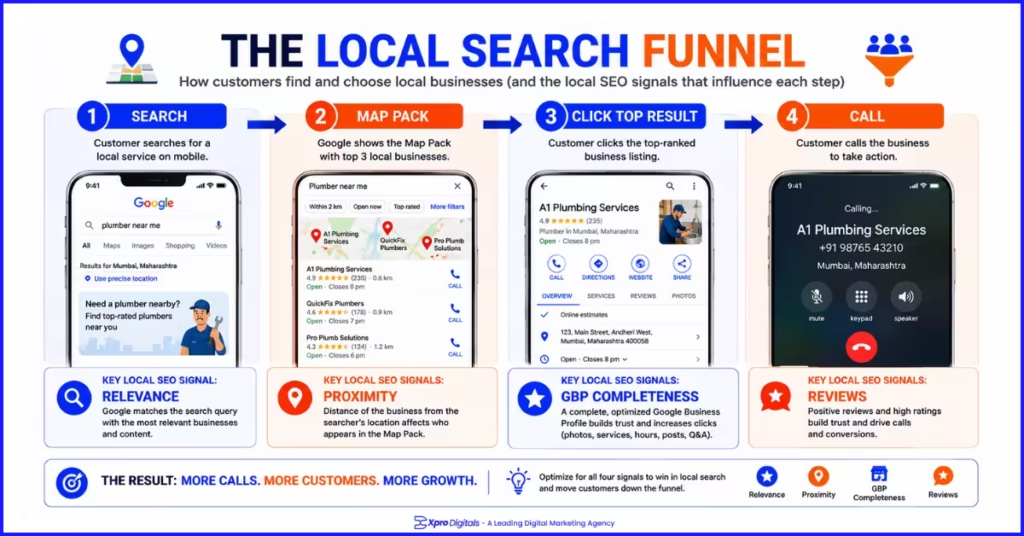
Here is what happens every day for most small businesses. Someone in your town searches Google for exactly what you offer. They type ‘plumber near me‘ or ‘best coffee shop in [your city]‘ or ‘accountant [your area]‘. They click one of the first three results that appears on the map. They call that business.
If that business is not you, it is your competitor. And the competitor may not be better than you. They may not have been trading longer. They may not have better reviews. They simply invested in local SEO and you did not.
The pain here is invisible precisely because you do not see the searches you are missing. You do not get a notification when someone searches for your service and chooses someone else. You just get fewer phone calls, fewer walk-ins, and fewer online bookings than you could have, without ever knowing exactly how much you are losing.
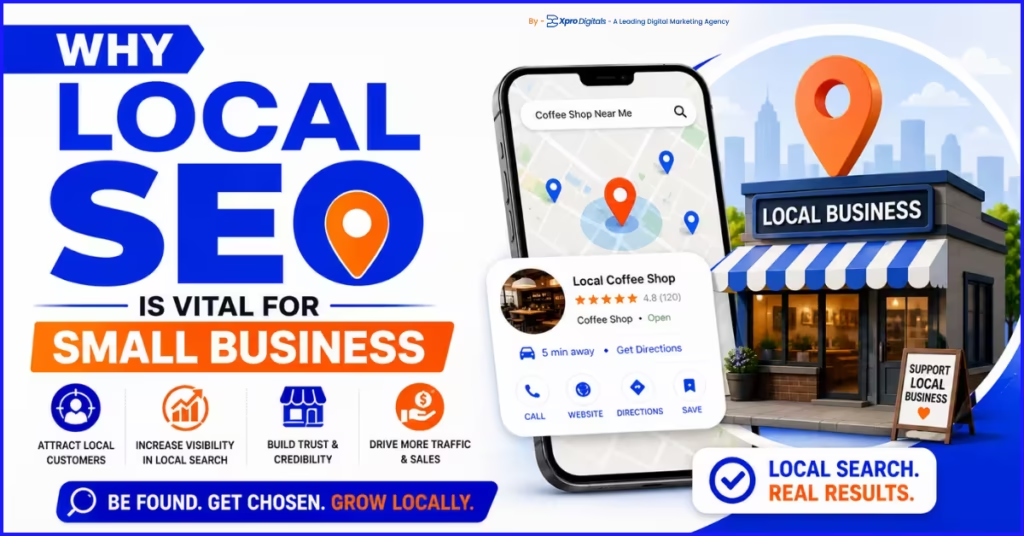
Local SEO is the practice of optimizing your online presence to appear prominently when nearby customers search for what you offer. For small businesses competing in a defined geographic area, it is the highest-return digital marketing investment available because it captures people who are already looking for exactly what you sell, at the moment they are ready to buy.
By the end of this guide you will understand why local SEO matters more in 2026 than ever before, what it covers, which businesses benefit most, and the exact steps to improve your local visibility starting today.
This guide focuses specifically on local SEO strategy. For a broader understanding of how SEO works across all business types before applying local tactics, our guide on what SEO is and how it works gives the foundational context that makes everything in this guide more actionable.
What Is Local SEO and How Is It Different From Regular SEO?
|
Local SEO is the process of optimizing your online presence to appear in search results for location-based queries. These are searches where the person is looking for a nearby business, service, or resource. When someone searches ‘dentist near me‘, ‘Italian restaurant Manchester‘, or ‘emergency locksmith tonight‘, Google prioritizes local results because geographic proximity is a central part of what makes a result useful. |
Regular SEO targets national or global audiences with content and authority signals designed to rank for broad keyword categories regardless of where the searcher is located. Local SEO targets a defined geographic area with signals specifically designed to tell Google that your business is the most relevant and credible option for people searching in that location.
Local SEO vs National SEO: Key Differences
| Factor | Local SEO | National SEO |
| Target audience | People in a specific geographic area | People across a country or globally |
| Primary signal | Google Business Profile completeness and reviews | Domain authority and backlink profile |
| Main result type | Map Pack (local pack) + local organic | Organic search results only |
| Competition level | Local businesses in your area | National brands and established domains |
| Time to results | 4 to 12 weeks for Map Pack improvements | 3 to 12 months for national organic rankings |
| Investment required | Moderate, accessible for small business | High, requires sustained content and link investment |
| Conversion rate | High, searcher has local buying intent | Variable, depends on query intent |
| Key tool | Google Business Profile | Google Search Console and content strategy |
For a more detailed comparison of how local and national SEO differ in approach, competitive dynamics, and expected outcomes, our guide on local SEO vs national SEO: key differences explained gives a complete breakdown with examples by business type.
Why Local SEO Matters More in 2026 Than It Ever Has
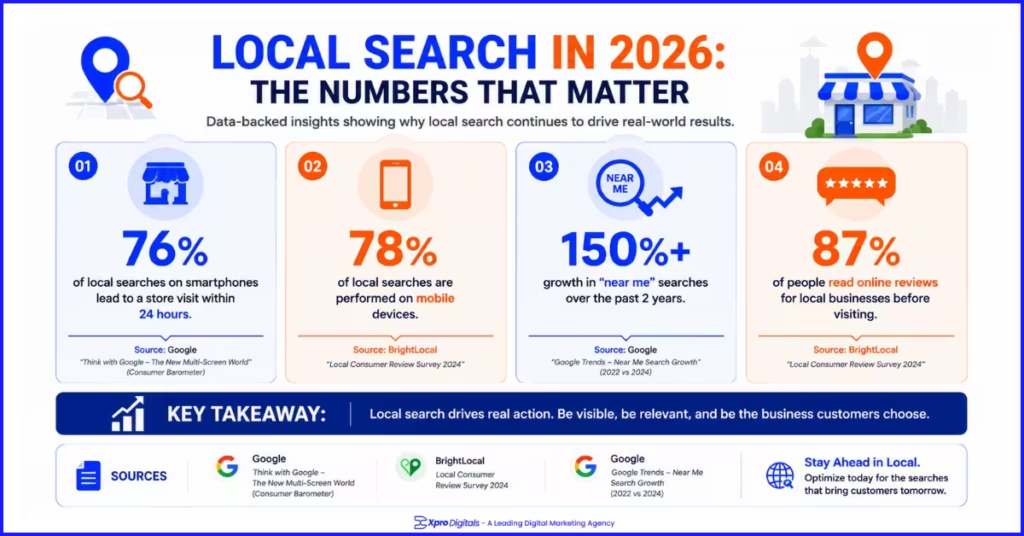
Four converging trends have made local SEO more valuable for small businesses in 2026 than at any previous point. Understanding each one explains why businesses that deprioritized local search in previous years are increasingly finding themselves invisible to their most valuable customers.
Trend 1: Mobile Search Dominates Local Discovery
The majority of local business searches now happen on mobile devices, frequently while the searcher is already out and looking for an immediate option. These searches carry the highest commercial intent of any query type.
A person searching ‘coffee shop near me‘ from their phone while walking through a shopping district is making a purchase decision in real time. The business that appears at the top of the Map Pack captures that customer. The business that does not appear loses them to a competitor who may be metres further away but more visible online.
Trend 2: Near Me Searches Continue Growing
‘Near me‘ searches have grown significantly year on year throughout the early 2020s and continue to increase. Google has reported that near-me searches have grown more than 500% over the past several years.
In 2026, these searches represent a core part of how consumers discover local businesses across every sector from food and retail to professional services and home trades. A small business without local SEO is effectively invisible for these searches.
Trend 3: Google AI Overviews Now Include Local Results
Google’s AI Overviews are beginning to incorporate local business data in responses to queries with local intent. This represents a new visibility channel for local businesses that have strong Google Business Profile signals, genuine reviews, and accurate structured data.
Businesses with complete, well-optimized local signals are more likely to appear in these AI-generated responses, which sit above the traditional organic listings and Map Pack.
Trend 4: Voice Search Drives Local Intent
Voice search through devices like Google Assistant, Siri, and smart speakers is heavily skewed toward local queries. ‘Where is the nearest pharmacy?‘, ‘What time does the hardware store close?‘, and ‘Find a plumber near me open now‘ are all voice search patterns that trigger local results.
Voice search optimization is an extension of local SEO because the same signals that improve Map Pack rankings also improve voice search answer eligibility.
The Three Local SEO Ranking Factors Google Uses
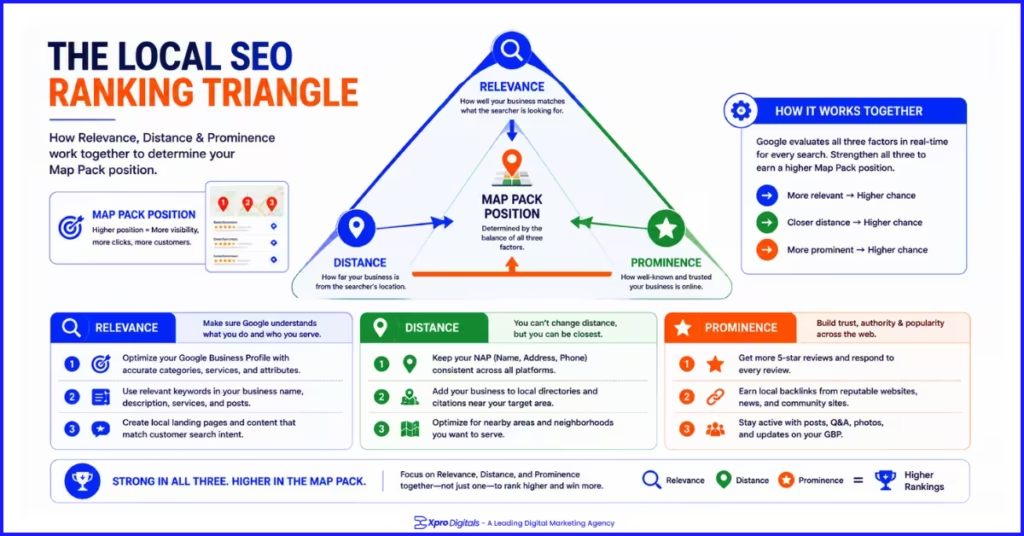
Google uses three core factors to determine which businesses appear in local search results and in what order. Understanding these three factors is the foundation of any effective local SEO strategy. Every tactic in this guide maps back to improving one or more of them.
Factor 1: Relevance
Relevance measures how well your business matches what the searcher is looking for. Google assesses relevance through your business category on Google Business Profile, the keywords in your GBP business description, the services and products you have listed, and the content of your website.
A plumber whose GBP lists specific services like ‘boiler repair‘, ‘emergency call-out‘, and ‘drain unblocking‘ is more relevant to queries for those specific services than a plumber whose profile simply says ‘plumber’.
Factor 2: Distance
Distance measures how close your business is to the searcher or to the location specified in the query. Google gives proximity significant weight in local results, particularly for searches without a specific location qualifier.
You cannot change where your business is physically located, but you can ensure your address is accurate and consistent across all platforms, and you can optimize for specific neighborhoods or districts within your service area to improve relevance for location-qualified searches.
Factor 3: Prominence
Prominence measures how well-known and credible your business is, both online and offline. Google assesses prominence through the number and quality of your Google reviews, your GBP post frequency, the quantity and quality of links from other websites to your business, how often your business name appears on other credible websites, and the overall completeness and accuracy of your online presence. Prominence is the factor most directly influenced by active local SEO investment.
Google Business Profile: The Foundation of Local SEO
Your Google Business Profile (GBP) is the single most important asset in local SEO. It is the business listing that appears in Google Maps and in the local pack (the map with three business listings that appears above organic results for local queries). A business without a GBP is essentially invisible in local search. A business with an incomplete or inaccurate GBP performs significantly below its potential.
We worked with a restaurant that had a GBP claimed but largely untouched. No photos had been added in 14 months. The opening hours were incorrect for two days of the week. The business description was 22 words and mentioned no cuisine type. They had 11 reviews and had not responded to a single one. Competitors appearing above them in the local pack had between 80 and 220 reviews and posted on GBP weekly.
After a full GBP optimization including corrected hours, 40 photos added across categories, a detailed business description with primary keywords, a complete service list with individual descriptions, and a systematic review request campaign to recent customers, the restaurant entered the top three in the local pack for their primary search terms within seven weeks. Reservation enquiries from Google increased 64% in the following six weeks.
Google Business Profile optimization Checklist
| GBP Element | Best Practice | Common Mistake | Done? |
| Business name | Exact legal name, no keyword stuffing | Adding keywords like ‘best plumber’ to business name | |
| Primary category | Most specific accurate category available | Choosing a broad category to appear for more searches | |
| Secondary categories | All relevant additional services | Using only one category when multiple apply | |
| Business description | 160 words, primary keywords included naturally | Generic description with no keyword relevance | |
| Address | Exact address matching website and all directories | Abbreviated or inconsistent address format | |
| Phone number | Local number, consistent across all platforms | Different number on website and GBP | |
| Website URL | Correct and working URL | Broken link or homepage when location page exists | |
| Hours | Accurate including special holiday hours | Incorrect hours leading to customer frustration | |
| Photos | Minimum 10, updated regularly, all categories covered | No photos or only 1-2 poor quality images | |
| Services/Products | Every service listed with individual description | Empty services section | |
| GBP Posts | Weekly posts with offers, updates, or events | No posts or posts more than 6 months old | |
| Q&A section | Populated with common customer questions | Empty or unanswered questions from customers |
For a complete audit of your Google Business Profile against every ranking signal Google uses for local search, our Google Business Profile audit checklist gives a structured framework to identify every gap in your current profile.
Why Reviews Are the Highest-Impact Local SEO Signal
Customer reviews on your Google Business Profile are simultaneously a local ranking factor and the most influential trust signal for prospective customers comparing local options. Businesses with more reviews and higher average ratings consistently appear higher in the local pack and earn more clicks from the same position than those with fewer reviews.
Google’s local ranking algorithm uses review count, review recency, review rating, and the presence of keywords in review text as signals of business prominence. A business that actively generates a consistent flow of genuine reviews builds these signals faster and more sustainably than one that relies on organic review accumulation.
We ran a review generation campaign for a physiotherapy clinic that had 8 reviews at an average of 4.1 stars. Competitors in the local pack had between 40 and 90 reviews. Over 10 weeks, through a systematic post-appointment text message follow-up asking satisfied patients to leave a Google review, the clinic generated 43 new reviews at an average of 4.9 stars. Their Map Pack ranking moved from position 7 to position 2 for their primary keyword. New patient enquiries from Google increased 88%.
Ethical Review Generation Strategy
| Method | How It Works | Compliance |
| Post-visit email with review link | Automated email sent 24-48hrs after visit with direct GBP review link | Compliant with Google guidelines |
| SMS follow-up to recent customers | Text message with direct review link sent after service completion | Compliant with Google guidelines |
| QR code on receipt or card | Physical QR code directing to GBP review page | Compliant with Google guidelines |
| In-person verbal request | Team trained to mention reviews to satisfied customers | Compliant with Google guidelines |
| Incentivized reviews | Offering discounts or free items in exchange for reviews | Violates Google guidelines, risk of penalty |
| Review gating | Only sending review requests to customers who say they are happy | Violates Google guidelines |
| Buying reviews | Purchasing fake reviews from services | Violates Google guidelines, risk of removal and penalty |
Our guide on how to get more Google reviews ethically covers every compliant review generation method with specific templates and timing recommendations for each approach.
NAP Consistency: The Silent Local SEO Killer
NAP stands for Name, Address, and Phone number. Consistency of these three pieces of information across every online platform where your business is listed is a foundational local SEO signal.
Inconsistencies confuse Google’s ability to confidently identify your business and suppress your local rankings as a result.
NAP inconsistencies are more common than most business owners realize. An old address on an industry directory from when you moved premises five years ago. A phone number on Yelp that differs from the one on your website by a single digit.
A business name listed as ‘Smith Plumbing‘ on one platform and ‘Smith Plumbing and Heating Ltd‘ on another. Each of these creates a conflicting signal that reduces Google’s confidence in your business data.
Audit your business listings across Google Business Profile, Bing Places, Apple Maps, Facebook, Yelp, Trustpilot, Yell, and any industry-specific directories relevant to your sector.
Every listing should show an identical name, address, and phone number matching exactly what appears on your website. Fix every discrepancy before investing in any other local SEO activity.
NAP Audit Checklist
| Platform | Check Name | Check Address | Check Phone | Consistent? |
| Google Business Profile | ||||
| Website contact page | ||||
| Bing Places | ||||
| Apple Maps / Apple Business Connect | ||||
| Facebook business page | ||||
| Yelp | ||||
| Trustpilot | ||||
| Yell.com | ||||
| Industry-specific directory 1 | ||||
| Industry-specific directory 2 |
Local Keyword Research for Small Businesses
Local keyword research is the process of identifying the specific search queries your nearby customers use when looking for businesses like yours. It differs from standard keyword research because geographic qualifiers, such as city names, neighborhood names, and near-me modifiers, significantly change both search volume and competition level.
A plumber in Sheffield should not just target ‘boiler repair‘. They should target ‘boiler repair Sheffield‘, ‘emergency plumber Hillsborough‘, ‘boiler service South Yorkshire‘, and variations that reflect the specific areas they serve and the specific services they provide. Each geographic and service combination is a distinct keyword with its own search volume and competitive landscape.
Local Keyword Research Process
Step 1: List Your Core Services
Write down every service you offer. For a dentist, this might include general check-ups, teeth whitening, emergency dentist, Invisalign, dental implants, and children’s dentistry. Each service is a separate keyword cluster.
Step 2: Map Your Geographic Coverage
List every area you serve: your primary city, surrounding towns, and specific neighbourhoods or districts where you regularly get customers. Each location combined with each service creates a distinct local keyword opportunity.
Step 3: Research Search Volume and Competition
Use Google Keyword Planner, Ahrefs, or Semrush to check monthly search volume for your service plus location combinations. Also check the Google autocomplete suggestions for each primary term to find additional long-tail local variations. Note competition level: local keywords are typically less competitive than national ones.
Step 4: Analyze Your Local Competitors
Search each of your target keywords in incognito mode. Note which businesses appear in the Map Pack and which appear in local organic results. Review their GBP profiles, their website content, and their review counts. Identify the gap between their local SEO signals and yours. That gap is your optimization opportunity.
Step 5: Map Keywords to Pages
Your GBP targets your primary location and service combination. Individual service pages on your website target specific service plus location keyword combinations. Separate location landing pages target each additional city or area you serve. Blog content targets informational local queries from potential customers in the research stage.
On-Page Local SEO for Your Website
Your website reinforces and extends the local signals in your Google Business Profile. Every page on your site that is relevant to local search needs specific on-page optimization that tells Google which location you serve and for which services.
Local On-Page SEO Checklist
| Page Element | Local SEO Best Practice | Done? |
| Title tag | Include primary service + location: ‘Emergency Plumber Sheffield | 24/7 Call-Out‘ | |
| H1 tag | Include location and primary service naturally | |
| Meta description | Mention location, service, and a local-specific differentiator (same-day service, local team) | |
| Content body | Reference location, local landmarks, service areas naturally throughout | |
| Contact page | Full NAP matching GBP exactly, embedded Google Map, opening hours | |
| LocalBusiness schema | Implemented with name, address, phone, hours, service area, reviews | |
| Location in URL | Service area pages at /plumber-sheffield/ or /sheffield-emergency-plumber/ | |
| Internal linking | Service pages link to location pages, location pages link to service pages | |
| Image alt text | Include location in alt text for relevant images where natural | |
| Mobile usability | All contact details tappable on mobile, map works on mobile |
LocalBusiness Schema: The Technical Signal Most Small Businesses Miss
LocalBusiness schema is structured data code added to your website that tells Google explicitly what type of business you are, where you are located, what your opening hours are, and how to contact you. It is the technical equivalent of your Google Business Profile and supplements the signals Google reads from your GBP with additional data from your own website.
Implementing LocalBusiness schema gives Google greater confidence in your business data, which contributes to prominence signals in the local ranking algorithm. It also enables rich results in search including opening hours and review stars displayed directly in your search listing. For small businesses, this schema is straightforward to implement using a plugin like Yoast SEO or Rank Math on WordPress, or through Google Tag Manager.
Our guide on ecommerce schema markup implementation including LocalBusiness structured data covers the technical implementation of LocalBusiness schema with working code examples and validation steps using Google’s Rich Results Test.
Local Link Building: Building Prominence Offline and Online
Backlinks from locally relevant, credible websites are one of the strongest prominence signals in local SEO. A link from your local chamber of commerce, a regional newspaper article about your business, a sponsorship mention on a local sports club website, or a feature on a local business blog all contribute to your prominence in ways that a generic national directory link does not.
Local link building is often more accessible than national link building because the relationship-based nature of local business communities creates natural linking opportunities.
Sponsoring a local charity event and getting a mention on their website, being featured in a local newspaper’s business section, contributing expert quotes to a regional publication, and partnering with complementary local businesses to create referral content are all realistic local link building activities for a small business.
We audited the local SEO for a family law solicitor whose main competitor had 34 links from locally relevant sources including the local law society, a regional business awards site, a local parents’ forum, and several local news outlets.
Our client had 6 links, all from generic legal directories. A six-month local link building program focusing on community involvement and press outreach generated 19 new locally relevant links. Map Pack ranking improved from position 6 to position 2 for their primary keyword within that period.
Local SEO for Service Area Businesses
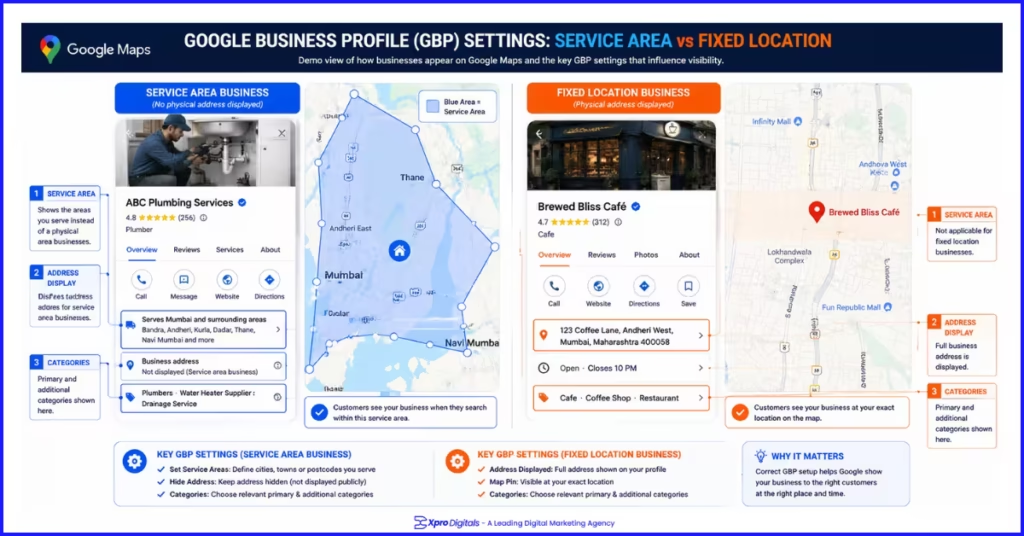
Not all local businesses serve customers from a fixed address. Plumbers, electricians, landscapers, mobile beauticians, and cleaning services work from a base but serve customers across a wider area. These service area businesses (SABs) have specific local SEO challenges because their customers are spread across multiple postcodes rather than concentrated near a single address.
For SABs on Google Business Profile, set your service area by listing the cities, regions, or postcodes you cover rather than hiding your address. Do not hide your address unless you genuinely do not want customers to visit. If you have a physical base, even a home office, displaying that address while also setting a service area gives Google more location data to work with than a hidden address only.
Create individual service area pages on your website for each significant location you serve. A plumber covering Sheffield, Rotherham, and Barnsley should have separate pages optimized for each location with unique content describing their service in that area, customer testimonials from that area, and local context specific to each town.
Local SEO Mistakes Small Businesses Make Most Often
| Mistake | Why It Hurts Local Rankings | Fix |
| Unclaimed or incomplete GBP | Missing the primary local ranking asset entirely | Claim, verify, and fully complete your GBP |
| Keyword stuffing in business name | Violates GBP guidelines, risks suspension | Use your exact legal business name only |
| Inconsistent NAP across platforms | Conflicting signals reduce Google’s confidence | Audit and standardise all directory listings |
| No photos on GBP | Low prominence signal, poor first impression | Add minimum 10 high-quality photos across all categories |
| Not responding to reviews | Missed prominence signal, poor reputation management | Respond to every review within 48 hours |
| No local keyword targeting on website | Website does not reinforce local relevance | Add location + service combinations to titles and content |
| No LocalBusiness schema | Missing technical local signal | Implement via SEO plugin or Tag Manager |
| Ignoring negative reviews | Unanswered complaints compound reputational damage | Respond professionally to every negative review |
| No GBP posts | Lower prominence signal than active competitors | Post weekly updates, offers, or events |
| Generic service descriptions on GBP | Lower relevance for specific service queries | Add individual service listings with specific descriptions |
People Also Ask: Why Local SEO Matters for Small Businesses
What Is Local SEO and Why Is It Important for Small Businesses?
Local SEO is the process of optimizing your online presence to appear in search results when nearby customers search for your services. It is important for small businesses because it captures customers with immediate buying intent who are searching in your area.
A person searching ‘accountant near me‘ or ‘florist [your city]‘ is ready to engage a local business. Local SEO puts your business in front of them at that moment.
How Does Local SEO Help Small Businesses Get More Customers?
Local SEO helps small businesses appear in Google Maps results and local organic search listings when nearby customers search for relevant services.
Higher visibility in these results drives phone calls, direction requests, website visits, and in-store visits from customers who are actively looking for what you offer.
Businesses that appear in the local pack (top three Map results) consistently capture the majority of local search clicks for their target queries.
What Is the Google Map Pack and How Do I Get My Business in It?
The Google Map Pack is the set of three local business listings that appear with a map above organic search results for location-based queries.
To appear in it, you need a verified, complete Google Business Profile with accurate information, a strong review profile with regular new reviews, consistent NAP information across all online platforms, and a website that reinforces your local relevance through keyword-optimized content and LocalBusiness schema.
How Long Does It Take for Local SEO to Show Results?
Local SEO typically produces faster results than national SEO. Google Business Profile improvements can show Map Pack ranking changes within four to eight weeks. Fixing NAP inconsistencies and completing a GBP profile have produced visible ranking improvements in as little as two to three weeks in some cases.
Building reviews take three to six months to accumulate a volume that significantly improves prominence signals. A well-executed local SEO programme typically shows measurable business impact within 90 days.
Do I Need a Website for Local SEO?
No, but having one significantly improves your local SEO performance. A Google Business Profile alone can earn local pack rankings.
However, a well-optimized website provides additional relevance and authority signals that strengthen your overall local search position.
Businesses with both a complete GBP and an optimized website consistently outperform those relying on GBP alone, particularly for competitive local markets.
How Do Google Reviews Affect Local SEO Rankings?
Google reviews are a direct local ranking signal through the prominence factor. Review count, average rating, review recency, and the presence of relevant keywords in review text all contribute to your prominence score in the local algorithm.
Businesses with more high-quality recent reviews consistently rank higher in the local pack than competitors with fewer or lower-rated reviews, all other factors being equal.
What Are Local Citations and Why Do They Matter?
Local citations are mentions of your business name, address, and phone number on other websites and directories.
Consistent citations across credible platforms including Google Business Profile, Bing Places, Apple Maps, Yelp, and industry directories build Google’s confidence in your business data.
The consistency of your NAP across these citations is a foundational local ranking signal. Inconsistent citations weaken your local authority.
How Do I Rank Higher on Google Maps?
Rank higher on Google Maps by completing and optimizing your Google Business Profile, generating a consistent flow of genuine customer reviews, ensuring your NAP is consistent across all online platforms, adding LocalBusiness schema to your website, creating location-specific content on your website pages, earning links from locally relevant websites, and posting regularly on your GBP with updates, offers, and event information.
What Is NAP Consistency and Why Does It Matter?
NAP stands for Name, Address, and Phone number. Consistency means these three pieces of information are identical across every online platform where your business appears.
Inconsistencies such as different phone numbers on different platforms or abbreviated addresses create conflicting signals that reduce Google’s confidence in your business data, which suppresses your local rankings. Auditing and standardising your NAP across all platforms is one of the fastest local SEO fixes available.
Is Local SEO Expensive for Small Businesses?
Local SEO is accessible at a range of investment levels. optimizing your Google Business Profile, standardising your NAP, and implementing a review generation process can be done without external help and at minimal cost.
A basic local SEO programme with an agency or consultant typically ranges from 500 to 2,000 USD per month depending on your market and competitive landscape.
For most small businesses, the return on this investment in customer acquisition is positive within the first three to six months.
What Is the Difference Between Local SEO and Regular SEO?
Regular SEO targets broad audiences regardless of location and focuses on domain authority, content depth, and keyword rankings in national organic results.
Local SEO targets customers in a specific geographic area and focuses on Google Business Profile optimization, local reviews, NAP consistency, and Map Pack visibility. Local SEO typically delivers faster results and higher conversion rates for small businesses because it captures customers with immediate location-specific buying intent.
How Do I Do Local SEO Myself?
Start by claiming and fully completing your Google Business Profile. Standardise your NAP across all major directories. Add LocalBusiness schema to your website. optimize your service page titles and content with location and service keyword combinations. Implement a review generation process for satisfied customers.
Post weekly updates on your GBP. Build relationships with local organisations and publications for locally relevant backlinks. Monitor your local rankings monthly using Google Search Console and a local rank tracking tool.
Can Local SEO Work Without a Physical Location?
Yes. Service area businesses that operate from a home base or travel to customers can still benefit significantly from local SEO. Set your service area in Google Business Profile to reflect the postcodes or cities you cover.
Create service area pages on your website for each significant location. Build local citations using your home or registered business address. Generate reviews from customers in each area you serve.
These signals allow service area businesses to appear in local results across their full coverage zone.
What Local SEO Tools Should Small Businesses Use?
- Google Business Profile (free, essential)
- Google Search Console (free, tracks local organic performance)
- Google Analytics 4 (free, tracks conversions from local search)
- BrightLocal (paid, local rank tracking and citation audit)
- Whitespark (paid, local citation building)
- Moz Local (paid, automated citation management)
These tools together give you full visibility into your local search performance without requiring the full-scale SEO tool subscriptions used in national programmes.
How Important Are Google Business Profile Posts for Local SEO?
GBP posts contribute to the prominence signal in Google’s local algorithm by indicating that a business is active and engaged with its online presence. Regularly posting updates, offers, events, and product information tells Google your business is current and operating.
Posts also give potential customers reasons to choose your business over a competitor with an inactive profile. We recommend posting at minimum once per week, with a mix of content types across updates, offers, and event posts.