How to Choose an SEO Agency: The Complete Guide for Getting It Right
Introduction: Why Choosing the Wrong SEO Agency Is So Costly
Here is the situation most businesses end up in. They spend weeks researching SEO agencies, receive several proposals, and pick the one that sounds most confident or costs the least. Three months later the reports show lots of activity but rankings have not moved. Six months later the contract is up and organic traffic looks exactly the same as it did on day one.
The pain is significant. Not just the wasted budget. The lost time. The opportunity cost of months when your competitors were growing their organic visibility while yours stayed flat. And then the dread of starting the search again, this time without knowing what you missed the first time.
The problem is not that good SEO agencies do not exist. They do. The problem is that the SEO industry has a low barrier to entry and no regulated standard of qualification. Anyone can call themselves an SEO expert, build a website, and pitch for your business.
The difference between an agency that will grow your organic revenue and one that will produce activity reports for six months before you realise nothing is happening is not always obvious from the outside.
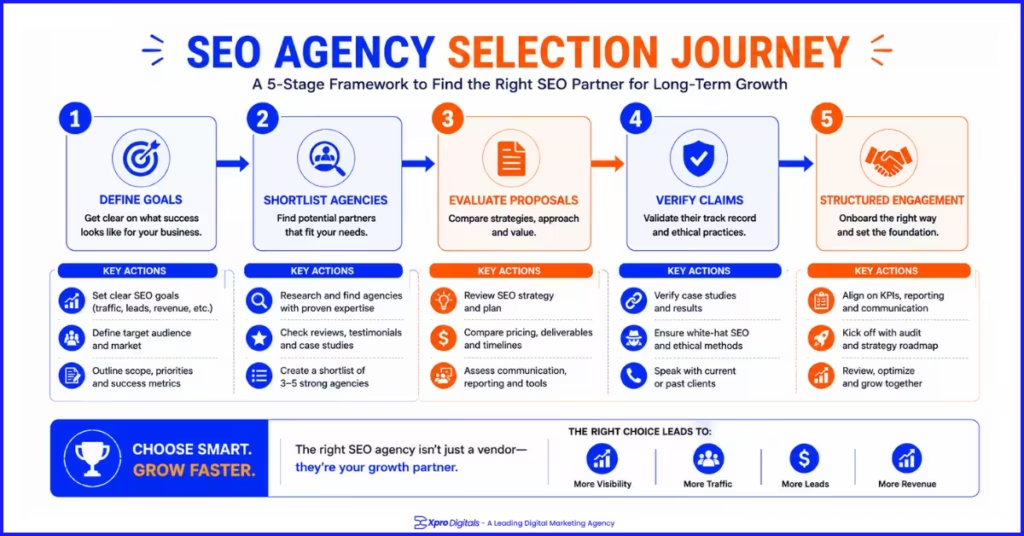
This guide solves that problem. By the end, you will have a complete evaluation framework covering what to assess, what questions to ask, what red flags to look for, and how to structure the engagement so you can exit cleanly if the agency does not perform. You will also have the specific questions that reveal technical competence in the first conversation.
Before choosing an agency, it helps to understand what effective SEO should be delivering. Our guide on what SEO is and how it works gives the foundational context that makes every agency evaluation in this guide more meaningful.
Step 1: Define What You Need Before You Contact Anyone
The most common mistake in SEO agency selection is approaching agencies before you have defined what you actually need. Without clear goals, you cannot evaluate whether any proposal addresses your specific situation. You end up comparing agencies on price and presentation quality rather than on whether their approach will deliver your specific outcome.
Before requesting a single proposal, document four things.
First, your current organic performance: how much traffic you receive from search, which pages rank for which queries, and what your current organic revenue or lead volume is.
Second, your primary goal: more local visibility, national rankings for commercial keywords, ecommerce category page traffic, or B2B lead generation from informational content.
Third, your budget range.
Fourth, your expected timeline for seeing results.
With this document prepared, every agency you contact receives the same brief. This allows you to compare proposals that are built on the same foundation rather than on each agency’s interpretation of a vague conversation. It also immediately filters out agencies that pitch the same generic strategy regardless of the brief, which is one of the most reliable early indicators of a low-quality provider.
Pre-Selection Brief Template
| Element | What to Document |
| Current organic traffic | Monthly sessions from organic search (from Google Analytics) |
| Current top-ranking pages | Your 5 highest-traffic organic landing pages |
| Target keywords | 10-15 keywords you want to rank for, with their intent (informational, commercial, transactional) |
| Primary business goal | Leads, sales, local visibility, brand awareness |
| Monthly budget range | Your realistic range, not your aspirational minimum |
| Timeline expectation | When you need to see directional results to justify continued investment |
| Previous SEO history | Any previous agency relationships, penalties, or major site changes |
| Platform and tech stack | WordPress, Shopify, WooCommerce, custom CMS, etc. |
Step 2: Know the Different Types of SEO Agencies
Not all SEO agencies are the same, and choosing the wrong type for your needs is as problematic as choosing a poor-quality agency of the right type. Understanding the main agency types before you shortlist prevents misalignment between what you need and what you are evaluating.
Types of SEO Agencies
| Agency Type | What They Offer | Best For |
| Full-service SEO agency | Technical, on-page, content, link building, and reporting | Businesses needing complete ongoing SEO management |
| SEO consultant (solo) | Strategic direction, auditing, implementation oversight | Businesses with some in-house capacity needing senior guidance |
| Specialist SEO agency | Deep expertise in one area: technical, local, ecommerce, B2B | Businesses with specific high-priority SEO challenges |
| Digital marketing agency with SEO | SEO as one of several services | Businesses wanting integrated multi-channel marketing |
| White label SEO provider | Delivers SEO under another agency’s brand | Marketing agencies offering SEO to their own clients |
For most growing businesses, a full-service SEO agency delivers the best combination of coverage and accountability. For businesses with strong internal content or technical teams, a specialist agency filling a specific gap delivers more value per dollar. The key is matching the agency type to your actual gap, not to what any given agency happens to sell most aggressively.
Step 3: Build a Shortlist of Three to Five Agencies
Evaluating too many agencies is as problematic as evaluating too few. With more than five, comparison fatigue sets in and decisions get made on superficial signals like website design quality rather than substantive evaluation criteria. With fewer than three, you do not have enough comparison data to identify whether a proposal is genuinely strong or just better than the one alternative you reviewed.
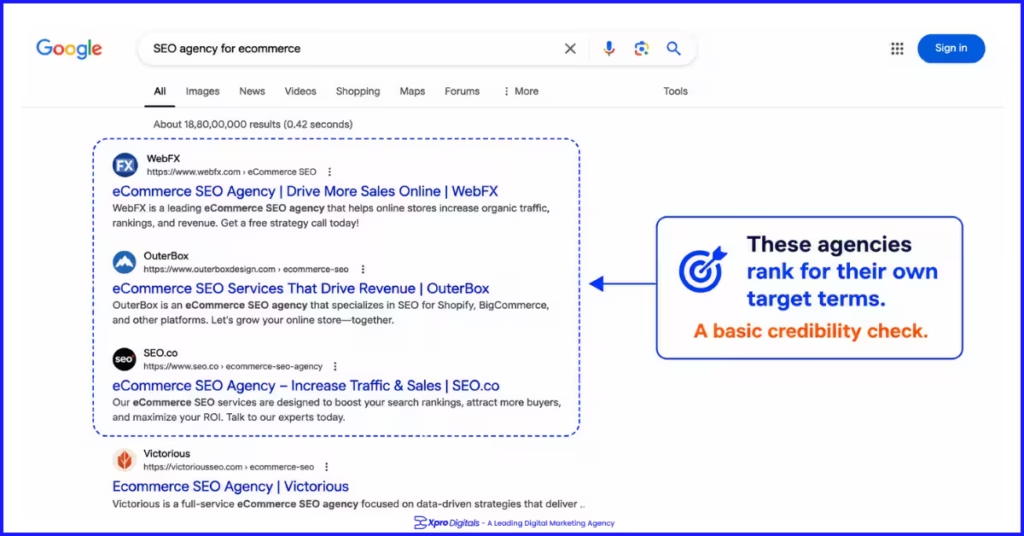
Sources for finding credible agencies: referrals from businesses in your network who have had measurable SEO results. Industry directories like Clutch, G2, or Agency Spotter which include verified client reviews with specific metrics. Google searches for ‘SEO agency for [your industry]’ noting which agencies rank well organically, since an agency that cannot rank itself for relevant terms should be questioned on their SEO capability. LinkedIn searches for SEO agencies in your region with client recommendations.
Apply one pre-filter before adding any agency to your shortlist: review their own website. Is it technically sound? Does it rank for terms relevant to their services? Is the content genuinely useful or thin and generic? An agency that does not invest in its own SEO is telling you something important about how seriously they take the discipline.
Step 4: Send a Detailed Brief and Evaluate the Proposals
Once you have your shortlist, send each agency the pre-selection brief you prepared in Step 1. Give them seven to ten working days to respond with a proposal. A good agency will use that time to research your site, review your competitors, and produce a proposal that reflects your specific situation. A poor agency will send a template pitch deck with your logo added.
What a Strong SEO Agency Proposal Includes
| Proposal Element | What Good Looks Like | Red Flag |
| Situation analysis | References your specific current performance and site issues | Generic description of SEO without referencing your site |
| Proposed strategy | Tailored approach addressing your specific goals | Same three-step strategy in every proposal |
| Monthly deliverables | Specific list of what will be done each month | Vague scope like ‘SEO optimization and reporting’ |
| KPIs and measurement | Business outcome metrics tied to your stated goal | Rankings and traffic only, no conversion or revenue metrics |
| Timeline and milestones | Realistic milestone map with honest caveats | Guaranteed rankings or unrealistic early-stage promises |
| Team structure | Named or described team members and their roles | No mention of who actually works on the account |
| Case studies | Specific client results from comparable businesses | Generic before/after claims without context |
| Pricing clarity | Clear breakdown of what each cost covers | Single all-in number with no scope detail |
Step 5: Ask These Specific Questions Before Signing Anything
The discovery call or proposal presentation is your opportunity to test the agency’s technical knowledge and identify whether they understand your specific situation. Most agencies have polished presentations. The questions below reveal whether the knowledge behind the presentation is genuine.
Technical SEO Questions to Ask
| Question | What a Credible Answer Includes | Warning Sign |
| How would you audit our site for technical SEO issues? | Mentions Screaming Frog, GSC Coverage, log file analysis, Core Web Vitals | Just says ‘we check for errors’ without specific tools or methods |
| What would you look for in our robots.txt and sitemap? | Discusses blocking rules, sitemap accuracy, no-index pages, canonicals | Cannot explain what robots.txt controls |
| How do you handle duplicate content on ecommerce sites? | Explains canonical tags, parameter management, variant URL handling | Says ‘we just avoid duplicate content’ |
| What Core Web Vitals thresholds does Google use? | LCP under 2.5s, INP under 200ms, CLS under 0.1 | Vague answer about page speed without specific metrics |
| How would you identify our crawl budget issues? | Mentions log file analysis, crawl depth reports, GSC crawl stats | Does not know what crawl budget means |
Content and On-Page Questions to Ask
| Question | What a Credible Answer Includes | Warning Sign |
| How do you research keywords for a new client? | Mentions Ahrefs or Semrush, intent classification, competitor gap analysis | Says ‘we look at what people search for’ |
| How do you determine search intent for a keyword? | Explains reviewing SERP format to identify informational/commercial/transactional intent | Cannot explain intent beyond volume and difficulty |
| Can we see examples of content you have produced for similar clients? | Provides samples with context on the target keyword and intent | Refuses to share samples or sends very generic examples |
| How do you optimize an existing page that is not ranking? | Covers title tag, heading structure, content depth, intent match, schema | Just says ‘add more keywords’ |
Link Building Questions to Ask
| Question | What a Credible Answer Includes | Warning Sign |
| What is your link building approach? | Describes outreach, content-driven link earning, digital PR | Mentions link packages, bulk submissions, or PBNs |
| How many links do you build per month? | Gives a range with quality caveats, not a fixed number | Commits to a specific high number without quality criteria |
| Can you show us a sample of links you have built for other clients? | Provides examples with referring domain metrics | Refuses or provides only directory links |
| Do you ever use paid links? | Clear ‘no, it violates Google guidelines’ | Hedges, says ‘it depends’, or implies paid links are standard |
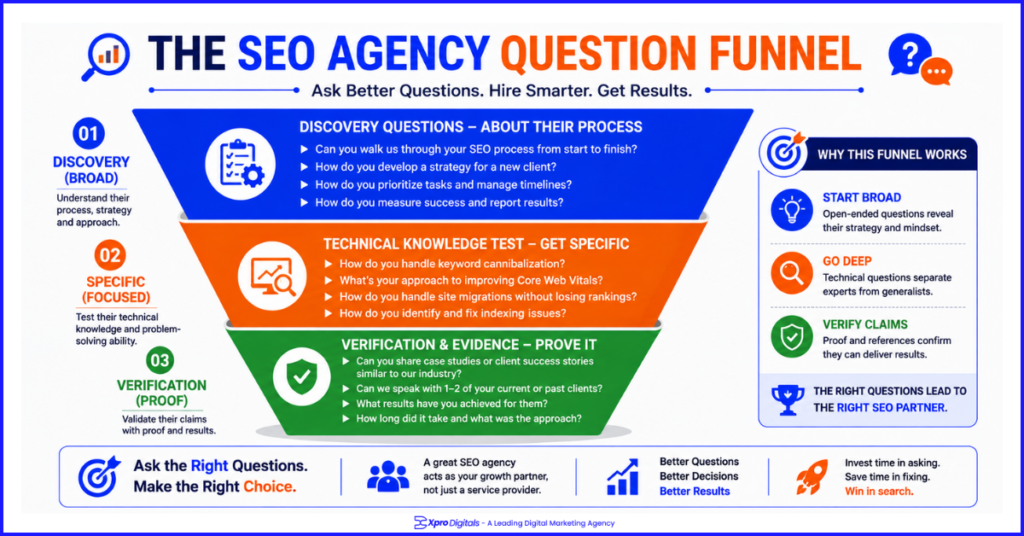
Step 6: Evaluate Their Own Online Presence
Before committing to any agency, spend 30 minutes independently evaluating their own digital presence. An SEO agency is its own most demonstrable case study. If they cannot rank their own pages, optimize their own website, or produce genuinely useful content on their own blog, that is meaningful evidence about the quality of work you can expect for your business.
Self-Evaluation Checklist for SEO Agencies
| Check | What to Look For | How to Verify |
| Their website ranks for relevant terms | Agency appears organically for searches like ‘SEO agency [city]’ or ‘ecommerce SEO agency’ | Google search in incognito mode |
| Their own Core Web Vitals pass | Site loads fast and passes mobile usability | PageSpeed Insights on their homepage |
| Their content is genuinely useful | Blog posts are detailed, well-structured, and cover topics with real depth | Read 2-3 recent posts |
| Schema markup implemented correctly | Rich results or breadcrumbs visible in their own search listings | Google Rich Results Test on their homepage |
| Their title tags are optimized | Title tags are keyword-led, under 60 characters, and specific | View source or use SEO browser extension |
| They have real client testimonials | Named clients, specific outcomes, verifiable company names | Search the companies mentioned in testimonials |
| Their backlink profile is credible | Links from industry publications, client websites, relevant directories | Ahrefs or Semrush free check on their domain |
Step 7: Check References and Verify Case Studies
Case studies and client testimonials on an agency’s website are marketing materials. They represent the best outcomes the agency has achieved, selected and presented in the most favourable light. Before taking them at face value, verify them independently.
Request three to five client references from the agency. Ask specifically for references from clients in a comparable industry or business type to yours.
When you speak with those references, ask four specific questions:
- How clearly did the agency communicate what they were doing and why?
- Were monthly deliverables consistently met?
- What measurable improvements did you see and over what timeframe?
- Would you re-sign with them today?
For case studies, ask the agency to walk you through one in detail on the call. Ask what the starting position was, what specific actions were taken, how long it took to see the results shown, and whether those results have been maintained. A genuine case study can be explained in detail. A fabricated or cherrypicked one tends to become vague under direct questioning.
Step 8: Understand the Contract Before You Sign
The contract is where many businesses create problems for themselves by signing terms they have not fully read. Specific contract elements to review carefully before signing any SEO agency agreement.
SEO Agency Contract Checklist
| Contract Element | What to Look For | What to Push Back On |
| Notice period | 30 to 90 days is standard and reasonable | 12-month lock-in with no performance exit clause |
| Scope of work | Specific monthly deliverables listed by task | Vague scope language like ‘SEO services as agreed’ |
| Reporting frequency | Monthly reporting at minimum, with specified metrics | Quarterly reporting only or no reporting commitment |
| Data ownership | You own all content, reports, and account access | Agency retains ownership of work product on termination |
| Account access | Your own admin access to GSC, GA, and CMS at all times | Agency manages accounts under their own login |
| Performance review clause | Defined process for reviewing and adjusting if KPIs are not met | No mechanism for addressing underperformance |
| Payment terms | Monthly in advance, clear invoice schedule | Large upfront payment before any work begins |
| Exclusivity clause | Check if they work with direct competitors | No competitor exclusivity even in your specific market |
Step 9: Start With a Defined Trial Period
Rather than signing a 12-month commitment before you have experienced the agency’s work quality, negotiate a three-month initial engagement with monthly rolling terms thereafter. This structure protects you financially while giving the agency enough time to demonstrate their process and produce initial results.
In the first three months, a credible agency should deliver a technical audit with prioritised fix recommendations, a keyword research document and content strategy, initial on-page optimizations on your priority pages, and a clear reporting framework showing baseline metrics and early directional progress. If they cannot deliver these outputs in three months, a longer commitment is unlikely to produce better results.
Set a specific milestone at the end of month three: a review meeting where you assess the audit findings against what has been implemented, the keyword strategy against your stated business goals, and early ranking movements against the target keywords identified in the brief. Use this meeting to decide whether to continue on the agreed monthly terms.
Red Flags: Walk Away From Any Agency That Does These Things
Some agency behaviours are clear signals that the relationship will not produce results and may actively harm your site. No amount of confidence, slick presentation, or low pricing justifies ignoring these warning signs.
Non-Negotiable Red Flags
| Red Flag | Why It Is Disqualifying |
| Guarantees page one rankings within a specific timeframe | No one controls Google’s ranking decisions. This is either ignorance or deception. |
| Claims a special relationship with Google | Google has no such arrangements with any agency. |
| Cannot name the tools they use for technical auditing | Professional SEO without professional tools is not professional SEO. |
| Proposes building links through bulk packages or PBNs | Violates Google Search Essentials. Risks a manual penalty to your domain. |
| Refuses to provide client references | Has something to hide about actual client relationships. |
| Reports activity metrics only with no outcome data | Activity is not the same as results. This is a distraction from underperformance. |
| Requires access to your GSC without giving you admin access | Removes your ability to see your own data independently. |
| Sends the same proposal to every prospect | Has not looked at your site or understood your situation. |
| Pushes for a 12-month minimum before you have seen any work | Protect their revenue rather than aligning to your outcomes. |
| Cannot explain their content strategy beyond ‘writing blogs’ | Has no understanding of search intent, keyword targeting, or topical authority. |
How to Evaluate SEO Agency Pricing
Price alone is not a reliable quality signal in SEO. A 500 USD per month agency is not necessarily lower quality than a 5,000 USD agency. But price combined with scope of work and demonstrated capability gives you a meaningful comparison framework.
SEO Agency Pricing: What to Expect at Each Level
| Monthly Budget | Realistic Scope | Best For |
| Under 1,000 USD | Task-specific only: one technical audit or a few content pieces | Specific one-off needs, not ongoing strategy |
| 1,000 to 2,500 USD | Basic monthly: on-page, limited content, light reporting | Small local business with modest growth targets |
| 2,500 to 5,000 USD | Full-service: technical, content (4-6 pieces), link building, reporting | Growing SME with clear organic growth goals |
| 5,000 to 10,000 USD | Comprehensive: dedicated team, content at scale, active link building | Mid-market business in competitive space |
| 10,000 USD+ | Enterprise or large ecommerce: multiple specialists, high-volume content and links | Large ecommerce, national brand, or highly competitive market |
The pricing trap to avoid: choosing the cheapest full-service package. An agency charging 500 USD per month for ‘full SEO services’ cannot cover the tool costs, staff time, and quality content production required to deliver meaningful organic growth. At that price point, you are paying for activity documentation, not results.
For a full picture of how SEO agency investment compares to building in-house capability and what you should realistically expect at different investment levels, our guide on why businesses should hire an SEO agency covers the cost-benefit analysis in detail with real data from client engagements.
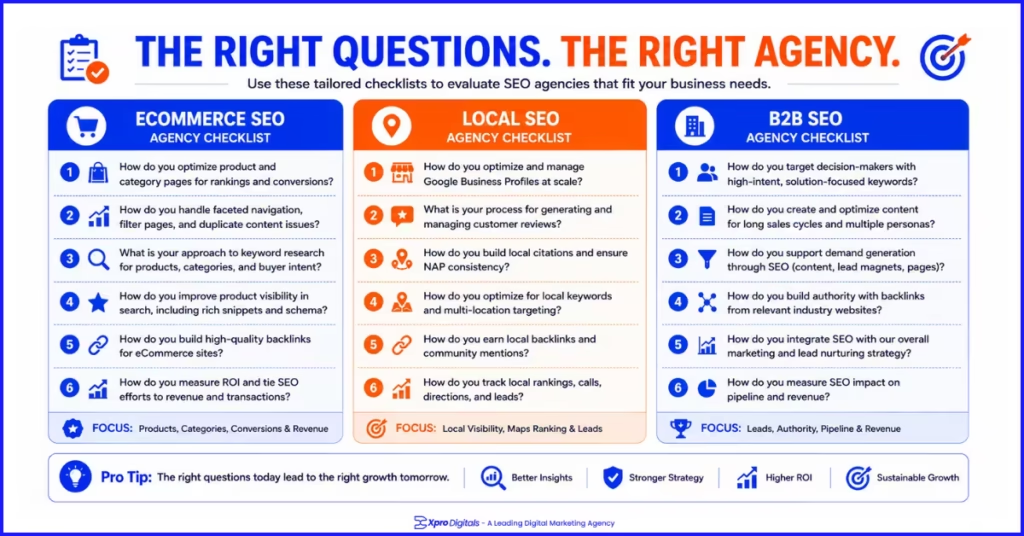
Choosing an SEO Agency for Specific Business Types
Choosing an SEO Agency for Ecommerce
Ecommerce SEO has specific technical and strategic requirements that generalist agencies frequently underestimate.
Your chosen agency should demonstrate specific experience with product and category page optimization, faceted navigation management, Product and AggregateRating schema implementation, and crawl budget management for large catalogues.
Ask for examples of ecommerce clients they have worked with and the specific technical problems they resolved.
Understanding what ecommerce SEO requires technically before evaluating any agency is essential.
Our ecommerce SEO checklist covers every technical and on-page area your agency should be addressing for an online store.
Choosing an SEO Agency for Local Businesses
A local SEO agency engagement should explicitly include Google Business Profile management, local citation building and NAP consistency auditing, local keyword research targeting location-qualified queries, and a review generation strategy.
Many general SEO agencies lack genuine local SEO expertise. Ask specifically what they have done for other local businesses and what Map Pack improvements they achieved.
Choosing an SEO Agency for B2B Companies
B2B SEO requires an agency that understands longer buying cycles, higher-value informational content, and keyword strategies that reflect how business buyers research rather than how consumers shop.
Your agency should be able to articulate how they approach top-of-funnel content that attracts decision-makers at the awareness stage alongside bottom-of-funnel content that captures purchase-ready searches.
People Also Ask: How to Choose an SEO Agency
What Should I Look for When Choosing an SEO Agency?
Look for specific case studies with measurable results from comparable businesses. Verify technical knowledge by asking direct questions about crawl budget, Core Web Vitals, and canonical tags. Review sample content and reporting formats.
Confirm they use professional tools like Ahrefs, Semrush, and Screaming Frog. Ensure the contract has clear deliverables and a reasonable notice period. Reject any agency that guarantees specific rankings.
How Much Should I Pay for an SEO Agency?
The budget depends on your market competitiveness and scope of work. Small local business SEO starts from 1,000 to 1,500 USD per month from a credible provider.
National or ecommerce SEO requires 2,500 to 5,000 USD per month for meaningful full-service activity. Below these benchmarks for full-service work, scrutinise what is actually being delivered rather than trusting the ‘full service’ label.
How Do I Know if an SEO Agency Is Legitimate?
A legitimate SEO agency can show specific client case studies with measurable results, provides named references willing to speak with you, uses professional tools (Ahrefs, Semrush, Screaming Frog), explains their approach in plain language, does not guarantee rankings, and has a website that ranks well for its own target terms. These signals together distinguish credible providers from those who produce reports without results.
What Questions Should I Ask an SEO Agency Before Hiring?
Ask the questions given below before hiring an SEO Agency:
- Which tools do you use for technical auditing?
- Can you walk me through how you would audit our site?
- How do you approach link building?
- Can I see examples of links built for other clients?
- What metrics do you report on and how do they connect to business revenue?
- Can I speak with two to three existing clients in a similar sector?
- What does your contract say about notice periods and data ownership?
How Long Should I Give an SEO Agency Before Judging Results?
Six months is the minimum meaningful evaluation period for most SEO engagements. Technical fixes can show results within weeks. On-page improvements on existing pages typically show ranking movement within four to eight weeks.
New content and link building take three to six months to generate measurable traffic impact. Evaluate agencies on directional progress at three months and clear outcome improvement at six months.
What Are Red Flags When Choosing an SEO Agency?
The clearest red flags are guaranteed rankings within a specific timeframe, inability to name the tools they use, proposals that do not reference your specific site or situation, refusal to provide client references, bulk link building packages, reports that show only activity metrics with no outcome data, requiring you to sign 12-month contracts before delivering any work, and claiming a special relationship with Google.
Should I Choose a Local SEO Agency or a Remote One?
For national SEO programmes, geography is largely irrelevant. For local SEO, an agency with experience in your specific market may have an advantage in understanding local search behaviour and competition.
However, a specialist remote agency with a proven track record in local SEO often outperforms a local generalist. Evaluate capability over proximity.
How Do I Compare SEO Agency Proposals?
Compare proposals on the same brief by evaluating:
- How specifically each agency addressed your stated goals?
- What monthly deliverables are listed in detail?
- Which KPIs do they propose measuring?
- What timeline they project for results and how realistic it is?
- What case studies do they use to demonstrate relevant capability?
- How clear is their pricing breakdown?
Do not make the decision based on presentation quality or website design.
What Is the Difference Between an SEO Agency and an SEO Freelancer?
An agency provides a team of specialists covering technical, content, link building, and analytics, with established processes and account management. A freelancer provides individual expertise at lower cost but with narrower scope and single-person bandwidth. Agencies suit ongoing full-service SEO management. Freelancers suit specific tasks or businesses with tighter budgets that need specialist support in one area.
How Do I Know if My SEO Agency Is Actually Working?
Track organic sessions to your key landing pages in Google Analytics, organic conversions and revenue from organic channels, click-through rate improvements in Google Search Console, and ranking improvements on target keywords over rolling three-month windows.
If these metrics are showing consistent directional improvement after six months, your agency is working. If they are flat despite six months of activity, request a strategy review.
Can I Switch SEO Agencies Without Losing Rankings?
Yes, if rankings were built through legitimate white hat SEO work such as quality content and genuine backlinks. Those rankings are attached to your domain, not to the agency.
When switching, ensure you have admin access to all your own accounts (GSC, GA, CMS), export all reports and strategy documents, brief the new agency thoroughly on what has already been done, and plan the transition to avoid a gap in technical maintenance.
What Is a Good SEO Agency Contract Length?
A three-month initial engagement with monthly rolling terms thereafter is the ideal structure for a new SEO relationship.
It gives the agency time to demonstrate their process and initial results while protecting you from a long financial commitment before you have seen the quality of their work.
After a successful initial period, many businesses move to six-month agreements that give the agency more confidence to invest in longer-term strategies.
Should I Choose an SEO Specialist Agency or a Full-Service Digital Agency?
For businesses where organic search is a primary growth channel, a specialist SEO agency typically delivers deeper expertise and more dedicated resources than a digital marketing agency treating SEO as one of many services.
Full-service agencies work better when you need coordinated multi-channel marketing and want one provider managing paid search, social, email, and SEO with shared audience and campaign data.
What Deliverables Should I Expect From an SEO Agency Every Month?
A quality SEO agency should deliver monthly: a written performance report covering agreed KPIs with context and commentary, specific completed tasks such as pages optimized, content published, or links built, a summary of what is planned for the following month, and any relevant algorithm update context affecting your rankings.
This combination of past activity, outcome data, and forward planning is the minimum standard for a credible monthly SEO engagement.
How Do I Evaluate an SEO Agency’s Link Building Approach?
Ask them to describe their link building process in detail. A credible answer involves content-driven outreach, digital PR, earning links from topically relevant sources, and measuring link quality by domain authority and topical relevance.
A concerning answer involves bulk link packages, private blog networks, link exchanges at scale, or fixed monthly link counts without quality criteria. Also ask to see examples of links they have built for other clients.