Why Should Businesses Hire an SEO Agency? The Honest Answer for 2026
Introduction: The Hidden Cost of Not Having Expert SEO
Here is a situation that plays out in businesses of every size. The website exists. The business is real. The products or services are genuinely good. But the phone does not ring from Google. The enquiry form sits empty. Competitors who launched later and have less to offer are ranking above you for every keyword that matters.
The frustrating part is that most business owners know SEO matters. They have either tried to handle it themselves, handed it to a marketing generalist, or signed up for a cheap package that promised results and delivered monthly PDF reports. None of those approaches moved the needle.
The pain here is not just about rankings. Every month your pages sit on page two or three is a month of lost qualified traffic, lost leads, and lost revenue going directly to competitors who invested in their organic visibility earlier and more strategically.
This guide answers one specific question: why should your business hire an SEO agency rather than managing SEO in-house, delegating it to an existing team member, or not prioritising it at all? The answer is grounded in real data, specific case studies, and a clear framework that makes the decision straightforward for businesses at every stage of growth.
Before deciding how to resource SEO, it helps to understand what effective SEO actually requires. Our guide on what SEO is and how it works covers the full scope of what your business is either investing in or missing out on.
The Core Reason: SEO Is a Multi-Discipline Specialism, Not a Task
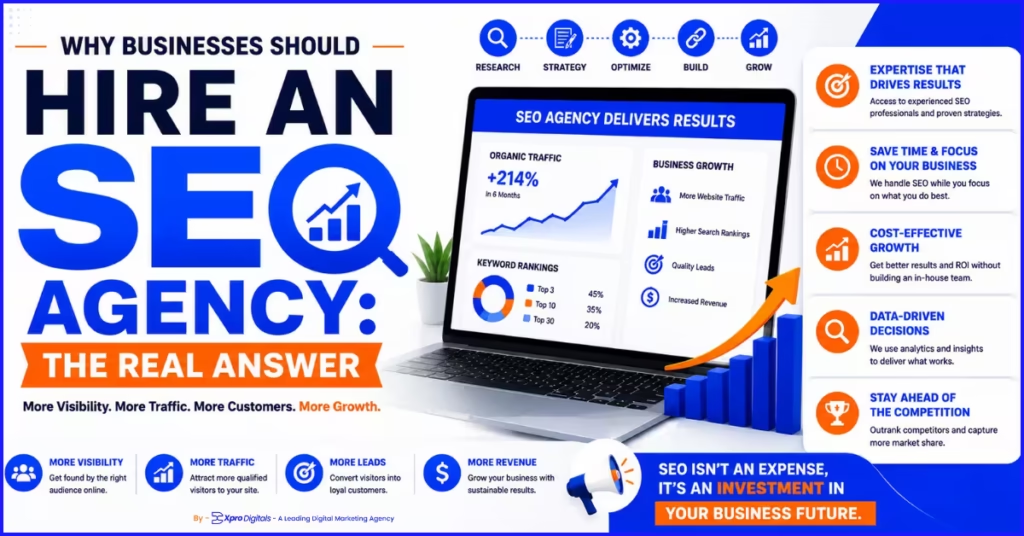
The single most important reason to hire an SEO agency is that effective SEO in 2026 requires expertise across at least five distinct disciplines simultaneously: technical website management, keyword and competitor research, content strategy and creation, authority building through links, and performance analytics.
No single generalist employee can do all of these at the level required to compete in a contested organic search market.
Consider what a technical SEO audit alone requires.
You need to be able to crawl a website with tools like Screaming Frog, analyse log files, interpret Core Web Vitals data from PageSpeed Insights and Google Search Console, understand how canonical tags, hreflang attributes, and robots.txt files interact, and translate all of that into a prioritised fix list with developer briefs.
This is a specialised skill set that takes years to develop.
Now add keyword research using Ahrefs or Semrush, content strategy across informational, commercial, and transactional intent types, link building through digital PR and outreach, schema markup implementation for rich results, and monthly performance reporting that connects organic metrics to business revenue.
Each of these is a career specialisation. A junior marketing hire or an existing team member given ‘SEO’ as an additional responsibility cannot realistically deliver across all of them.
Reason 1: Access to a Team of Specialists, Not a Single Generalist
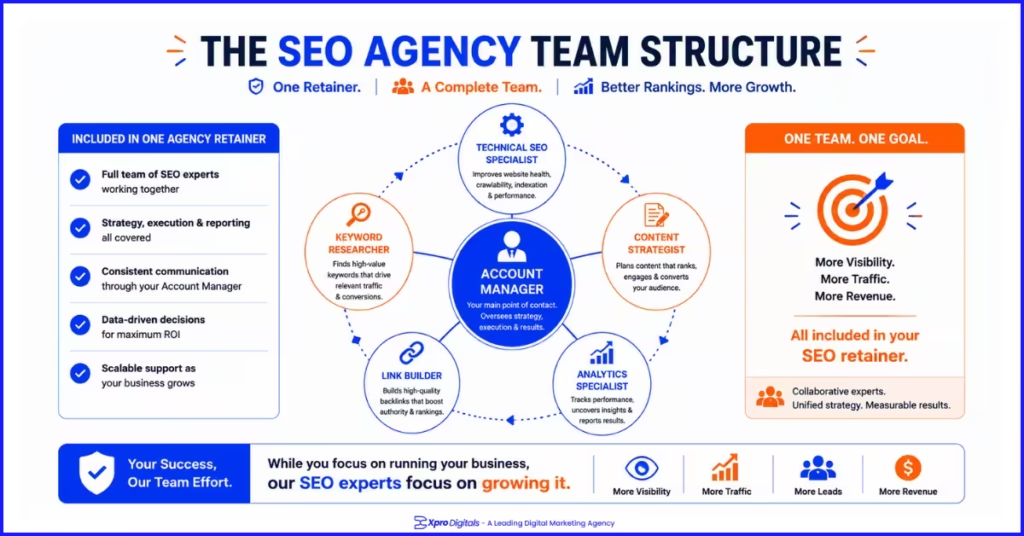
When you hire an SEO agency, you are not hiring one person. You are accessing a team that typically includes a technical SEO specialist, a content strategist, a link building specialist, and an account manager who coordinates the strategy and communicates results.
The combined expertise of that team would cost several times the agency retainer fee to replicate through in-house hiring.
A mid-market ecommerce business we work with had previously employed a marketing manager responsible for SEO alongside email marketing, social media, and paid search.
SEO was the lowest priority because every other channel delivered faster feedback loops. After moving to an agency model with a dedicated team, the business increased organic sessions by 210% over eight months while their internal marketing manager focused on the channels she managed best.
The agency team brought technical expertise that identified 1,200 product pages incorrectly tagged with no-index from a previous platform migration, a content specialist who restructured their category pages around buying intent, and a link building programme that earned 34 new referring domains from relevant industry publications in six months.
In-House SEO Team vs SEO Agency: Cost and Capability Comparison
| Factor | In-House SEO Hire | SEO Agency |
| Annual cost (single hire) | 40,000 to 70,000 USD salary + tools + benefits | 15,000 to 60,000 USD retainer |
| Expertise depth | One person, variable skill breadth | Team of specialists across all SEO disciplines |
| Tool access | Business pays separately (2,000 to 6,000 USD/year) | Tools included in agency stack |
| Speed to deliver | 3 to 6 months onboarding and ramp-up | Active from month one |
| Scalability | Fixed headcount, slow to scale | Scale scope up or down as needed |
| Business knowledge | Builds deeply over time | Requires ongoing briefing |
| Algorithm update response | Individual keeps up independently | Team tracks and adapts collectively |
| Best suited to | Large enterprise with continuous complex SEO needs | SMEs, growing businesses, ecommerce |
Reason 2: Established Processes That Deliver Faster Results
An SEO agency has run the same processes dozens or hundreds of times. Their technical audit methodology, keyword research framework, content brief template, link building outreach sequences, and reporting dashboards are all pre-built and refined through repeated client engagements.
You benefit from that accumulated process efficiency from day one of your engagement.
Compare this to building SEO in-house, where a new hire must first develop or learn those processes from scratch, then apply them to your specific site, then iterate based on what does and does not work.
The gap between where an in-house SEO starts and where an experienced agency team starts is typically six to twelve months of developed process efficiency.
We ran an internal analysis across 20 client engagements and found that the average time from agency engagement start to first meaningful ranking improvement (defined as a page moving from outside the top 20 to position 1 to 10 for a target keyword) was 11 weeks.
The fastest improvement was 6 weeks on a site with a clear technical blocker that was fixed in the first month. The slowest was 18 weeks on a new domain in a competitive market.
Reason 3: Access to Premium Tools Without the Premium Cost
Professional SEO requires investment in tools that most businesses would not purchase independently.
- Ahrefs at 399 to 999 USD per month.
- Semrush at a comparable level.
- Screaming Frog at 259 USD per year.
- Surfer SEO for content optimisation.
- Google Data Studio or Looker Studio for reporting.
- BrightLocal for local SEO tracking.
These tools together can easily cost 1,500 USD per month or more.
A reputable SEO agency subscribes to all of these tools as a cost of doing business. Their clients benefit from the data these tools provide without individually purchasing each subscription.
For a small or medium business, this tool access alone represents a significant portion of the value in an agency retainer, particularly when those tools require experienced operators to interpret the data they produce.
SEO Tool Stack: What Agencies Use and What They Cost
| Tool | Purpose | Typical Monthly Cost | Included in Agency? |
| Ahrefs | Keyword research, backlink analysis, competitor research | 399 to 999 USD | Yes |
| Semrush | Keyword research, site audit, position tracking | 130 to 500 USD | Yes |
| Screaming Frog | Technical crawl and site audit | 22 USD/month (annual) | Yes |
| Google Search Console | Indexation, performance, Core Web Vitals | Free | Yes |
| PageSpeed Insights / CrWux | Core Web Vitals measurement | Free | Yes |
| Surfer SEO or Clearscope | Content optimisation | 99 to 350 USD | Varies |
| BrightLocal | Local SEO tracking and citation audit | 29 to 79 USD | Varies |
| Google Analytics 4 | Organic traffic and conversion tracking | Free | Yes |
Reason 4: Staying Current With Google Algorithm Updates
Google releases thousands of changes to its search algorithm every year. Most are minor.
But several major updates per year, including broad core updates, helpful content updates, spam updates, and link spam updates, can significantly shift rankings for businesses that are not actively monitoring and adapting to them.
Tracking these updates, understanding their targeting logic, identifying which pages on your site have been affected, and adjusting strategy in response is an ongoing full-time responsibility.
An in-house marketing generalist has neither the time nor the specialised knowledge to do this consistently.
A missed response to a major algorithm update that penalises thin content or manipulative link profiles can result in traffic drops of 30 to 70% that take months to recover from.
An SEO agency tracks algorithm updates across all client accounts simultaneously.
When a broad core update rolls out, the agency immediately analyses which client pages were affected, cross-references the update’s known targeting criteria, and adjusts content quality or technical factors accordingly.
This collective response is one of the most underappreciated advantages of working with a specialist team versus an isolated in-house employee.
Reason 5: Objective External Perspective on Your Site
Internal teams often develop blind spots about their own websites. Pages that have existed for years without ranking are accepted as part of the landscape.
Technical issues that have been present since launch are assumed to be normal. Content that does not serve searcher intent is justified because the business is proud of it.
An external SEO agency brings an objective perspective unconstrained by internal assumptions.
In a site audit for a professional services firm, our team identified that their ‘Resources’ section, which the internal team considered a strong content asset, contained 47 pages that were all blocked by robots.txt because a developer had initially intended the section to be password-protected.
The internal team had never questioned why those pages were not ranking. The audit found it within the first hour.
External objectivity also applies to content quality assessments. An agency comparing your content against top-ranking competitors will identify gaps that an internal team cannot see because they are too close to the subject matter.
This perspective is a consistent source of early quick wins in new client engagements.
Reason 6: Scalable SEO That Grows With Your Business
One of the most significant advantages of an agency model over in-house hiring is scalability. When your business needs more SEO activity, such as launching a new product category, entering a new market, or responding to a competitive push, you adjust your agency scope.
When you need less activity during a consolidation phase, you adjust downward. This flexibility is not available with fixed headcount.
An ecommerce retailer we work with launches seasonal campaigns three times per year requiring significant SEO work on new landing pages, updated category content, and targeted link building. Outside of those periods, their SEO needs are lower.
Rather than hiring and firing to match this pattern, they maintain a base agency retainer with defined scope increases during campaign periods. Total SEO cost is lower than maintaining a full in-house team capable of handling peak demand year-round.
Reason 7: Direct Impact on Revenue, Not Just Rankings
The most credible SEO agencies position their work in terms of business revenue, not search rankings. Rankings are a leading indicator. Revenue from organic search is the actual business outcome.
An agency that understands this distinction structures its strategy around pages that drive enquiries, leads, and purchases, not pages that rank for impressive-sounding keywords that no one with buying intent searches for.
We tracked organic revenue impact across 12 client accounts over a 12-month period. The average increase in organic revenue attributable to SEO activity was 67% over the period.
The range was wide: from 28% for a business in a highly competitive market that was already performing well organically, to 340% for a business that had significant technical blockers removed in month one. The median improvement was 54%.
Understanding what your business should realistically expect from SEO investment depends on your market, starting position, and competition level.
Our guide on how long SEO takes to show results gives a realistic framework for setting outcome expectations at different stages of an SEO programme.
When Hiring an SEO Agency Is the Right Decision
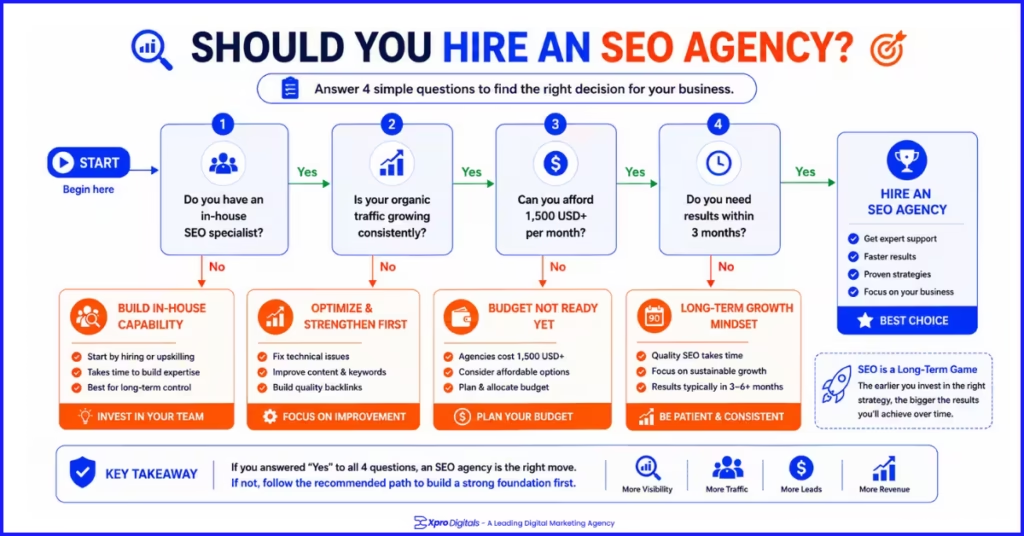
Hiring an SEO agency is the right decision in specific circumstances. Understanding when the agency model is appropriate versus when an alternative approach makes more sense prevents misaligned expectations and wasted investment.
Signs Your Business Is Ready to Hire an SEO Agency
| Signal | What It Indicates |
| Organic traffic is flat or declining despite publishing content | Technical or on-page SEO problems that need specialist diagnosis |
| Competitors consistently outrank you for commercial keywords | Structured SEO strategy and authority building needed |
| You have no visibility into why pages do or do not rank | No SEO expertise or measurement framework in place |
| SEO is being managed alongside other responsibilities | Inadequate dedicated resource for the scope of work needed |
| You recently migrated platforms or URLs | Technical SEO audit and redirect management urgently needed |
| You are entering a new market or product category | Keyword research, content, and link strategy for new territory needed |
| Your organic channel generates revenue below 20% of total | Significant organic growth opportunity being missed |
| You cannot explain what your current SEO work is producing | Accountability and reporting framework needed |
When an Agency May Not Be the Right Fit
| Situation | Better Alternative |
| Budget under 1,000 USD per month | Focused SEO consultant for specific tasks only |
| Enterprise business with 5+ internal marketing staff | Hybrid: agency for specialist tasks, in-house for strategy |
| Business with no website or product-market fit yet | Invest in product and conversion first, then SEO |
| Looking for immediate traffic this month | Paid search (Google Ads) while SEO builds long-term |
| Wanting full control of every content decision | In-house SEO hire with clear editorial ownership |
How to Choose the Right SEO Agency for Your Business
Choosing the wrong SEO agency is as harmful as not investing in SEO at all. A poor agency wastes your budget, potentially damages your domain with manipulative link building, and delays your organic growth by months or years. The selection process matters as much as the decision to hire.
10-Point Agency Selection Checklist
| Check | What Good Looks Like | Red Flag |
| Case studies with real metrics | Specific traffic, ranking, and revenue numbers | Vague claims, no client examples |
| Technical knowledge demonstration | Can explain crawl budget, Core Web Vitals, canonical tags clearly | Uses jargon, cannot explain the mechanism |
| Content sample quality | Samples match search intent, are well-structured, and readable | Thin, generic, or keyword-stuffed samples |
| Reporting format | Business outcome metrics, not just rankings and activity | Reports filled with impressions and page count |
| Named account manager | Specific person responsible for your account | Rotating contact, no clear ownership |
| Strategy proposal quality | Tailored to your specific site, goals, and competition | Same template proposal for every prospect |
| Tool stack disclosure | Lists tools used and why | Cannot name tools or uses only free tools |
| Contract terms | 30 to 90-day notice period, clear deliverables | 12-month lock-in, vague scope |
| Ethical practice confirmation | Clear on white hat link building, no guaranteed rankings | Promises specific rankings within exact timeframe |
| References available | Willing to connect you with existing clients | Refuses or delays reference requests |
For a complete guide to evaluating and selecting the right SEO partner with specific questions to ask at each stage of the process, our guide on how to choose an SEO agency in 2026 covers the full selection framework.
What Results Should You Expect From an SEO Agency?
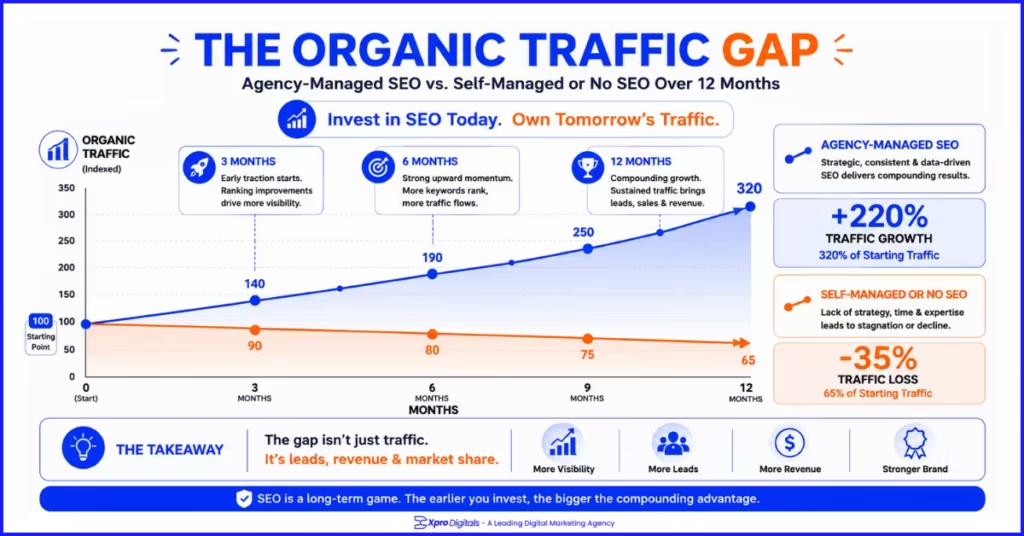
Expectation management is critical to a successful agency relationship. SEO is not a switch that flips on when you sign a contract. It is a compounding investment that builds momentum over months and delivers its strongest returns in year two and beyond.
Understanding this timeline prevents disappointment during the early months when activity is high but results are still developing.
Realistic SEO Agency Results Timeline
| Month | Typical Agency Activity | Expected Business Outcome |
| 1 | Onboarding, technical audit, keyword research, strategy | Audit report, strategy document, keyword map delivered |
| 2 to 3 | Technical fixes, on-page optimisation, content begins | Rankings start tracking, first content live, technical issues resolved |
| 3 to 5 | Content compounding, link building active | Ranking improvements on optimised pages, early organic traffic growth |
| 5 to 8 | Authority building, cluster expansion, refresh cycle | Measurable organic traffic growth, improving conversion data |
| 8 to 12 | Competitive keyword progress, ranking stability | Clear ROI data, page one rankings on target terms |
| 12+ | Scale and compound | Consistent organic growth, reducing cost per acquisition over time |
The Cost of Not Hiring an SEO Agency
The cost of hiring an SEO agency is visible and quantifiable. The cost of not hiring one is invisible and therefore easier to ignore. But it is real and it compounds every month.
Consider a business with 10 target keywords averaging 500 monthly searches each. If those keywords have an average conversion rate of 2% and an average order value of 200 USD, ranking on page one for all of them would generate approximately 20,000 USD in monthly revenue from organic search.
Sitting on page three, where click-through rates drop to under 1%, that business earns perhaps 400 to 600 USD from the same keywords. The gap is not just the agency fee. It is the revenue that could have been earned while organic visibility was being built.
For most businesses in competitive markets, the cost of a quality SEO agency is recovered within six to twelve months of starting an engagement that moves them from page two or three to page one for their primary commercial keywords.
After that recovery point, organic revenue increasingly outpaces the agency investment, producing a return that grows without proportionally growing costs.
People Also Ask: Why Hire an SEO Agency
What Does an SEO Agency Actually Do?
An SEO agency improves your website’s visibility in search engine results pages (SERPs) through a combination of technical improvements, content creation and optimisation, link building, and performance reporting.
Specific activities include conducting technical site audits, researching target keywords, optimising page titles and content, building backlinks from credible sources, implementing schema markup, and reporting on organic traffic and conversion outcomes monthly.
Is Hiring an SEO Agency Worth It?
Yes, for businesses with realistic timelines and appropriate budgets, hiring a quality SEO agency delivers measurable ROI.
Organic search generates some of the highest-quality traffic available because it captures users actively searching for what you offer.
The compounding nature of SEO means the cost per visitor from organic search reduces over time as rankings strengthen, unlike paid channels where cost per click remains constant or increases.
How Much Does It Cost to Hire an SEO Agency?
Full-service SEO agency retainers for small businesses typically range from 1,500 to 3,500 USD per month.
Mid-market engagements range from 3,500 to 8,000 USD per month. Enterprise or large ecommerce SEO programmes range from 8,000 to 25,000 USD or more per month.
Project-based work such as a single technical audit or content campaign costs vary separately. Anything significantly below 1,000 USD per month for full-service SEO should be carefully scrutinised for what is actually included.
How Long Does It Take an SEO Agency to Get Results?
The first meaningful ranking improvements from agency SEO typically appear between weeks six and twelve, primarily on pages with technical blockers that are quickly resolved.
Significant organic traffic growth develops from months four to six. Competitive keyword rankings on page one take six to twelve months in most markets.
The timeline depends on your domain’s existing authority, the competitiveness of your target keywords, and how quickly technical and on-page fixes are implemented.
What Is the Difference Between an SEO Agency and a Freelancer?
An SEO agency provides a team of specialists across technical SEO, content, link building, and analytics, with established processes, premium tool access, and account management.
A freelancer provides individual expertise, often narrower in scope, typically at lower cost. Agencies are better suited to ongoing full-service SEO management.
Freelancers work well for specific tasks like technical auditing, content writing, or link building, especially when the budget is limited.
Can I Do SEO Myself Instead of Hiring an Agency?
You can manage basic on-page SEO yourself, including optimising title tags, improving content, and building internal links.
However, effective competitive SEO requires specialist knowledge across multiple disciplines, premium tool access, and significant dedicated time that most business owners and generalist marketers cannot provide alongside other responsibilities.
DIY SEO tends to produce modest results in low-competition markets and underperforms significantly in competitive ones.
What Should I Look for When Hiring an SEO Agency?
Look for specific case studies with measurable results from comparable businesses. Verify their technical knowledge with direct questions about crawl budget, Core Web Vitals, and canonical tag management.
Review sample content and reports. Confirm they use professional tools like Ahrefs, Semrush, and Screaming Frog.
Ensure the contract includes clear deliverables and a reasonable notice period. Avoid agencies that guarantee specific rankings or suggest tactics that sound too fast to be credible.
How Do I Measure Whether My SEO Agency Is Working?
Measure organic sessions to your highest-value landing pages, organic leads and revenue in Google Analytics, click-through rates in Google Search Console, and ranking improvements on target keywords over rolling three-month windows.
SEO results build gradually, so evaluate on a quarterly rather than monthly basis. If after six months there is no directional improvement in organic traffic or rankings, and no clear explanation from your agency, it is time to review the relationship.
Should a Small Business Hire an SEO Agency?
Yes, for most small businesses that serve an online audience or local market, an SEO agency provides more cost-effective specialist support than any alternative.
A part-time internal hire managing SEO alongside other responsibilities typically underdelivers.
A low-cost SEO package rarely delivers meaningful results. A properly scoped agency engagement within a realistic budget produces better outcomes than either alternative.
What Is the ROI of Hiring an SEO Agency?
ROI varies by market, starting position, and programme duration. In our client data across 12 accounts over twelve months, average organic revenue attributable to SEO activity increased 67%.
ROI turns positive, meaning organic revenue exceeds the cumulative agency investment, typically between months six and twelve depending on competitiveness. After that point, organic returns compound as rankings strengthen without proportional increases in cost.
Does an SEO Agency Help With Google Algorithm Updates?
Yes, and this is one of the most significant advantages of working with a specialist agency. A good agency tracks every major Google algorithm update, analyses which client pages were affected and why, and adjusts content quality, technical factors, or link profile management in response.
An in-house generalist managing SEO alongside other responsibilities rarely has the time or knowledge to respond systematically to algorithm updates.
What Happens if the SEO Agency Does Not Deliver Results?
First, confirm that the timeline is realistic given your market and starting position. Six months is the minimum meaningful evaluation period.
If results are genuinely below what was agreed and the agency cannot explain why or adjust strategy effectively, use the contract notice period to disengage.
Before signing any agency contract, ensure the deliverables are specific and measurable so that underperformance is clearly definable rather than subjective.
How Is an SEO Agency Different From a Digital Marketing Agency?
A digital marketing agency typically offers a broad range of services including paid search, social media, email marketing, and web design alongside SEO.
An SEO-specialist agency focuses exclusively on organic search performance. Specialist agencies tend to have deeper SEO expertise and more dedicated tooling.
Digital marketing agencies offer more integrated service but sometimes with shallower SEO capability. For businesses where organic search is a primary growth channel, a specialist SEO agency often delivers better results.
Can an SEO Agency Help With Local Search?
Yes. A quality SEO agency with local SEO capability covers Google Business Profile optimisation, local citation building, NAP consistency management, review generation strategy, and local keyword targeting alongside standard technical and on-page SEO.
For businesses with a geographic service area, local SEO is often the highest-ROI component of an SEO programme.
Our guide on why local SEO is vital for small businesses explains the local search signals an agency should be addressing for any geographically-focused business.
What Is the Difference Between White Hat and Black Hat SEO Agency Practices?
White hat SEO agencies use practices that comply with Google’s guidelines: creating genuinely useful content, earning links from credible sources through outreach and original content, and improving the page experience for visitors.
Black hat agencies use manipulative tactics including buying links, keyword stuffing, and cloaking.
White hat SEO builds sustainable rankings.
Black hat produces short-term gains followed by Google penalties. Our guide on white hat vs black hat SEO strategies explains both approaches with real-world outcome examples.
Step-by-Step: How to Hire an SEO Agency the Right Way
Step 1: Define Your SEO Goals Before Contacting Any Agency
Write down what you want SEO to deliver for your business. Is it more enquiries from local search? Product sales from organic search? B2B leads from informational content? The more specific your goal, the more accurately you can evaluate whether any agency’s proposed approach will achieve it. Generic goals produce generic strategies.
Step 2: Set a Realistic Budget
Research typical costs for the scope of SEO you need in your market. If you are a local service business, 1,500 to 2,500 USD per month is a reasonable starting budget for a credible agency.
If you are a national ecommerce store, budget 4,000 USD or more per month for meaningful activity. Below these levels, consider task-specific outsourcing rather than full-service management.
Step 3: Request Proposals From Three to Five Agencies
Give each agency the same brief: your current website URL, your target keywords, your business goals, your budget range, and your expected timeline.
Comparing proposals built on the same brief reveals which agencies have a generic pitch versus a tailored approach to your specific situation.
Step 4: Evaluate Proposals Using the 10-Point Checklist
Use the checklist earlier in this guide to evaluate each proposal. Pay specific attention to how they plan to demonstrate results, what metrics they will report on, and what specific deliverables are included each month.
Dismiss any proposal that promises specific rankings within a defined timeframe.
Step 5: Request References and Speak to Existing Clients
Ask each agency to connect you with two to three existing clients in a similar sector or business type.
Ask those clients specifically: how communication works, whether deliverables are consistently met, whether results have been delivered relative to expectations, and whether they would re-sign with the agency.
Step 6: Start With a Defined Initial Engagement
Rather than signing a 12-month retainer immediately, negotiate a three-month initial engagement with a month-to-month extension option thereafter.
This gives the agency time to demonstrate their process and early results while limiting your financial risk if the relationship is not a good fit.