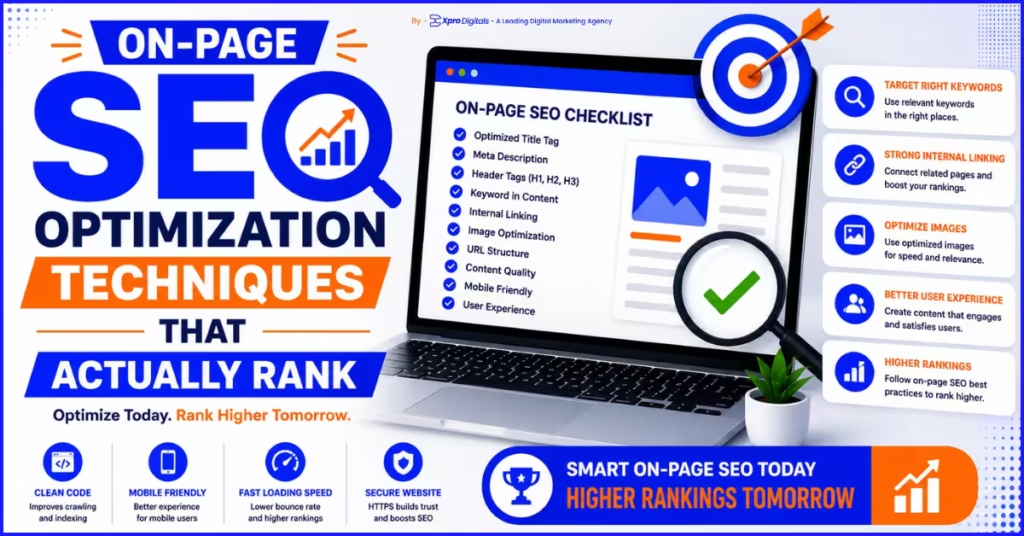
On-Page SEO Optimization Techniques
Written by
Xpro Digitals
Published on
July 21, 2026
Read Time
Table of Contents
ToggleOn-Page SEO Optimization Techniques That Actually Move Rankings in 2026
Introduction: Why Most On-Page SEO Advice Fails Businesses
Here is a problem we see constantly. A business spends weeks publishing content. They add keywords in the title. They write 1,500 words. They hit publish. 3-months later the page ranks on page four and earns almost no clicks. The frustrating part is they followed the advice they found online. The pain is real. You invest time and money into content that simply does not perform. Rankings stay flat. Organic traffic does not grow. And you start questioning whether SEO is actually working. The problem is not the content itself. It is the execution of on-page SEO. Most guides teach outdated signals, keyword density formulas, and title tag tricks that Google deprioritized years ago. What actually moves rankings in 2026 is more nuanced and more powerful. By the end of this guide, you will know exactly how to structure every page you publish for maximum ranking potential. You will understand how Google reads and evaluates pages in 2026, and you will have a repeatable checklist to apply to every piece of content you create or update. This guide covers on-page SEO specifically. If you want to understand how it fits alongside technical and off-page factors, our article on technical SEO vs on-page SEO explains how each discipline connects.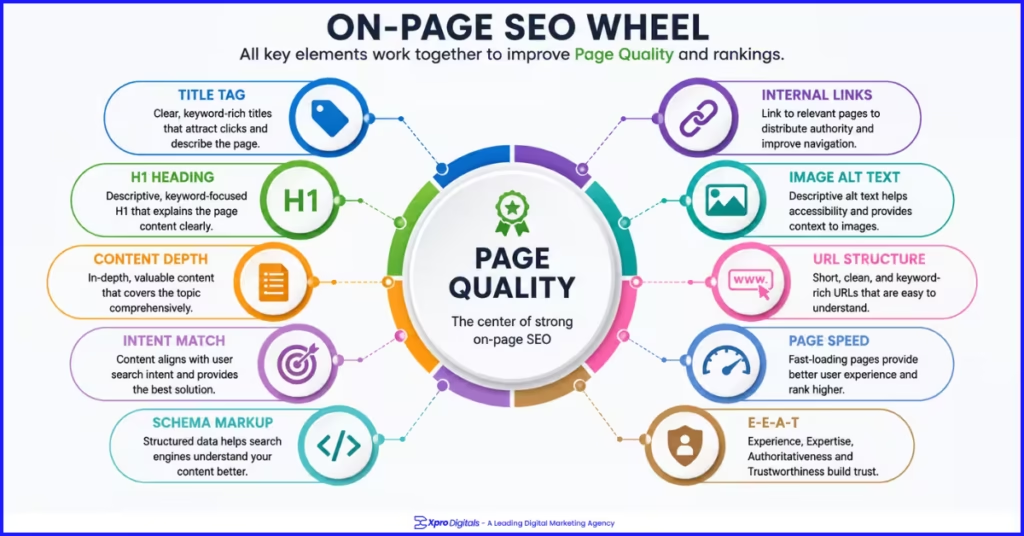
What Is On-Page SEO and Why It Matters More in 2026
On-page SEO is every optimization you make within a single page to help Google understand what it is about and why it is the best result for a specific search query. It covers visible elements like headings and content, structural elements like URLs and schema, and engagement signals like page speed and mobile usability. In 2026, on-page SEO matters more than ever because Google’s ability to evaluate content has become significantly more sophisticated. Its natural language processing models can now detect topical depth, author expertise, and intent alignment at a level that older keyword-based algorithms could not. A page with weak on-page SEO gives Google almost no signal about what it should rank for. A page with strong on-page SEO tells Google precisely what the page is about, who it serves, and why it is better than competing results.On-Page SEO vs Off-Page SEO vs Technical SEO
| Discipline | What It Controls | Who Implements It | When It Matters |
| On-Page SEO | Content, keywords, tags, schema, structure | Content writers, SEO strategists | Every page you publish |
| Technical SEO | Crawlability, speed, indexation, mobile | Developers, technical SEOs | Site infrastructure level |
| Off-Page SEO | Backlinks, brand mentions, authority | Outreach and PR teams | After on-page is solid |
Technique 1: Match Search Intent Before Anything Else
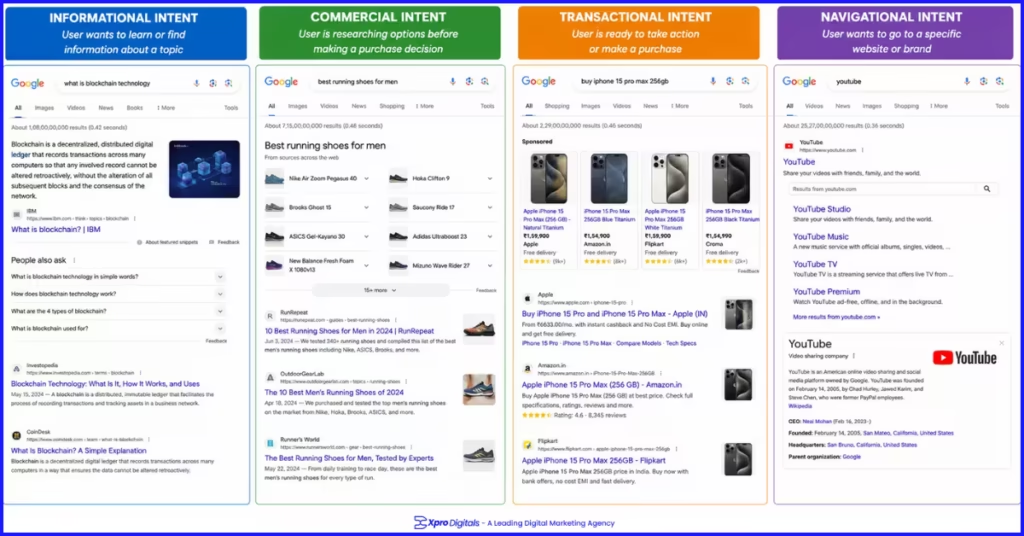
Search intent is the single most important on-page factor in 2026. Google’s core algorithm update history consistently shows that pages misaligned with intent drop, regardless of their technical quality or keyword optimization. Getting intent right is the prerequisite for everything else in this guide. Before writing a single word, search your target keyword in an incognito browser. Study the top five results. What format are they using? Is the dominant result a how-to guide, a product page, a comparison article, or a listicle? That format reflects what Google has determined the searcher actually wants. Your page needs to match it.The Four Intent Types and the Right Content Format
| Intent Type | Searcher Goal | Correct Format | Example Keyword |
| Informational | Learn or understand | Guide, explainer, tutorial | how does schema markup work |
| Commercial | Research before buying | Comparison, review, best-of | best SEO tools for small business |
| Transactional | Buy or take action now | Product page, landing page | hire SEO agency India |
| Navigational | Find a specific brand | Homepage, brand page | Xpro Digitals SEO services |
Technique 2: Write Title Tags That Win Clicks and Rankings
The title tag is the most influential single on-page element. It appears as your headline in search results and is the primary keyword signal Google reads on your page. A weak title tag suppresses both rankings and click-through rate simultaneously.Title Tag Rules for 2026
Keep every title tag under 60 characters to avoid truncation in search results. Lead with your primary keyword where it reads naturally. Include a differentiating element that gives searchers a reason to click your result over the others. Avoid keyword stuffing, repeating the same phrase twice in one title adds no value and reads as unnatural.Title Tag Comparison: Weak vs Strong
| Weak Title Tag | Strong Title Tag | Why It Wins |
| SEO Tips | My Website | On-Page SEO Techniques That Actually Rank | Xpro Digitals | Keyword-led, benefit-driven, brand included |
| Product Page SEO | Product Page SEO: The Complete Optimization Guide | Clear topic, format stated, under 60 chars |
| About Us | Xpro Digitals: SEO Agency for Ecommerce and B2B Brands | Keyword-relevant, describes who you serve |
Technique 3: Meta Descriptions That Drive Clicks
Meta descriptions are not a direct ranking factor. However, they directly influence click-through rate, and click-through rate influences rankings indirectly through engagement signals. A well-written meta description converts impressions into clicks. A generic or missing meta description lets Google auto-generate one, often pulling an unhelpful sentence fragment. Keep meta descriptions under 155 characters. Include the primary keyword naturally. End with a specific, action-oriented statement that tells the searcher what they will get by clicking. Write it as a two-sentence pitch: one sentence summarising the page, one sentence giving a reason to click.Meta Description Formula
[What the page covers in one clear sentence] + [Specific benefit or CTA that makes the click worthwhile] Example: ‘Learn the exact on-page SEO techniques that move rankings in 2026. Covers title tags, schema, intent matching, and a full checklist you can apply today.’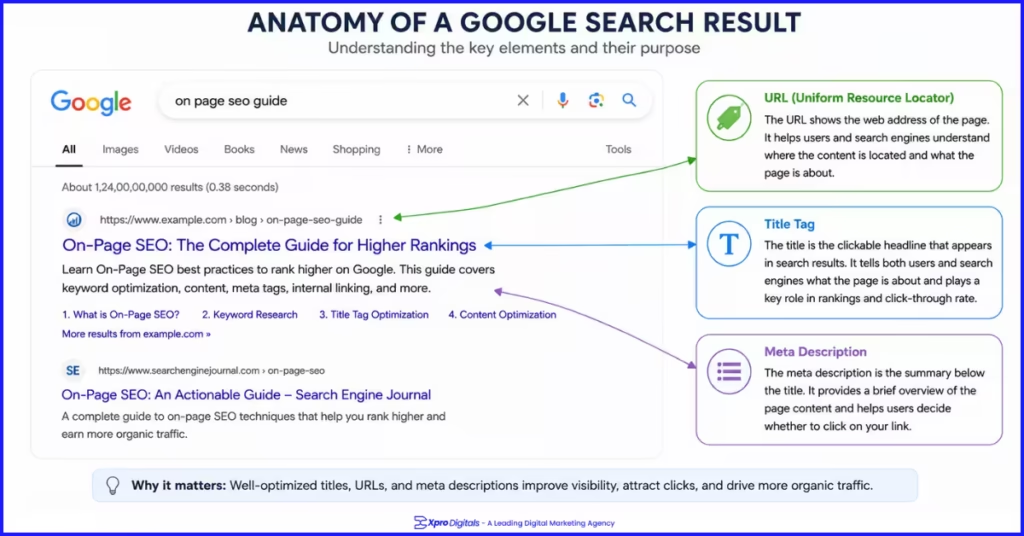
Technique 4: Use Heading Structure as a Content Map
Your heading hierarchy is not just visual formatting. It is a content map that tells Google the relative importance of every topic on your page. A page with a clear H1, well-structured H2 sections, and H3 subsections is significantly easier for Google to parse, extract answers from, and feature in rich results than a page with inconsistent or missing heading structure.Heading Structure Rules
Every page needs exactly one H1 that includes the primary keyword and clearly states the page’s topic. Use H2 headings for major sections. Use H3 headings for subsections within H2 sections. Never skip levels, jumping from H1 to H3 without an H2 creates structural gaps that affect how Google reads the page hierarchy. Include secondary and related keywords in H2 headings naturally where they reflect the actual section content. People Also Ask questions from your target keyword’s SERP are excellent candidates for H2 or H3 headings because they reflect real searcher queries Google has identified as related to your topic.Heading Structure Checklist
| Heading Element | Rule | Common Mistake |
| H1 | One per page, includes primary keyword | Multiple H1s, or H1 that does not match title tag |
| H2 | Major sections, includes secondary keywords | Too few H2s, leaving long blocks of unstructured text |
| H3 | Subsections under H2, specific subtopics | Using H3 as the first heading level after H1 |
| Heading sequence | H1 > H2 > H3, no skipped levels | Jumping from H1 to H4 |
| Keyword use | Natural, reflects section content | Forcing exact-match keywords unnaturally |
Technique 5: Strategic Keyword Placement Without Stuffing
Keyword placement in 2026 is about strategic positioning, not frequency. Google’s NLP models understand context, synonyms, and entity relationships well enough that unnatural keyword repetition is counterproductive. The goal is to confirm topic relevance through natural language, not to hit a density percentage.Where to Place Your Primary Keyword
Your primary keyword should appear in the title tag, the H1, the first 100 words of the page content, at least one H2 subheading, and the meta description. These positions confirm relevance without requiring repetition throughout the body. Beyond these positions, use the keyword only where it genuinely fits the sentence. Fill the rest of your content with semantic keywords, related entities, and natural language variations that reflect how people actually discuss your topic. A page about ‘on-page SEO’ should naturally contain terms like title tags, meta descriptions, heading structure, content quality, search intent, and user experience. Google reads these co-occurring terms as confirmation of topic depth.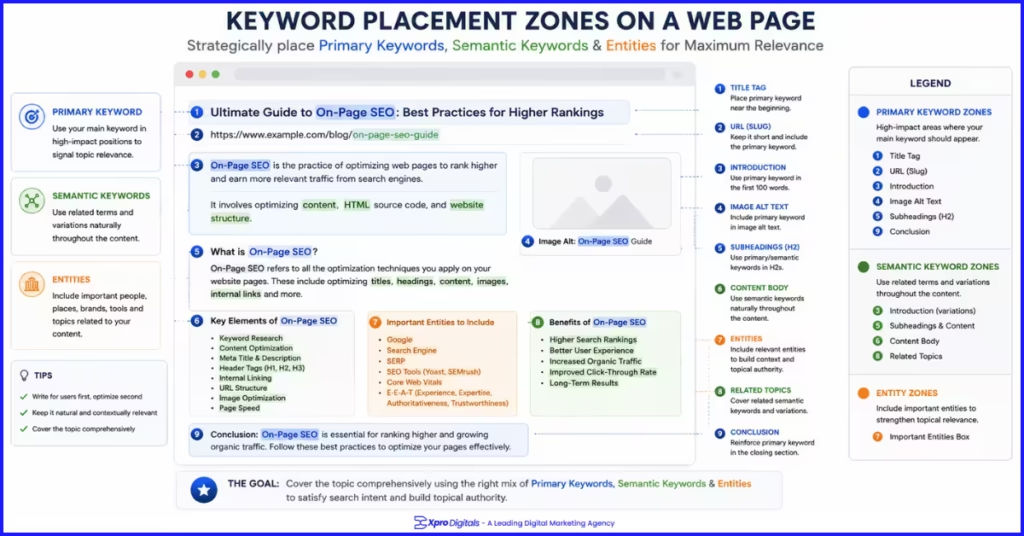
Semantic Keyword and Entity Integration
Entities are named concepts, people, places, tools, and brands that Google has indexed in its Knowledge Graph. Including relevant entities in your content strengthens your topical signal. A guide on on-page SEO that mentions Google Search Console, Core Web Vitals, structured data, schema.org, and Google’s Search Quality Evaluator Guidelines is demonstrating deeper topical authority than one that only uses the phrase ‘on-page SEO’ repeatedly. Understanding how entities relate to SEO has become more important as Google’s Knowledge Graph has expanded. Our guide on E-E-A-T and why it matters for your rankings covers how entity signals connect to the trust framework Google uses to evaluate content.Technique 6: Write Content That Demonstrates Real Expertise
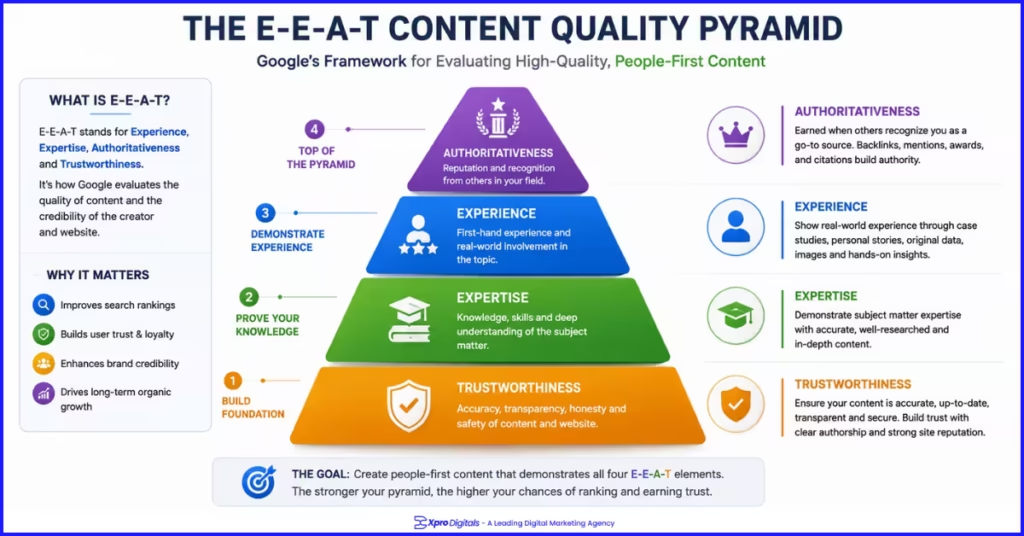
Content quality in 2026 is not about word count. It is about depth, accuracy, and demonstrated expertise. Google’s Search Quality Evaluator Guidelines explicitly define high-quality content as content that serves the reader’s actual need completely, comes from a credible source, and demonstrates first-hand knowledge or professional expertise where relevant.The E-E-A-T Framework in Practice
Experience means demonstrating that your content reflects real-world knowledge, not just researched information. Add original data, client case studies, specific examples from your own practice, and first-person observations where relevant. Expertise means structuring your content to show depth of knowledge, covering not just the what but the why and how. Authoritativeness means being recognised as a credible source in your field through external citations and links. Trustworthiness means presenting accurate, transparent, and well-sourced information.Content Quality Checklist
| Quality Signal | What It Looks Like | How to Implement |
| Experience | First-hand observations, original data, real examples | Add case studies, client results, and personal practice notes |
| Expertise | Depth beyond surface coverage, accurate technical detail | Cover subtopics competitors miss, cite authoritative sources |
| Authoritativeness | Referenced by other credible sources | Earn links, get mentioned in industry publications |
| Trustworthiness | Accurate, cited, transparent, author-attributed | Add author bios, cite sources, update outdated content |
| Completeness | Covers the topic fully for the target reader | Review top-ranking competitors and address all gaps |
| Readability | Clear, concise, well-structured sentences | Max 30 words per sentence, one idea per paragraph |
Technique 7: Clean URL Structure for Clarity and Relevance
URL structure is a minor direct ranking signal but has meaningful indirect effects. A clean, keyword-relevant URL communicates page topic to Google and to the searcher before they click. It also makes internal linking easier, canonical management cleaner, and site architecture more logical. Keep URLs short and descriptive. Use hyphens to separate words. Use lowercase throughout. Remove stop words like ‘a’, ‘the’, and ‘of’ where they add no meaning. Never include session IDs, tracking parameters, or auto-generated number strings in URLs you want to rank.URL Structure Examples
| Poor URL | Better URL | Why It Improves |
| yoursite.com/blog/?p=4829 | yoursite.com/on-page-seo-techniques | Readable, keyword-relevant, no parameters |
| yoursite.com/category/sub/product-name-SKU-4921A | yoursite.com/running-shoes/nike-pegasus-40 | Clean hierarchy, keyword-focused |
| yoursite.com/2026/03/15/article-title | yoursite.com/on-page-seo-checklist | No date, evergreen-friendly, keyword-led |
Technique 8: Schema Markup to Earn Rich Results
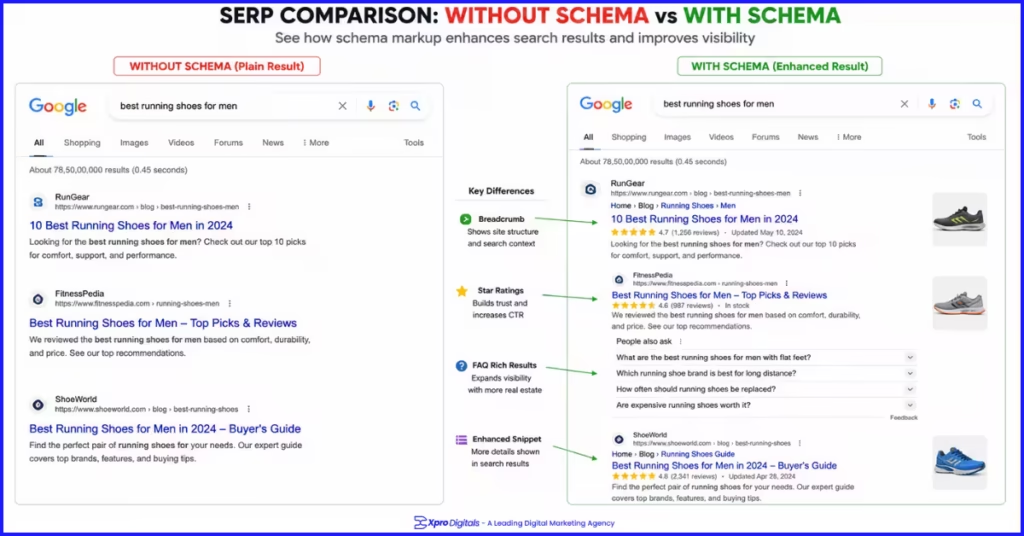
Schema markup is structured data in your page code that gives Google machine-readable context about your content. It does not directly improve rankings, but it enables rich results in search that increase your listing’s visual prominence and click-through rate. Pages without schema compete as plain blue links against pages displaying star ratings, FAQ expansions, product pricing, and breadcrumb trails.The Most Impactful Schema Types for On-Page SEO
| Schema Type | What It Enables | Best For |
| Article / BlogPosting | Article rich results, author display | Blog posts and guides |
| FAQPage | FAQ expansion below the listing in SERPs | Any page with Q&A sections |
| Product + Offer | Price, availability, rating in search | Ecommerce product pages |
| AggregateRating | Star ratings in organic listings | Product, service, recipe pages |
| BreadcrumbList | Breadcrumb trail instead of URL in SERP | All hierarchical pages |
| HowTo | Step-by-step rich results | Tutorial and instructional content |
Technique 9: Image Optimization for SEO and Page Speed
Images serve two on-page SEO functions simultaneously. They are the primary driver of slow page load times, which affects Core Web Vitals scores and rankings. They are also an additional source of keyword relevance signals through file names and alt text, and a separate traffic channel through Google Image Search.Image SEO Checklist
| Element | Best Practice | Tool |
| File name | Descriptive, hyphenated, keyword-relevant | Rename before upload |
| Alt text | Describes image content, includes keyword naturally | CMS alt text field |
| File format | WebP for all photography, PNG only for transparency | Squoosh, ShortPixel |
| Compression | Smallest file size without visible quality loss | Squoosh, Imagify |
| Dimensions | Explicit width and height in HTML to prevent CLS | Theme or page builder |
| Lazy loading | Apply to below-fold images, NOT the hero image | Native HTML loading=’lazy’ |
| Hero image priority | Add fetchpriority=’high’ to main above-fold image | HTML attribute |
Technique 10: Internal Linking as an On-Page Power Tool
Internal linking is one of the most underutilised on-page SEO techniques. Every internal link you add to a page does three things: it passes authority to the linked page, it signals the topical relationship between the two pages, and it helps Google discover and recrawl the destination page more efficiently. Every page you publish should include at least two to four internal links to genuinely related pages. Use descriptive anchor text that reflects the content of the destination page rather than generic phrases. Vary your anchor text across different linking contexts to avoid unnatural repetition patterns.Internal Linking Best Practices
| Practice | Why It Matters | Example |
| Descriptive anchor text | Reinforces destination page’s keyword relevance | ‘product page SEO guide’ not ‘click here’ |
| Link to related content | Builds topical clusters and authority flow | From SEO guide to technical SEO checklist |
| Link from high-authority pages | Passes more authority to linked pages | Homepage or top-ranked posts linking to newer content |
| Avoid orphaned pages | Unlinked pages receive minimal crawl attention | Every published page gets at least one internal link |
| Use contextual in-content links | Carry more weight than navigation or footer links | Links within body paragraphs, not just sidebars |
Technique 11: Page Experience Signals That Affect On-Page Rankings
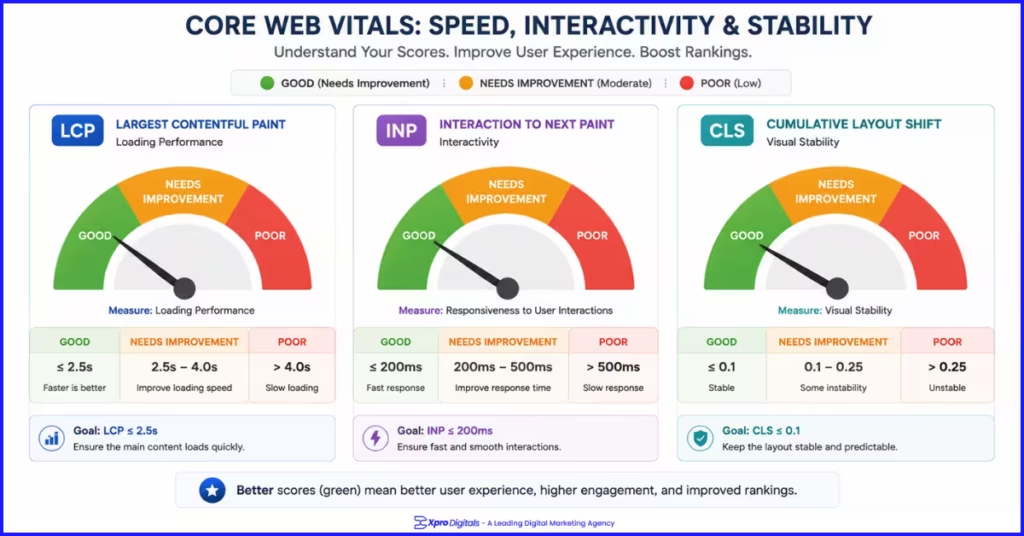
On-page SEO in 2026 extends beyond content and tags to include how users experience the page. Google’s page experience signals, including Core Web Vitals, mobile usability, and HTTPS security, are factored into ranking decisions alongside traditional relevance signals. A page with excellent content but a poor experience will be outranked by a slightly less comprehensive page that delivers a smooth, fast, stable experience.Core Web Vitals Benchmarks
| Metric | What It Measures | Good Score | Common Cause of Failure |
| LCP (Largest Contentful Paint) | How fast main content loads | Under 2.5 seconds | Unoptimised hero images |
| INP (Interaction to Next Paint) | Page responsiveness to input | Under 200ms | Heavy JavaScript execution |
| CLS (Cumulative Layout Shift) | Visual stability as page loads | Under 0.1 | Images without explicit dimensions |
Technique 12: Content Freshness and the Update Strategy
Google rewards content that is kept accurate and current, particularly for topics where information evolves over time. A page published two years ago that has never been updated signals stale content. The same page, refreshed with updated statistics, new examples, and expanded sections, signals to Google that the source is actively maintained and therefore more trustworthy. Our recommended approach: run a quarterly review of your top 20 ranking pages. For each one, check whether any statistics or data points are outdated, whether any new subtopics have emerged that the page does not cover, whether competitors have published more thorough content since you last updated, and whether the search intent for the keyword has shifted. Update accordingly and change the last-modified date. A real example: one of our clients had a local SEO guide ranking position 6. We refreshed the page to reflect Google’s most recent algorithm changes, added a new section on AI Overviews and local search, and updated three outdated statistics. The page moved to position 2 within five weeks.Step-by-Step: How to Run an On-Page SEO Audit on Any Page
Step 1: Check Indexation
Use the URL Inspection tool in Google Search Console. Confirm the page is indexed and that there are no crawl errors, canonical issues, or no-index tags preventing visibility. Fix any issues before proceeding.Step 2: Audit Title Tag and Meta Description
Check the current title tag in your browser tab and in Search Console’s Performance report. Is the primary keyword in the first half of the title? Is it under 60 characters? Is the meta description under 155 characters with a clear CTA? If not, rewrite both.Step 3: Review Heading Structure
View the page’s heading structure using a browser extension like Detailed SEO Extension or HeadingsMap. Confirm there is a single H1 with the primary keyword. Check that H2 sections are logically structured and include secondary keywords. Fix any skipped heading levels.Step 4: Assess Content Against Top-Ranking Competitors
Search for your target keyword and compare your page against the top three results. Are they covering subtopics you have missed? Are they using a format you are not (table, step-by-step, comparison)? Do they have more original data or examples? Note every gap and plan content additions.Step 5: Check Image Optimization
Run the page through Google PageSpeed Insights. Note any image-related issues. Review alt text on every image. Check that the hero image is not being lazy loaded. Confirm images are served in WebP format.Step 6: Verify Schema Markup
Paste the page URL into Google’s Rich Results Test. Check which schema types are detected and whether any have errors or warnings. Fix all errors before the schema can generate rich results.Step 7: Review Internal Links
Check how many internal links point TO this page and how many it links OUT to. A page with no inbound internal links is deprioritised in crawling. A page with no outbound internal links misses an opportunity to pass authority and build topical clusters. Add links in both directions where gaps exist.Step 8: Test Core Web Vitals on Mobile
Run PageSpeed Insights on mobile specifically. Note the LCP, INP, and CLS scores. Address any failing metrics using the specific fixes in the Core Web Vitals section above. Retest after implementing fixes.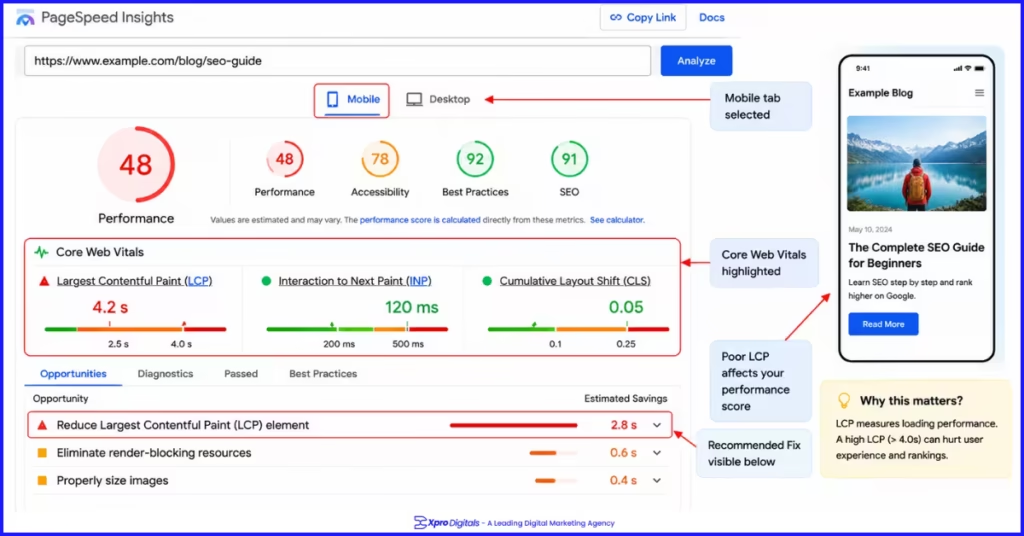
Complete On-Page SEO Checklist for Every Page
| Element | Check | Done? |
| Title tag | Keyword-led, under 60 chars, unique, click-worthy | |
| Meta description | Under 155 chars, keyword included, ends with CTA | |
| H1 tag | One per page, matches topic, includes primary keyword | |
| H2 / H3 structure | Logical hierarchy, secondary keywords included | |
| Keyword in intro | Primary keyword within first 100 words | |
| Search intent match | Content format matches what top results use | |
| Content completeness | Covers all subtopics top competitors address | |
| E-E-A-T signals | Author bio, original data, citations present | |
| Image file names | Descriptive, hyphenated, no IMG_ strings | |
| Image alt text | Describes image, includes keyword naturally | |
| Image format | WebP used for all photography | |
| Image dimensions | Explicit width and height set in HTML | |
| Hero image priority | fetchpriority=high on above-fold image | |
| Schema markup | Correct type applied, no errors in Rich Results Test | |
| Internal links out | 2-4 links to genuinely related pages | |
| Internal links in | At least one page linking to this one | |
| Anchor text | Descriptive, varied, no generic ‘click here’ | |
| URL structure | Short, keyword-relevant, hyphenated, lowercase | |
| Core Web Vitals | LCP, INP, CLS pass on mobile | |
| HTTPS | Page served securely, no mixed content | |
| Mobile usability | Text readable, tap targets adequate | |
| Content freshness | Statistics and examples are current | |
| Canonical tag | Correct canonical set, no self-competing pages | |
| No thin content | Page covers topic with genuine depth |
People Also Ask: On-Page SEO Optimization Techniques
What Are the Most Important On-Page SEO Factors in 2026?
Search intent alignment, content quality and depth, title tag optimization, heading structure, and internal linking are consistently the highest-impact on-page factors. Schema markup has grown in importance as rich results become more competitive. Core Web Vitals on mobile now function as a baseline requirement rather than a differentiator.How Do I Optimise a Page for SEO Without Keyword Stuffing?
Place your primary keyword in the title tag, H1, first 100 words, and one H2 heading. Use it only where it reads naturally throughout the rest of the content. Fill surrounding content with semantic keywords, related entities, and natural language variations. Write for the reader first. If a sentence needs the keyword forced into it, rewrite the sentence instead.What Is the Ideal Length for On-Page SEO Content?
Content length should match the depth the topic genuinely requires. There is no universal ideal word count. Study the top-ranking pages for your keyword and note their approximate length. Your goal is to cover the topic at least as completely as the top results, without padding for length. If you can cover the topic completely in 800 words, 1,500 words of padding adds no ranking benefit.How Many Internal Links Should a Page Have?
There is no fixed number, but every published page should have at least two to four outbound internal links to genuinely related content. More important than the number is the relevance of each link. Every internal link should be placed where it adds value for the reader, not inserted artificially to hit a link count target.Does Meta Description Affect Rankings?
Meta descriptions are not a direct ranking factor. Google ignores the meta description when determining whether a page is relevant to a query. However, meta descriptions directly affect click-through rate. A well-written meta description with a clear call to action will generate more clicks from the same ranking position, and sustained higher click-through rates can contribute to ranking improvements over time.What Is Search Intent and Why Does It Matter for On-Page SEO?
Search intent is the underlying goal behind a search query. Google classifies intent as informational, commercial, transactional, or navigational and consistently ranks pages whose format and content match the dominant intent for a given keyword. A page targeting a transactional keyword with informational content will underrank because the format mismatches what searchers at that stage of the buying journey need.How Often Should I Update My On-Page SEO?
Review your highest-traffic pages every three months. Run a full on-page audit on any page whose rankings have dropped. Update any page where the content has become outdated or where competitors have published significantly more thorough content. On-page SEO is not a one-time task. It requires periodic maintenance to stay competitive.What Schema Markup Should I Use for a Blog Post?
Use Article or BlogPosting schema for standard content pages. Add FAQPage schema if the page includes a question-and-answer section. Add BreadcrumbList schema to support navigational context in search results. If the page includes step-by-step instructions, add a HowTo schema. Combining multiple schema types on the same page is supported and encouraged where the content warrants it.Does Page Speed Count as On-Page SEO?
Page speed is primarily a technical SEO factor controlled through server configuration, image optimization, and script management. However, image optimization choices made at the content level, such as which format to use and whether to lazy load the hero image, are on-page decisions that affect speed. The two disciplines share responsibility for page performance, which is why on-page SEO audits should include a Core Web Vitals check.How Do I Write Title Tags That Rank and Get Clicked?
Lead with the primary keyword. Keep the title under 60 characters. Add a format indicator or benefit statement that differentiates your result, such as ‘Complete Guide’, ‘Step-by-Step’, or a specific outcome. Include your brand name at the end if the character budget allows. Test different title tag formats in Search Console by comparing click-through rates after updating.What Is Topical Authority and How Does It Connect to On-Page SEO?
Topical authority is the depth of coverage your site demonstrates on a subject area. Google favours sources that cover a topic comprehensively across multiple interconnected pages over sources with a single page on the subject. Building topical authority requires on-page SEO work across a cluster of pages covering a core topic and its related subtopics, all internally linked in a logical structure.How Does E-E-A-T Apply to On-Page SEO?
E-E-A-T signals are built through on-page content choices. Experience is demonstrated through original data, case studies, and first-hand observations in the content. Expertise is shown through depth of coverage and accurate technical detail. Authoritativeness is built over time through external citations, but starts with demonstrating credibility on the page itself. Trustworthiness is signalled through accurate information, cited sources, author attribution, and transparent content practices.What Is a Featured Snippet and How Do I Optimise for It?
A featured snippet is a direct answer extracted from a ranked page and displayed above organic results. To earn a featured snippet, you must first rank in the top ten for the target query. Then structure your answer as a concise paragraph, numbered list, or table that directly answers the query within a clearly labelled section. FAQPage schema can support featured snippet eligibility for question-and-answer content.Should Every Page Have Schema Markup?
Every indexed page on your site should have at minimum BreadcrumbList schema and the appropriate content-type schema (Article, Product, LocalBusiness, etc.). FAQPage schema should be added to any page with Q&A content. Product pages should have Product, Offer, and AggregateRating schema where reviews exist. Schema is not optional for competitive rankings in 2026.How Do I Fix Thin Content That Is Not Ranking?
First, confirm the page is actually indexable with no technical blockers. Then search for your target keyword and compare your page against the top three results. Identify every subtopic, question, and format element they include that you do not. Expand your page to address all gaps, add original examples or data, improve your heading structure, and add schema markup. Thin content fixes typically show ranking improvements within four to eight weeks of being recrawled.Frequently Asked Questions (FAQs)
On-page SEO is everything you do within a single web page to help Google understand what it is about and rank it for relevant search queries. It includes your title tag, heading structure, content quality, keyword placement, images, internal links, and schema markup. It is the layer of SEO you have complete control over without needing external links or developer involvement.
Technical SEO deals with your site's infrastructure: crawlability, page speed, indexation, and mobile configuration. On-page SEO deals with the content and structure of individual pages. Technical SEO determines whether Google can access your pages. On-page SEO determines what Google does with them once it can. Our article on technical SEO vs on-page SEO explains the full distinction with practical examples.
You can implement many on-page improvements without paid tools. Google Search Console is free and surfaces title tag issues, click-through rate data, and indexation problems. Google's Rich Results Test is free for schema validation. PageSpeed Insights is free for Core Web Vitals testing. The Detailed SEO Extension for Chrome is free and shows heading structure, meta tags, and internal link counts directly in your browser.
On-page improvements to pages already ranking in positions 5 to 20 typically produce visible ranking movement within four to eight weeks of being recrawled. New pages targeting competitive keywords take longer, typically three to six months, to earn significant positions. Technical fixes like removing a no-index tag can show results within days to weeks as Google recrawls the affected page.
For low to medium competition keywords, well-optimised on-page content on a domain with reasonable age and authority can rank without specific backlinks targeting individual pages. For competitive keywords dominated by high-authority domains, strong on-page SEO is necessary but rarely sufficient on its own. Think of on-page SEO as setting the ceiling for what a page can achieve. Backlinks and domain authority determine how close to that ceiling the page actually performs.
Title tag optimization on pages already ranking in positions 5 to 20 is consistently the fastest route to meaningful improvement. These pages have demonstrated enough relevance and authority to compete but are held back by weak title tags that underperform in click-through rate. Improving the title tag improves CTR, which signals positive engagement to Google and can move rankings within weeks.
Monitor your target pages in Google Search Console's Performance report. Look for improving average position and click-through rate for your target queries. Check organic traffic to each optimised page in Google Analytics on a weekly basis. SEO improvements rarely show as overnight changes. Evaluate performance over rolling four to eight week windows to see the trend clearly.
Both have a role, but optimising existing pages with ranking history typically delivers faster results than creating new pages from scratch. A page that already ranks on page two or three for a target keyword has demonstrated enough relevance to compete. On-page improvements push it over the threshold to page one. New pages need to build that relevance and authority from zero, which takes more time.
Publishing content without matching search intent is consistently the most damaging on-page mistake. Businesses create pages based on what they want to say rather than what searchers at each stage of the buying journey want to find. The fix starts before writing: research the intent behind your target keyword, study the format of top-ranking results, and build your page to match what Google has determined the searcher actually needs. Our guide on common SEO mistakes businesses make covers this and every other frequent error with specific fix instructions.
On-page SEO and conversion rate optimization share significant overlap because both aim to serve the visitor effectively. Clear heading structure, relevant and complete content, and well-placed calls to action serve both SEO and conversion goals simultaneously. A page that ranks well but converts poorly is earning traffic without revenue. A page that converts well but has weak on-page SEO is missing the traffic that would make those conversions meaningful. Our guide on website conversion rate optimization covers how to align your pages for both goals.
Our Related Posts