SEO Guide for Businesses in India, Australia and the USA: Market-Specific Strategies for 2026
Introduction: Why the Same SEO Playbook Does Not Work Across Every Market
Here is a situation that trips up businesses expanding across English-speaking markets. They have a working SEO strategy in one country. They replicate it in a second market, sometimes even in the same language, and organic traffic barely materialises. The content is good. The technical setup is correct. But the rankings do not follow.
The pain is compounding. International expansion is expensive and time-sensitive. Every month without organic visibility in a new market means paying more for paid acquisition to fill the gap. The competitive landscape shifts while you wait for rankings to develop.
And because all three of these markets, India, Australia, and the USA, use English as a primary or major business language, it is easy to assume the SEO approach should be identical across all three. It should not.
India, Australia, and the USA represent three of the largest and fastest-growing digital markets globally. Each has distinct search behaviour, competitive dynamics, dominant industries, local search signals, and content preferences that significantly affect what SEO strategies actually work.
A business targeting all three needs a framework that accounts for those differences rather than treating them as one homogeneous English-language market.
This guide covers the market-specific SEO realities of all three regions. You will understand how search behaviour differs across each, what technical and content priorities matter most in each market, how to approach local SEO for each region, and the common mistakes businesses make when they apply a single strategy where three tailored ones are needed.
This guide assumes familiarity with core SEO principles. If you want to build that foundation first, our guide on what SEO is and how it works covers the full picture before you specialise by market.
Market Overview: How India, Australia and the USA Differ for SEO
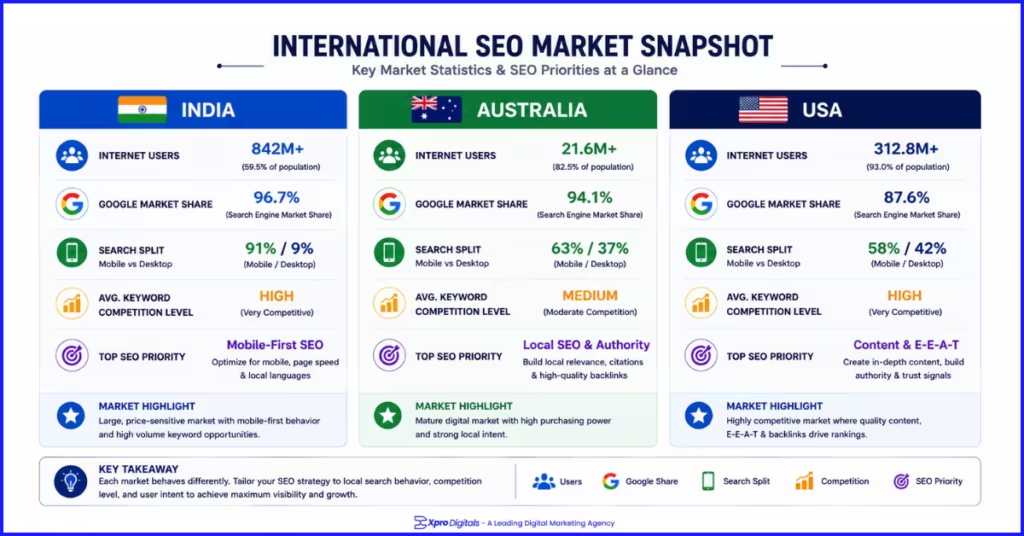
Factor | India | Australia | USA |
Internet users | 900M+, growing rapidly | 22M+, highly penetrated | 330M+, highly penetrated |
Google market share | 98%+ | 94%+ | 90%+ |
Primary device for search | Mobile (85%+ of searches) | Mobile and desktop balanced | Mobile (55-60% of searches) |
Search language | English + 20+ regional languages | English | English (Spanish growing) |
SEO competition level | Lower in most niches, growing fast | Moderate, well-established market | Highest globally in most niches |
Average cost of links | Lower, active link ecosystem | Moderate | High, competitive link market |
Local SEO importance | Very high, hyper-local intent | Very high, geographic awareness strong | Very high, near-me searches dominant |
Dominant content format | Mobile-Optimized, video-supported | Long-form, trust-focused | Comprehensive, data-driven |
Review culture | Strong, high review volume | Strong, Google review emphasis | Very strong, Yelp and Google both active |
SEO for Businesses in India
Understanding the Indian Search Landscape
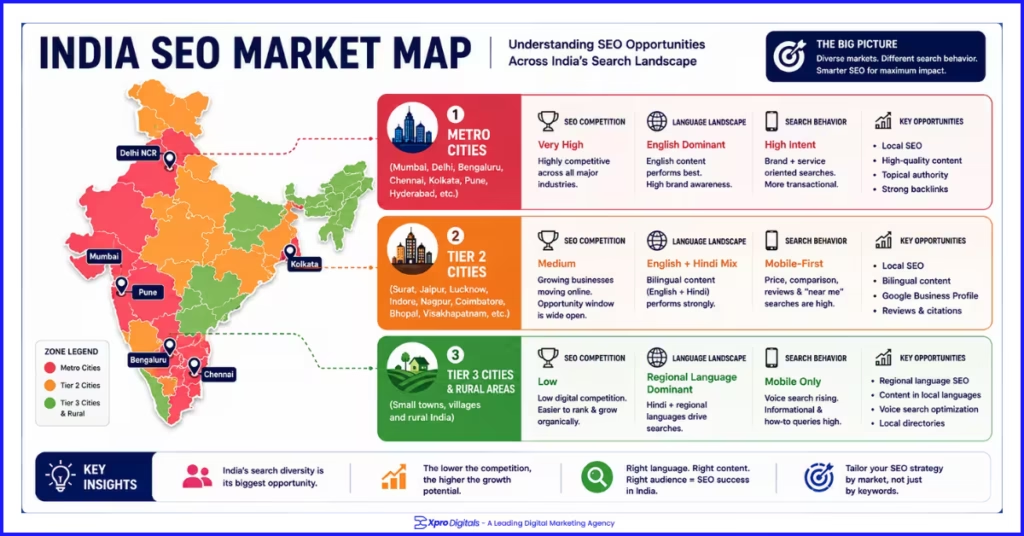
India’s digital market is unique in its combination of massive scale, rapid growth, and diversity. With over 900 million internet users and the majority accessing the web primarily through smartphones on mobile data connections, SEO for India requires a mobile-first approach that goes beyond responsive design to encompass page speed optimization for slower data connections common in Tier 2 and Tier 3 cities.
Google dominates Indian search with over 98% market share, making Google-focused SEO the correct strategy for almost all businesses. However, the diversity of regional languages creates a significant opportunity that most businesses overlook.
While English-language content reaches urban, educated, and business demographics effectively, regional language content in Hindi, Tamil, Telugu, Bengali, Marathi, and other major languages reaches hundreds of millions of additional searchers whose search behaviour is entirely in their native language.
We worked with an Indian D2C skincare brand targeting pan-India growth. Their English-language website ranked well in metro areas. After adding Hindi language content to their blog targeting informational queries around skincare in Hindi, their organic sessions from Tier 2 and Tier 3 cities grew 340% over seven months.
The Hindi content required separate keyword research because common skincare terms translate differently from English vocabulary used in Indian skincare conversations.
Indian Keyword Research: What Makes It Different
Indian keyword research has several characteristics that distinguish it from US or Australian research. Search volume data from tools like Ahrefs and Semrush often underestimates actual Indian search demand because a significant proportion of Indian search traffic occurs in regional languages not fully captured by English-language keyword tools. Always supplement tool data with Google Keyword Planner set to India specifically, and validate with Google Autocomplete on Google.co.in.
Indian searchers frequently use Indian English terminology that differs from UK or US equivalents. ‘Prepaid mobile plan‘ rather than ‘SIM only deal‘. ‘Two-wheeler insurance‘ rather than ‘motorcycle insurance‘. ‘Flat for rent‘ rather than ‘apartment for rent‘. These are not just regional dialect differences. They represent meaningfully different keyword sets with distinct search volumes and competitive landscapes.
Price sensitivity is significantly higher in Indian search than in Western markets, and this is reflected in keyword behaviour. ‘Cheap‘, ‘affordable‘, ‘under [price]‘, and ‘best value‘ modifiers appear at much higher frequency in Indian commercial keyword research than in equivalent US or Australian research. Content and product pages that address price transparency directly tend to outperform those that do not.
Technical SEO Priorities for India
Page speed is the most critical technical SEO factor for Indian audiences. A significant portion of Indian internet traffic, particularly from Tier 2 and Tier 3 cities, arrives on 4G connections that are reliable but not the fastest in the world. Pages that load in under two seconds on a 4G connection capture and retain Indian mobile users effectively. Pages that take four or more seconds lose the majority of their mobile audience before they see the content.
Optimize every image to WebP format with compression targeting under 80KB for mobile. Implement lazy loading on all below-fold images. Minimise JavaScript execution by deferring non-critical scripts. Use a CDN with Indian point-of-presence servers to reduce latency for users in different parts of the country. Mumbai and Bangalore are common CDN locations for Indian traffic but a CDN covering multiple Indian cities serves the full geographic spread of your Indian audience more effectively.
Core Web Vitals performance specifically on mobile 4G connections should be your testing standard, not Wi-Fi or desktop speeds.
Our ecommerce Core Web Vitals Optimization guide covers the specific image and script Optimizations that deliver the most significant load time improvements for mobile-heavy audiences.
Local SEO in India
India’s local search market is characterised by hyper-local intent. Indian searchers use very specific local qualifiers when looking for nearby services: ‘plumber in Koregaon Park Pune‘, ‘CA firm Connaught Place Delhi‘, or ‘restaurant near Bandra West Mumbai‘. This granularity reflects the way Indian cities are structured into distinctive neighbourhoods and areas with strong local identity.
Google Business Profile Optimization is essential for any business with a physical presence in India. The Indian review market is active and high-volume. Competitors with strong review profiles dominate local pack results across most Indian cities. Generating a consistent flow of genuine Google reviews in both English and regional languages where relevant gives your GBP the review density and language diversity that reflects the local customer base.
For businesses serving multiple Indian cities, create separate location pages on your website for each major city you serve, Optimized with city-specific and neighbourhood-specific content. Do not use the same location page template with city names swapped. Indian searchers respond to content that demonstrates genuine knowledge of their specific local context.
India SEO Checklist
Priority Area | Action | India-Specific Note |
Mobile performance | Achieve LCP under 2s on mobile 4G | Test on Indian networks, not just lab data |
Regional language content | Add Hindi or relevant regional language pages for target demographics | Requires native keyword research, not translation |
Local specificity | Optimize for neighbourhood-level keywords in target cities | Indian cities are searched at colony/area level |
Google Business Profile | Complete with local language content where relevant | High review volume expected in Indian markets |
Price signal in content | Address pricing transparently on product and service pages | Price transparency drives higher CTR in India |
CDN configuration | Use Indian CDN points of presence for static assets | Reduces latency for Tier 2 and 3 city users |
Keyword research tool | Supplement Ahrefs/Semrush with Google Keyword Planner set to India | Tool data underestimates Indian regional volumes |
SEO for Businesses in Australia
Understanding the Australian Search Landscape
Australia’s digital market is small in population but high in digital maturity. With 22 million internet users and extremely high smartphone penetration, Australia has one of the highest rates of online commerce and digital service consumption per capita in the world. The SEO competition level is moderate compared to the USA but significantly higher than India, with well-established local and international brands competing for most commercial keyword categories.
Australian search is almost entirely in English, which means Australian businesses face competition not just from domestic competitors but from UK and US websites whose domain authority can outmatch local sites on national queries. This is one of the distinctive challenges of Australian SEO: building the authority needed to outrank global competitors who also rank in Australia without specifically targeting it.
We audited an Australian accounting software company that was ranking behind two UK competitors and one US competitor for their primary Australian commercial keyword. A local link building programme targeting Australian accounting associations, Australian business publications, and regional business directories generated 28 locally relevant referring domains over six months. Their Australian ranking moved from position 8 to position 3 for the target keyword, outranking the UK and US competitors on their home turf.
Australian Keyword Research: What Makes It Different
Australian English uses terminology that differs from both UK and US English in ways that affect keyword research. ‘Tradie‘ instead of ‘tradesman‘ or ‘tradesperson‘. ‘Superannuation‘ instead of ‘pension‘ or ‘401k‘. ‘Ute‘ instead of ‘pickup truck‘. ‘Home loan‘ is more common than ‘mortgage‘ for residential lending products. These are not minor variations. They represent distinctly different keyword sets with their own search volumes and competitive landscapes.
When conducting Australian keyword research, always set your keyword tool to Australia specifically and validate high-volume terms using Google.com.au with Australian location settings. Terms that have high volume in the US or UK may have low volume in Australia, and Australian-specific terms will not appear in tools defaulting to global or US data.
Seasonal search behaviour in Australia is the inverse of the Northern Hemisphere due to the reversed seasons. ‘Air conditioning installation‘, ‘pool maintenance‘, and ‘outdoor furniture‘ peak in Australian summer (December to February). ‘Heating serviced‘, ‘winter clothing‘, and ‘ski trips‘ peak in Australian winter (June to August). Content strategy and promotional pages must account for this inverted seasonal calendar.
Technical SEO Priorities for Australia
Page speed matters in Australia, but the standard is somewhat different from India. Australian internet infrastructure is generally good quality in metro areas but can be inconsistent in regional areas where the National Broadband Network (NBN) has had variable rollout quality. Test page speed both on fibre connections representative of metro users and on typical ADSL or slower NBN speeds representative of regional Australian users.
Australia’s geographic size creates a latency consideration for website hosting. A website hosted on a US-based server has meaningful latency for Australian users compared to a server hosted in Sydney or Melbourne. For businesses primarily targeting Australian audiences, Australian-based hosting or a CDN with Australian nodes is worth the investment. Faster load times for local users improve both user experience and Core Web Vitals field data collected from Australian visitors.
Local SEO in Australia
Local SEO in Australia follows similar principles to other English-speaking markets but with some specific characteristics. Google reviews are extremely influential for Australian businesses. Australian consumers have high review engagement rates, and the local pack for most service category searches in Australian cities is dominated by businesses with 50+ reviews at high ratings.
Australian searchers show strong awareness of geographic boundaries at the state level. Melbourne searchers looking for professional services frequently specify ‘Melbourne’ or ‘Victoria’. Sydney searchers specify ‘Sydney’ or ‘NSW’. This state-level geographic awareness means location targeting should include both city and state names in your keyword strategy and on-page content.
For trades, professional services, and local retail in Australia, the combination of a strong GBP profile and Google reviews frequently determines local pack visibility more than organic domain authority. A local plumber with 80 genuine reviews at 4.8 stars will consistently outrank a large national brand with lower review volume in the Australian local pack.
Australia SEO Checklist
Priority Area | Action | Australia-Specific Note |
Australian hosting or CDN | Host in Australia or use CDN with Sydney/Melbourne nodes | Reduces latency for metro and regional Australian users |
Australian English keyword research | Set tools to Australia and validate on google.com.au | Australian terminology differs from UK and US English |
Seasonal content calendar | Build content strategy around Southern Hemisphere seasons | Inverted from Northern Hemisphere seasonal patterns |
Local review generation | Build GBP review count to competitive 50+ threshold | Australian consumers are highly review-engaged |
State-specific targeting | Include city + state in location pages and content | Australians search with state awareness |
Local link building | Target Australian industry associations and publications | International domain authority does not offset local link gaps |
NBN-aware speed testing | Test on both fibre and slower NBN connections | Regional Australian users have variable connection quality |
SEO for Businesses in the USA
Understanding the US Search Landscape
The USA is the world’s most competitive SEO market. Domain authority requirements to rank on page one for commercial keywords are higher in the US than in any other English-speaking country. Content quality expectations are higher. Link acquisition costs are higher. The investment required to earn and maintain competitive organic visibility in the US is significantly greater than in Australia or India for equivalent keyword categories.
However, the rewards are proportionally larger. US organic search traffic converts at high rates across most commercial categories. The average order value and lifetime customer value in US markets frequently justifies the higher investment required to compete. For businesses that can afford the timeline (typically nine to eighteen months to achieve competitive rankings in contested US keyword categories) and the investment, US SEO delivers some of the strongest organic revenue results globally.
We managed SEO for a UK software company entering the US market. After twelve months of a US-specific content and link building programme, organic traffic from the US grew from 800 to 14,000 monthly sessions. The content strategy included 22 long-form comparison pages targeting US-specific SaaS evaluation queries, a US-focused resource hub with original industry data, and a link building programme targeting US technology publications and SaaS review platforms. The investment was higher than any other market they had entered. The organic revenue return was also higher by a comparable margin.
US Keyword Research: What Makes It Different
US keyword research operates in the world’s most tool-rich and data-dense environment. Ahrefs, Semrush, Moz, and SpyFu all provide their most comprehensive data for the US market. Competition scores in keyword tools are most accurate for the US market because the database coverage is fullest. This makes US keyword research the most reliable in terms of data accuracy but also reveals the most intimidating competitive picture.
US search intent is highly evolved. Google’s understanding of intent for US English queries is the most sophisticated of any language globally because the US has the longest history of high-volume English search data. This means intent alignment is even more critical in the US than in other markets: pages that misalign with the dominant SERP intent for a US commercial keyword face steeper ranking suppression than they would for equivalent queries in less-evolved markets.
Spanish-language search in the US is a significant and growing opportunity. Over 41 million native Spanish speakers and 12 million bilingual Spanish speakers in the US represent a substantial Spanish-language search audience that many English-language businesses do not currently serve. Adding high-quality Spanish-language content targeting US Spanish search patterns is an increasingly important growth lever for businesses with products or services relevant to the Hispanic American market.
Technical SEO Priorities for the USA
US audiences have high digital expectations. Fast page load times are a baseline assumption rather than a differentiator in the US market. A page that loads in three seconds is not competitive in the US. The standard for competitive US content is under two seconds LCP on mobile. US audiences have lower tolerance for poor mobile experiences than Indian or even Australian audiences, and this is reflected in engagement data that Google uses as quality signals.
The competitive intensity of US SEO means that technical SEO errors that might be tolerated in lower-competition markets become significant ranking liabilities in the US. A site with multiple canonicalisation errors, significant crawl budget waste, or failing Core Web Vitals will lose ranking ground to technically superior competitors faster in the US than in any other market because the competitors are more technically sophisticated and more actively investing in their technical foundations.
Content Standards in the US Market
US content standards in 2026 are demanding. Long-form content for competitive commercial keywords frequently exceeds 2,500 words and includes original data, expert contributions, comparison tables, and multimedia elements.
Thin content that might rank for commercial terms in lower-competition markets will not achieve page one in competitive US categories. E-E-A-T signals are scrutinised more intensely in the US because the content ecosystem is richer and Google has more high-quality options to choose from for any given query.
Building topical authority through a systematic content cluster approach is the most effective content strategy for the US market. Pillar pages covering core topics comprehensively, supported by cluster pages addressing specific subtopics in depth, signal to Google the breadth and depth of knowledge required to rank competitively in contested US categories.
Our guide on the ultimate SEO guide for boosting website visibility covers the content cluster model in full with a practical framework for implementation.
Local SEO in the USA
Local SEO in the US operates at a scale and sophistication level that reflects the maturity of the US digital market. Near-me searches dominate local discovery across virtually every service category. Google reviews are essential but so is Yelp for certain categories (restaurants, home services, healthcare) where Yelp review profiles significantly influence local pack appearance and consumer trust.
US local SEO also requires attention to Bing Places, as Bing holds a larger share of US search (around 6-8%) than in most other English-speaking markets and powers Cortana and some smart device searches. The investment of claiming and Optimizing a Bing Places profile is proportionally more worthwhile in the US than in Australia or India.
For US local businesses, the combination of a fully Optimized Google Business Profile, an active review generation strategy targeting both Google and category-relevant review platforms, and consistent NAP across major US directories creates the strongest local authority signal.
Our guide on why local SEO is vital for small businesses covers the local signal framework that applies across all three markets with market-specific nuances for each.
USA SEO Checklist
Priority Area | Action | US-Specific Note |
Content quality threshold | Produce the most comprehensive content on the target topic | US SERPs have highest content quality baseline globally |
E-E-A-T investment | Original data, expert authorship, industry citations | Google’s quality assessment most rigorous in US English |
Technical perfection | Zero crawl errors, Core Web Vitals passing on mobile | Technical errors are exploited by sophisticated US competitors |
Link authority | Target US publications, industry associations, and trade media | US link market most competitive, also highest quality links |
Topical authority | Build content clusters around core topic areas | Thin topical coverage ranks below comprehensive cluster approach |
Spanish-language opportunity | Research US Spanish search demand in your category | 40M+ US Spanish speakers represent growing organic opportunity |
Multi-platform review strategy | Optimize Google + Yelp + category-specific review platforms | Yelp more influential in US than in other English-speaking markets |
Bing Places | Claim and Optimize Bing Places listing | Bing has higher US market share than in other markets |
Cross-Market SEO Strategy: Prioritising When Targeting All Three
For businesses targeting India, Australia, and the USA simultaneously, the investment and timeline requirements are very different for each market. Understanding this helps you sequence your market entry and allocate budget effectively.
Market Entry Priority Framework
Factor | India | Australia | USA |
Time to first page one rankings | 3 to 8 months in most niches | 5 to 10 months in most niches | 9 to 18 months in competitive niches |
Investment required relative | Lowest of the three markets | Moderate | Highest of the three markets |
Competition intensity | Low to moderate, growing | Moderate to high | High to very high in most niches |
Early organic revenue potential | High volume, lower average order value | Moderate volume, high average order value | High volume, high average order value |
Local link building cost | Lowest | Moderate | Highest |
Content investment required | Moderate | High | Very High |
Recommended entry sequence | First market for most growing businesses | Second market | Third market or simultaneous with higher investment |
Step-by-Step: Building a Multi-Market SEO Strategy
Step 1: Audit Your Current Performance in Each Market
Before building a strategy for each market, understand your current position. Open Google Search Console and filter the Performance report by country.
Note your current organic sessions, average position, and click-through rate for each of the three markets separately. If you have no GSC data for a market, that itself is a data point: you have zero established organic presence to build on.
Step 2: Conduct Market-Specific Keyword Research
Run separate keyword research exercises for each market.
For India, use Google Keyword Planner set to India plus Ahrefs with India country filter.
For Australia, use tools set to Australia and validate on google.com.au.
For the USA, use tools set to the United States. Build a separate keyword map for each market rather than applying one keyword set across all three.
Step 3: Identify the Technical Requirements for Each Market
India: prioritise mobile page speed for 4G connections and CDN coverage across Indian cities.
Australia: consider Australian hosting or CDN nodes, test on variable NBN speeds.
USA: achieve technical perfection across all Core Web Vitals, ensure zero crawl errors and canonical issues.
Run separate PageSpeed Insights tests geolocated to each market.
Step 4: Develop Market-Specific Content Plans
India: create content that addresses Indian buyer context, includes price transparency, and covers regional specifics.
Australia: produce long-form trust-building content using Australian English terminology and seasonal awareness.
USA: invest in the most comprehensive content on each topic, backed by original data and expert authorship.
Do not share content between markets without localisation.
Step 5: Build Local Presence in Each Market
For each market where you have a local presence or serve local customers: set up and fully Optimize separate Google Business Profiles for each location. Build market-specific citations on the most important local directories in each country. Generate reviews from customers in each market, encouraging them to leave reviews on the most relevant platform for that market (Google for all three, Yelp additionally for the US).
Step 6: Build Market-Specific Link Authority
Target locally relevant link sources for each market.
- Indian industry associations, trade publications, and business directories for India.
- Australian professional associations, regional business publications, and .com.au directories for Australia.
- USA industry media, SaaS review platforms, and professional association directories for the USA.
Mixing link sources across markets dilutes geographic relevance signals.
Step 7: Measure and Report by Market
Set up separate reporting views in Google Analytics 4 and Google Search Console for each market. Review market-specific performance monthly and adjust investment allocation based on which market is showing the strongest return relative to spend. Use the cross-market comparison table in this guide to assess whether your progress in each market is tracking against realistic market-specific timelines.
Our guide on common SEO mistakes businesses make includes a section on tracking the right metrics, which applies equally to single and multi-market programmes.
People Also Ask: SEO for India, Australia and the USA
Is SEO Different in India vs the USA?
Yes, significantly. India has lower keyword competition, higher mobile search dominance, regional language search opportunities, and price-sensitive search behaviour. The USA has the world’s highest SEO competition, the most sophisticated content quality standards, and the highest domain authority requirements for page one rankings. Investment and timeline requirements are substantially different in each market, with India being faster and more accessible for new entrants and the USA requiring longer timelines and higher content investment.
How Do I Rank on Google India?
Ranking on Google India requires a mobile-first website that loads in under two seconds on a 4G connection, Google Business Profile Optimization if you have a local presence, content that addresses Indian search terminology rather than Western equivalents, local backlinks from Indian industry publications and directories, and where relevant, content in regional languages targeting non-English-speaking Indian searchers. Google India uses the same ranking algorithm as Google globally but the competitive landscape, search behaviour, and technical requirements are India-specific.
How Do I Do SEO for the Australian Market?
SEO for Australia requires Australian-specific keyword research using Australian English terminology, hosting or CDN infrastructure with Australian presence to reduce latency, a Google Business Profile for local visibility if you serve Australian customers physically, Australian backlinks from local publications and associations to overcome the authority advantage of US and UK competitors, and seasonal content planning aligned to the Southern Hemisphere calendar. The competitive standard is higher than India but lower than the USA.
What Are the Most Competitive SEO Niches in the USA?
The most competitive US SEO niches are legal services (particularly personal injury and criminal defence), financial services (insurance, mortgages, loans), healthcare (medical providers and supplements), real estate, and SaaS software. These categories combine high commercial value per conversion with intense well-funded competition and very high domain authority requirements for page one visibility. New entrants to these categories should expect twelve to twenty-four months before achieving competitive rankings.
Does Local SEO Work the Same Way in India, Australia and the USA?
The principles are the same: Google Business Profile Optimization, consistent NAP, reviews, and local content. The differences are in the specific platforms that matter most, the geographic granularity expected (neighbourhood-level in India, city and state level in Australia, city and zip code level in the USA), the review volume required to be competitive, and the local link sources that carry the strongest geographic relevance signal in each market.
What Language Should I Use for SEO in India?
English for urban, educated, and business demographics across all major Indian cities. Hindi for Tier 2 and Tier 3 city audiences in Hindi-speaking states. Tamil for Tamil Nadu, Telugu for Andhra Pradesh and Telangana, Bengali for West Bengal and the North-East, and Marathi for Maharashtra. The right language combination depends on which geographic and demographic audience your business targets. A pan-India growth strategy benefits from English plus Hindi at minimum, with additional regional languages as resources allow.
How Important Are Backlinks for SEO in Australia?
Backlinks are very important in Australia, particularly for outranking US and UK competitors who bring their existing domain authority into Australian search results without specifically targeting Australia. Australian businesses must build enough local link authority to overcome the advantage that internationally established domains bring. Australian links from .com.au domains, Australian news publications, and Australian industry associations carry strong geographic relevance signals that help Google understand your business is specifically relevant to Australian searchers.
What Is the Difference Between SEO for eCommerce in India vs the USA?
Ecommerce SEO in India prioritises mobile performance above all else, addresses price sensitivity signals in content and product listings, and requires regional language content for broader market penetration. Ecommerce SEO in the USA requires the highest content quality standards, comprehensive product and category page Optimization, and significantly more domain authority to outrank established US ecommerce players.
Our ecommerce SEO checklist covers the technical and content priorities that apply across all three markets with notes on market-specific variations.
How Long Does SEO Take to Show Results in India?
In India, businesses in lower-competition niches can see meaningful ranking improvements within three to five months with consistent SEO investment. More competitive niches in metro cities take six to nine months for significant page one visibility. Hindi and regional language content targeting Tier 2 and Tier 3 markets often rank faster than English content for metro areas because competition in those keyword categories is significantly lower.
What SEO Tools Work Best for Indian Market Research?
Google Keyword Planner set to India is the most reliable volume data source for Indian search because it draws directly from Google’s own data. Ahrefs and Semrush with country filters set to India provide competitive analysis, backlink research, and content gap analysis. Google Search Console is essential for tracking actual performance. BrightLocal covers local SEO tracking for Indian cities. For regional language keyword research, native Google searches with the target regional language interface provide the most accurate insight into search patterns that Western tools undercount.
Should I Create Separate Websites for India, Australia and the USA?
For most businesses, no. Separate websites (separate domains or ccTLDs) require building authority independently for each, which multiplies the investment required and delays results in each market. The recommended approach is a single domain with country-targeted subdirectories (/in/, /au/, /us/) or simply Optimizing pages with market-specific content and using Google Search Console’s geotargeting tools. Separate sites make sense only when the product offering, pricing, or brand positioning is genuinely distinct enough to warrant a completely separate presence.
How Do Review Strategies Differ Across India, Australia and the USA?
In India, Google reviews are dominant and review volume on GBP is the primary review signal. Asking customers to leave reviews in their own language (English or regional) increases the diversity of review content signals. In Australia, Google reviews are essential and the volume threshold for local pack competitiveness is typically 50+ reviews. In the USA, Google reviews are critical but Yelp carries significant additional weight in categories like restaurants, home services, and healthcare. US businesses benefit from a multi-platform review strategy that includes both Google and Yelp.
Is On-Page SEO the Same Across All Three Markets?
The principles are identical: title tags, heading structure, content quality, search intent match, schema markup, and internal linking all apply universally. The differences are in the content itself: terminology must reflect each market’s natural language usage, examples and case studies should be locally relevant, pricing references should use local currency, and cultural context should feel native to the target audience. A page with technically correct on-page SEO but content that feels foreign to the target market will underperform a locally relevant competitor at an equivalent on-page technical level.
What Is the Best SEO Strategy for a Business Entering the Indian Market?
Start with mobile performance: achieve LCP under two seconds on 4G. Claim and Optimize your Google Business Profile with Indian-specific content. Conduct Indian keyword research separately from global keyword research, identifying Indian English terminology and relevant regional language opportunities. Build backlinks from Indian industry directories and publications. Generate Google reviews from Indian customers. Create content that addresses Indian price sensitivity and local context. These six actions together create the foundational local search presence for an Indian market entry.