E-E-A-T Guide for SEO: How to Build the Trust Signals Google Rewards in 2026
Introduction: Why Good Content Stops Ranking and What Google Is Actually Measuring
Here is a situation that genuinely puzzles business owners and content teams. A well-researched, clearly written article targeting a well-chosen keyword sits on page four. A shorter, thinner article from a well-known brand sits on page one. The content quality, by any reasonable measure, favours the former. The rankings do not.
The pain is frustrating precisely because it breaks the simple equation most businesses rely on: create better content, rank higher. That equation is incomplete. Google is not just assessing the content on the page. It is assessing whether the source of that content can be trusted to provide accurate, credible information on the topic.
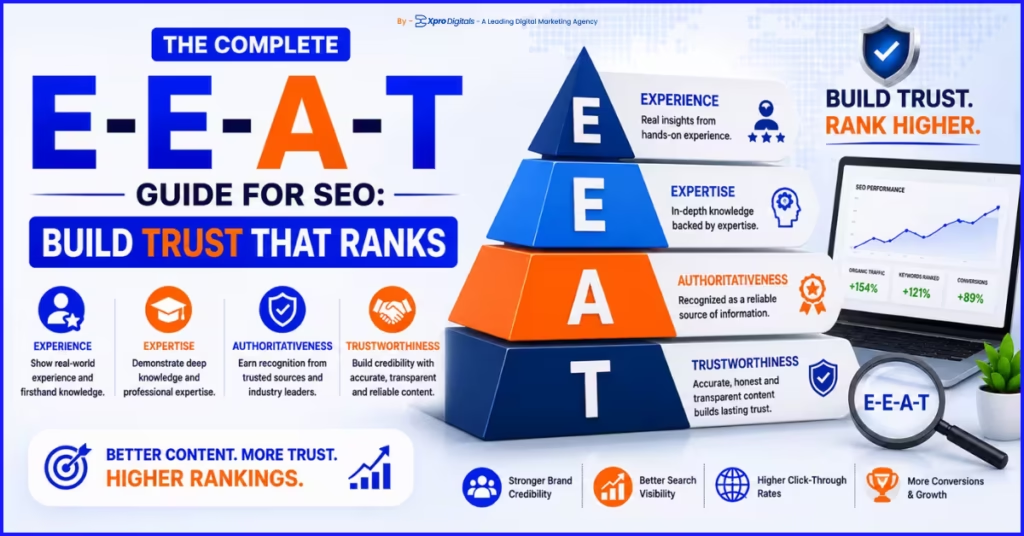
This is what E-E-A-T is. Experience, Expertise, Authoritativeness, and Trustworthiness. These are the four dimensions through which Google’s Search Quality Evaluator Guidelines instruct human raters to assess the quality of a page and its source. They inform how Google’s algorithms assess content quality at scale. And they explain why domain reputation, author credibility, and off-page brand signals matter as much as the content itself.
By the end of this guide you will understand what each E-E-A-T signal actually means in practical terms, how Google evaluates them both algorithmically and through its quality rater programme, which signals matter most for your specific business type, and the specific actions you can take to strengthen every dimension of E-E-A-T on your website starting today.
E-E-A-T applies across all SEO disciplines. For the foundational context on how these signals interact with technical and on-page factors, our guide on technical SEO vs on-page SEO: which matters more explains where E-E-A-T fits within the broader ranking signal framework.
What Is E-E-A-T and Where Does It Come From?
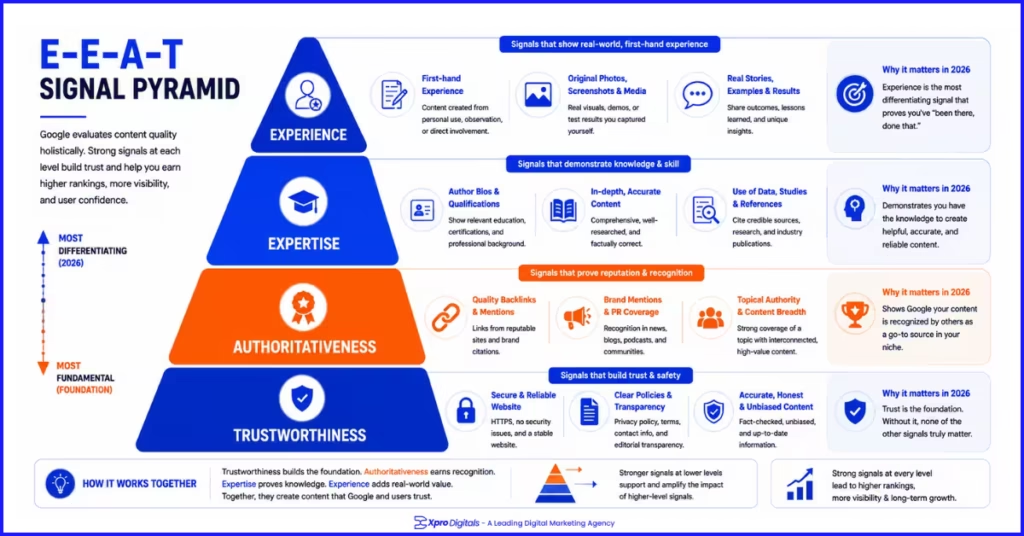
E-E-A-T stands for Experience, Expertise, Authoritativeness, and Trustworthiness. It was originally introduced as E-A-T (without Experience) in Google’s Search Quality Evaluator Guidelines, the handbook used by Google’s human quality raters to assess page quality.
In December 2022, Google added the first E for Experience, acknowledging that demonstrated first-hand experience with a topic is a distinct and valuable quality signal beyond general expertise.
E-E-A-T is not a direct ranking algorithm. Google has been explicit that it does not have a single E-E-A-T score that it calculates and applies to rankings. What it does have are hundreds of signals that approximate how well a page, its author, and the site it appears on satisfy the four E-E-A-T criteria.
Those signals feed into its ranking algorithms. The Search Quality Evaluator Guidelines describe what high-quality content looks like so that both human raters and algorithmic systems can identify it consistently.
Understanding E-E-A-T matters more in 2026 than it did three years ago for two reasons. First, Google’s AI-driven content quality assessments have become more sophisticated at distinguishing genuinely expert content from surface-level coverage.
Second, the proliferation of AI-generated content has increased the value Google places on signals of genuine human expertise and first-hand experience, as these are the things AI-generated content most consistently lacks.
E-E-A-T: What Each Component Means
| Component | What It Means | How Google Assesses It | Primary Signals |
| Experience | First-hand knowledge of the subject from direct participation | Does the content reflect genuine personal or professional experience? | Original observations, personal examples, case studies, first-person perspective |
| Expertise | Deep knowledge and skill in a subject area | Does the creator demonstrate technical accuracy and depth? | Credential indicators, professional background, content depth and accuracy |
| Authoritativeness | Recognition as a credible source by others in the field | Do external sources reference and cite this creator or site? | Backlinks, brand mentions, press coverage, Wikipedia citations, industry awards |
| Trustworthiness | Accuracy, transparency, and honesty | Is the site honest about who it is, what it sells, and what information it presents? | Accurate content, clear ownership, privacy policy, security, factual citations |
Why E-E-A-T Matters More for Some Topics Than Others
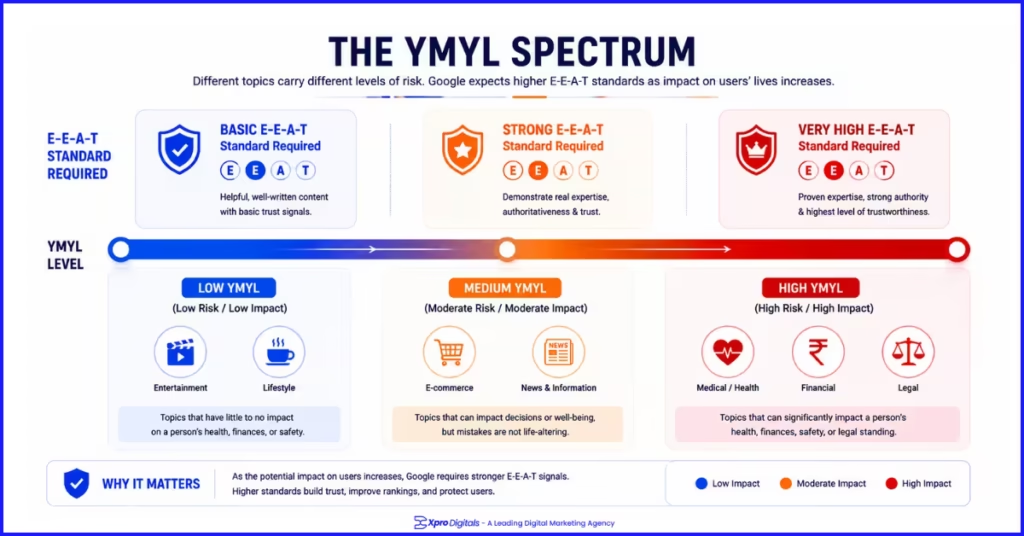
Google applies E-E-A-T assessment most rigorously to topics it classifies as YMYL: Your Money or Your Life. These are topics where inaccurate or low-quality information could directly harm the reader’s health, financial wellbeing, safety, or major life decisions. Medical advice, financial guidance, legal information, product safety, news coverage, and civic information all fall into the YMYL category.
For YMYL topics, the bar for E-E-A-T is genuinely high. A medical advice page from an anonymous author with no stated credentials will consistently underperform against a page from a named, licensed medical professional, regardless of the keyword optimization on either page.
For a healthcare business, this means your content strategy must include credentialled authorship, medical review attribution, and citation of peer-reviewed sources.
For non-YMYL topics, the E-E-A-T bar is lower but not zero. A recipe website from an enthusiastic home cook who demonstrates genuine first-hand experience through detailed personal notes, original photography, and honest recipe testing observations will consistently outperform a recipe aggregator producing formulaic content without any personal perspective.
YMYL Topics and E-E-A-T Requirements
| Topic Category | YMYL Level | E-E-A-T Requirement | Example Standards |
| Medical and health advice | Very High | Medical professional authorship or review | Named licensed clinician, peer-reviewed sources cited |
| Financial advice and products | Very High | Financial professional credentials or regulatory compliance | Named qualified adviser, FCA/SEC regulated information |
| Legal information | Very High | Legal professional authorship | Named practising solicitor or attorney |
| Safety and emergency information | Very High | Official or expert sources only | Government or professional body citations |
| News and current events | High | Identified journalist or editorial organisation | Named journalist, editorial standards stated |
| Ecommerce product information | Moderate | Accurate product data, genuine reviews | Correct specifications, verified customer reviews |
| General informational content | Lower | Demonstrated knowledge and accuracy | Cited sources, accurate information, clear author |
| Entertainment and lifestyle | Low | Genuine voice and perspective | Personal experience, original content |
The Experience Signal: The Newest and Most Differentiating E-E-A-T Factor
Experience was added to Google’s E-E-A-T framework in December 2022, and it is the signal that most clearly separates content created by people who have actually done a thing from content created by someone (or something) that has only read about it.
In a world where AI can generate technically accurate-sounding content on almost any topic, evidence of genuine first-hand experience is one of the clearest quality differentiators available.
Experience signals in content include: personal observations that only someone who has actually done the thing would make, specific details that reflect hands-on knowledge (not just what is commonly documented), acknowledgement of what did not work as well as what did, photographs or screenshots taken personally rather than sourced from stock libraries, numerical data from your own testing or practice, and client or customer case studies from real engagements.
We see the experience signal directly in our own content performance. Articles on our site that include specific client results, named examples from client audits, and first-person observations from our own SEO practice consistently outperform structurally similar articles that cover the same topic without those original elements. The difference is not in keyword strategy or technical optimization. It is entirely in whether the content reflects genuine first-hand experience.
How to Demonstrate Experience in Content
| Content Type | Without Experience Signal | With Strong Experience Signal |
| Product review | Lists features from manufacturer data | Includes personal testing observations, honest assessment of drawbacks |
| How-to guide | Generic steps describing the process | Specific observations from actually doing it, including what commonly goes wrong |
| Industry guide | Summarises existing published information | Includes original data from your own practice or client work |
| Case study | Describes hypothetical scenario | Named client (with permission), specific numbers, timeline, and lessons learned |
| Opinion piece | States a position without evidence of personal involvement | Argues from direct observation or personal professional experience |
The Expertise Signal: Demonstrating Depth of Knowledge
Expertise is the dimension of E-E-A-T most easily conflated with content depth. Longer articles are not automatically more expert. Expert content is accurate, covers the topic at the depth required for the audience, avoids oversimplification of complex points, and reflects genuine knowledge of the subject area rather than surface-level research.
For Google’s quality raters, expertise is assessed by whether the content creator is a credible source for the topic being covered. A tax accountant writing about tax law demonstrates expertise. A general blogger writing about the same topic without stated credentials does not, even if the content happens to be accurate. The credentials signal is separate from the accuracy signal.
Expertise signals include: professional credentials listed in the author bio, institutional affiliations relevant to the topic, industry recognition or professional certifications, depth of content coverage that demonstrates genuine subject knowledge, technical accuracy verifiable against authoritative sources, and the absence of common factual errors that an expert would not make.
Expertise Signals by Business Type
| Business Type | Expertise Signal Examples |
| Healthcare practice | Named clinician authors with GMC/licensing number, peer-reviewed source citations, medical review attribution |
| Legal firm | Named practising solicitor or barrister authors, bar association membership cited, jurisdiction clearly stated |
| Financial services | Named regulated adviser, FCA authorisation number, regulatory compliance statements |
| SEO agency | Named practitioners with verifiable track records, original data from client work, industry speaking or publication history |
| Ecommerce store | Named product specialists, technical specifications verified, quality testing results, industry certification where relevant |
| SaaS company | Named engineering or product team authors, technical documentation depth, integration and API accuracy |
The Authoritativeness Signal: Building External Recognition
Authoritativeness is the E-E-A-T dimension that most closely overlaps with traditional off-page SEO. It is earned when other credible sources recognise your site or its authors as trustworthy references for a particular topic. Unlike experience and expertise, which can be demonstrated through your own content decisions, authoritativeness depends on what the rest of the web says about you.
The clearest authority signals are backlinks from credible, topically relevant websites. When a respected medical publication cites your healthcare content as a reference, or a national newspaper quotes your business commentary, or a government website links to your consumer guidance, Google reads these as strong authority endorsements. The source’s own credibility determines how much authority weight the endorsement carries.
Brand mentions without links, press coverage that names your business, inclusion in industry directories and professional bodies, Wikipedia citations, and awards from industry organisations all contribute to authoritativeness. These off-page signals tell Google that the broader web considers your site and its content worth referencing, which is a credibility signal no amount of on-page optimization can substitute.
Building authoritativeness through strategic link acquisition from credible sources is one of the highest-impact long-term SEO investments available.
Our guide on why businesses should hire an SEO agency covers how professional link building and brand authority development fits into a managed SEO programme.
Authoritativeness Building Checklist
| Authority Signal | How to Build It | Priority Level |
| Topically relevant backlinks | Content marketing, digital PR, expert commentary outreach | Very High |
| Brand mentions in press | PR outreach to industry publications and journalists | Very High |
| Industry directory listings | Submit to verified, credible directories in your sector | High |
| Professional association membership | Join and list sector-specific professional bodies | High |
| Industry award recognition | Enter and list relevant sector awards | Medium-High |
| Wikipedia citations or page | Earn citations through original research; Wikipedia page if notable | Medium (long-term) |
| Podcast appearances and interviews | Participate as expert guest in relevant podcasts and interviews | Medium |
| Conference speaking | Speak at industry conferences, link to recording from website | Medium |
| Academic or research citations | Publish original research that academics or analysts cite | Medium (long-term) |
The Trustworthiness Signal: The Foundation Everything Else Builds On
Google’s updated Search Quality Evaluator Guidelines explicitly state that Trustworthiness is the most important of the four E-E-A-T dimensions. A site can demonstrate experience, expertise, and authority but if Google cannot establish that it is honest and transparent about who it is, what it does, and what information it presents, all other signals are undermined.
Trustworthiness is assessed at both the site level and the page level. At the site level, Google evaluates whether the site clearly identifies who owns and operates it, whether contact information is accurate and accessible, whether the site has standard trust infrastructure (about page, privacy policy, terms and conditions), whether products or services are clearly described with accurate pricing, and whether the site handles customer data responsibly.
At the page level, trustworthiness is assessed through content accuracy, transparent disclosure of commercial interests (if a page is sponsored or contains affiliate links), citation of credible sources for factual claims, clear date-stamping showing when content was last updated, and absence of deceptive practices like clickbait headlines that misrepresent the actual content.
Trust Infrastructure Checklist
| Trust Signal | What Good Looks Like | What Failing Looks Like | Done? |
| About page | Clear description of who the business is, leadership team, founding story | No about page or generic placeholder text | |
| Contact information | Physical address, phone number, and email all accessible | Contact form only, no direct contact details | |
| Privacy policy | Clear, accurate policy explaining data collection and use | No privacy policy or outdated/generic policy | |
| Terms and conditions | Clear terms covering service delivery or purchase conditions | No terms page or incomplete terms | |
| Author attribution | Named author on every content page with bio and credentials | Anonymous content or generic ‘Admin’ authorship | |
| Content accuracy | Factual claims cited with credible sources | Unsourced statistics or claims | |
| Last updated dates | Content pages show publication and last updated dates | No dates visible on content, preventing freshness assessment | |
| Affiliate/sponsored disclosure | Commercial relationships clearly disclosed where relevant | Affiliate content or sponsored posts without disclosure | |
| HTTPS security | Padlock visible across all pages | HTTP pages or mixed content warnings | |
| Review responses | Business responds to customer reviews publicly | No engagement with customer reviews positive or negative |
E-E-A-T and Author Signals: The Most Actionable Improvement
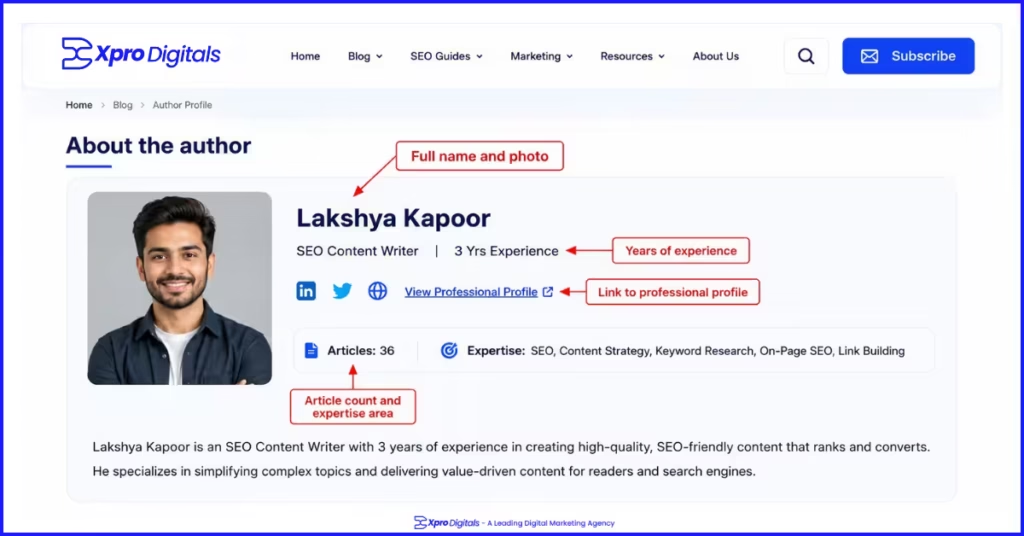
Author signals are one of the most directly actionable E-E-A-T improvements any website can make because they are entirely within your control. Adding credentialled author attribution to your content pages is a signal that can be implemented within days and that demonstrates expertise and experience simultaneously.
An effective author bio for E-E-A-T purposes includes: the author’s full name, their professional credentials or qualifications relevant to the topic, their years of experience in the relevant field, links to their professional profiles (LinkedIn, professional association listings), any publications, speaking engagements, or other third-party recognition, and a photo that reinforces the human authorship signal.
We added structured author bios with professional credentials to 32 content pages for a healthcare client that had previously used anonymous authorship. All 32 pages had named clinicians as authors with their licensing details. Within ten weeks of the update, 19 of those pages improved their ranking positions. The average improvement was 3.4 positions. No other content changes were made during that period.
Author Schema Implementation
Implementing author information in both visible content and structured data (Person schema) gives Google two consistent signals about the author’s identity and credentials. The Person schema should include the author’s name, job title, professional URL (such as their LinkedIn profile or professional body page), and sameAs references to other authoritative profiles that confirm their identity.
Schema markup for author attribution is a technical implementation that complements the on-page author bio.
Our ecommerce schema markup implementation guide covers Person schema alongside other structured data types, with code examples that can be adapted for author attribution on any content page.
E-E-A-T for Different Business Types
E-E-A-T for Ecommerce Businesses
Ecommerce E-E-A-T focuses on product accuracy, review authenticity, and supply chain credibility. Customers and Google both look for evidence that an ecommerce store is a legitimate, trustworthy place to spend money.
Key signals include: named team behind the business, physical address displayed, clear returns and refunds policy, genuine customer reviews with business responses, accurate product specifications verified against manufacturer data, and secure checkout with recognised payment providers.
Original product content that goes beyond manufacturer descriptions demonstrates expertise. Detailed product guides, comparison content, and buying advice written by team members with genuine product knowledge builds the experience signal. Video content showing products in real use builds both experience and trust signals simultaneously.
For ecommerce stores, combining strong E-E-A-T signals with correct on-page and technical SEO creates the most competitive possible ranking foundation.
Our ecommerce SEO checklist covers the full range of optimization areas where E-E-A-T sits alongside technical and content factors.
E-E-A-T for Local and Service Businesses
For local businesses, E-E-A-T is strongly tied to community recognition and customer trust signals. Google reviews are the most visible trust signal for local businesses and function as a direct authoritativeness indicator. A plumber with 120 genuine Google reviews at 4.9 stars has stronger local E-E-A-T than a competitor with 8 reviews regardless of website quality. Team pages showing named professionals with relevant trade qualifications build expertise signals. Press coverage in local publications builds authoritativeness.
Local businesses benefit from E-E-A-T signals that reinforce their community credibility. Our guide on why local SEO is vital for small businesses covers the local trust and authority signals that directly affect Map Pack and local organic rankings.
E-E-A-T for B2B Companies
B2B E-E-A-T is built through thought leadership content attributed to named senior practitioners, original industry research and data, case studies from named clients (with permission), conference speaking records, industry publication contributions, and professional association involvement. LinkedIn author profiles and company pages that link back to the company website reinforce author identity signals.
B2B content that demonstrates experience through specificity consistently outperforms generic B2B content. Rather than writing ‘we help businesses improve efficiency’, a case study showing exactly how a specific intervention improved a specific client’s output by a specific percentage demonstrates the experience and expertise signals that drive E-E-A-T in the B2B context.
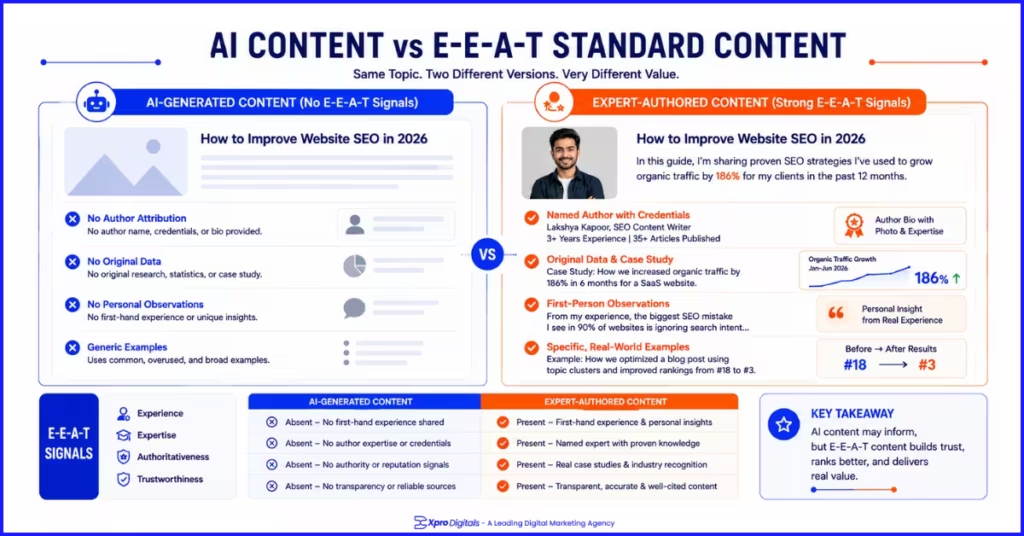
E-E-A-T and AI-Generated Content
AI-generated content presents a specific E-E-A-T challenge. AI can produce grammatically correct, topically relevant content at scale. What it cannot produce is genuine first-hand experience, personal observation from direct involvement, or authentic credentials. These are the signals Google has specifically added and reinforced in its quality assessment framework since AI content became widespread.
Google’s guidance on AI content states that it is not opposed to AI-assisted content per se but that content must demonstrate helpfulness, accuracy, and originality regardless of how it was produced. Content that is AI-generated without human expert review, original data, or first-person experience consistently underperforms against content that includes those signals, particularly on competitive or YMYL topics.
The practical implication for businesses using AI content tools is that AI assistance is most defensible when it is genuinely assisting a human expert rather than replacing one. AI drafting a structure that a qualified professional then adds their experience and expertise to is a different product from AI generating content on a topic without expert involvement. The E-E-A-T signals in the final output reveal the difference.
E-E-A-T Improvement: Step-by-Step Action Plan
Step 1: Audit Your Current E-E-A-T Signals
Review your top 20 pages by traffic. For each, note: Is there a named author with a bio and credentials? Does the content include original data, personal examples, or case studies? Are factual claims cited with sources? Is the page date-stamped? Does the site have a complete About page, Contact page, and Privacy Policy? This audit creates a baseline and identifies the highest-priority gaps.
Step 2: Add Author Attribution to All Content Pages
For every content page without a named author, assign the most credentialled person in your organisation whose expertise is relevant to the topic. Write a bio that includes their full name, professional credentials, years of experience, and links to verifiable external profiles. Implement Person schema to provide structured data attribution alongside the visible bio.
Step 3: Build the Trust Infrastructure
Verify your About page clearly describes who operates the business, who the team is, and what your qualifications and track record are. Ensure contact information includes a physical address and direct phone number. Confirm your Privacy Policy accurately reflects your current data practices. Add Terms and Conditions if you sell products or services. Confirm all pages are served over HTTPS.
Step 4: Add Original Experience to Priority Pages
For each of your highest-traffic content pages, add one element of genuine first-hand experience: a client case study, original data from your own testing or practice, a personal observation about a common mistake you have seen, or a specific example from your own professional experience. This is the signal most consistently missing from content that should be ranking but is not.
Step 5: Cite Authoritative External Sources
Go through your highest-traffic content pages and identify every factual claim that is currently unsourced. Add citations from authoritative external sources: peer-reviewed research, official government data, industry bodies, respected trade publications. This signals that your content is verified against credible information rather than asserted without evidence.
Step 6: Build Authoritativeness Through External Recognition
Develop a systematic programme for earning external recognition. Pitch commentary and expert quotes to industry publications. Apply for relevant industry awards. Contribute to professional associations. Pursue guest posting opportunities on respected publications in your field. Build a content asset (original research, comprehensive guide, or unique tool) designed to earn backlinks from credible sources in your industry.
Step 7: Monitor and Refresh Content Regularly
E-E-A-T is not built once. Content that was accurate and current twelve months ago may have drifted from the current state of knowledge in your field. Conduct a quarterly review of your top-performing pages and update any outdated statistics, add new examples from recent experience, and expand any sections that have become thin relative to the current state of your competitors’ content.
E-E-A-T Signals Checklist: Complete Reference
| E-E-A-T Signal | Component | Priority | Implemented? |
| Named author on all content pages | Experience + Expertise | Critical | |
| Author bio with professional credentials | Expertise | Critical | |
| Author bio links to verifiable external profile | Authoritativeness | High | |
| Person schema for author attribution | Expertise + Trust | High | |
| Original data, case studies, or first-hand examples in content | Experience | Critical | |
| Factual claims cited with credible external sources | Trustworthiness | High | |
| Publication and last-updated dates visible | Trustworthiness | High | |
| Complete About page with team and credentials | Expertise + Trust | High | |
| Contact page with physical address and direct number | Trustworthiness | High | |
| Privacy policy accurate and current | Trustworthiness | High | |
| Commercial disclosures where relevant | Trustworthiness | High | |
| HTTPS across all pages | Trustworthiness | Critical | |
| Genuine customer reviews with business responses | Trustworthiness + Authority | High | |
| Backlinks from credible topically relevant sites | Authoritativeness | Very High | |
| Press mentions and media coverage | Authoritativeness | High | |
| Industry directory and association listings | Authoritativeness | Medium | |
| Content accuracy verified against authoritative sources | Trustworthiness | Critical | |
| Content updated quarterly for top performing pages | Trustworthiness | High | |
| Medical review attribution for health content | Expertise + Trust (YMYL) | Critical for YMYL | |
| No AI-only generated content on YMYL topics | Expertise + Experience | Critical for YMYL |
People Also Ask: E-E-A-T Guide for SEO
What Does E-E-A-T Stand for in SEO?
E-E-A-T stands for Experience, Expertise, Authoritativeness, and Trustworthiness. It is a framework from Google’s Search Quality Evaluator Guidelines that describes the quality characteristics Google looks for in content and its sources. Experience was added to the original E-A-T framework in December 2022. Together, the four components describe what makes a source credible, accurate, and trustworthy enough to rank prominently in Google search results.
Is E-E-A-T a Direct Google Ranking Factor?
E-E-A-T is not a single direct ranking factor with a numeric score. Google does not calculate an E-E-A-T score and apply it directly to rankings. Instead, Google uses hundreds of signals that together approximate how well a page and its source satisfy the E-E-A-T criteria. These signals feed into its ranking algorithms. The practical effect is that pages with strong E-E-A-T signals consistently outperform those without in quality-assessed categories, particularly YMYL topics.
How Do I Improve My Website’s E-E-A-T?
The most impactful E-E-A-T improvements are: adding named author bios with professional credentials to all content pages, adding original data or first-hand case studies to priority pages, ensuring your About page clearly describes who operates the site and what their qualifications are, building backlinks from credible industry sources, generating genuine customer reviews, and ensuring all factual claims in your content are cited from authoritative external sources.
What Is the Difference Between Expertise and Experience in E-E-A-T?
Expertise refers to theoretical and professional knowledge of a subject area. Experience refers to first-hand, direct involvement with the subject. A qualified financial adviser has expertise in investment. A financial adviser who has personally managed client portfolios through multiple market cycles and writes about the specific challenges they navigated has both expertise and experience. Experience signals are most effectively demonstrated through original observations, personal case studies, and specific details that only someone who has actually done the thing would know.
Does E-E-A-T Affect All Websites Equally?
No. E-E-A-T is applied most rigorously to YMYL topics where inaccurate information could harm the reader. Medical, legal, financial, and safety topics face the highest E-E-A-T scrutiny. For non-YMYL topics like entertainment, lifestyle, or hobby content, the E-E-A-T bar is lower but still relevant. A cooking blog demonstrating genuine cooking experience will outperform one producing content without personal involvement even if neither is YMYL.
How Does Author Attribution Affect SEO Rankings?
Author attribution contributes to E-E-A-T by providing Google with signals about who is responsible for the content and whether that person has relevant credentials. Named authors with verifiable professional backgrounds strengthen the Expertise and Trustworthiness components. For YMYL topics, anonymous content consistently underperforms credentialled author content because Google’s quality assessment framework requires identifiable expertise for topics where inaccuracy could cause harm.
Can a New Website Have Good E-E-A-T?
Yes, but it requires deliberate investment from the start. A new website can build strong E-E-A-T signals by attributing content to credentialled named authors immediately, building trust infrastructure (About, Contact, Privacy Policy) before launch, producing original content with genuine first-hand experience signals, and pursuing backlinks and brand mentions from the beginning rather than treating off-page authority as a long-term consideration.
What Is YMYL and How Does It Relate to E-E-A-T?
YMYL stands for Your Money or Your Life. It describes the category of topics where inaccurate or low-quality information could directly harm a reader’s health, finances, safety, or major life decisions. Medical advice, financial guidance, legal information, and civic information are classic YMYL topics. Google applies its highest E-E-A-T standards to YMYL content because the risk of harm from low-quality information in these areas is most significant. Non-YMYL content faces lower E-E-A-T requirements but still benefits from strong signals.
How Does AI-Generated Content Affect E-E-A-T?
AI-generated content challenges E-E-A-T primarily in the Experience dimension. AI can approximate expertise through well-trained models and can be structured to appear trustworthy. What it cannot demonstrate is genuine first-hand involvement with the subject matter or authentic professional credentials. Google’s guidance on AI content states that content should be helpful and accurate regardless of how it is produced. Businesses using AI content tools should add expert human review, original data, and first-person experience to any AI-assisted content, particularly on YMYL topics.
What Are the Most Important E-E-A-T Signals for Ecommerce?
For ecommerce, the most important E-E-A-T signals are: accurate product information verified against manufacturer data, genuine customer reviews with business responses, clear identification of who operates the store (named team, physical address), secure checkout with recognised payment providers, accurate returns and refunds policy, and original product content that goes beyond manufacturer descriptions. These signals collectively build the trust that converts visitors and the credibility that influences rankings.
How Does Link Building Relate to E-E-A-T?
Backlinks from credible, topically relevant websites are the primary signal of Authoritativeness in the E-E-A-T framework. When a respected publication, professional body, or industry authority links to your content, it signals to Google that external sources consider your site and its content worth referencing. This external recognition is one of the E-E-A-T dimensions you cannot build purely through on-page actions: it depends on what the rest of the web says about you.
Should Every Page Have an Author Bio?
Every content page that presents information as authoritative should have a named author bio with relevant credentials. This includes blog posts, guides, how-to articles, and any page where the credibility of the information is relevant to the visitor’s decision to trust and use it. Product pages, category pages, and purely navigational pages do not need individual author attribution, though a site-level About page clearly describing who operates the business performs a similar trust function.
How Do Reviews and Ratings Affect E-E-A-T?
Customer reviews contribute to both Trustworthiness and Authoritativeness in the E-E-A-T framework. They provide third-party validation of your business’s claims about its products and services. For ecommerce and local businesses, Google reviews specifically are recognised as a prominence signal in local rankings. AggregateRating schema on product pages makes review data accessible to Google’s structured data systems, enabling star rating displays in search results that reinforce trust signals visually.
What Is the Role of the About Page in E-E-A-T?
The About page is one of the most important trust infrastructure pages on your website. It tells Google and visitors who operates the site, what qualifications or experience the team has, what the business does, and how it can be contacted. A comprehensive About page with named team members, their credentials, and links to verifiable external profiles provides strong Expertise and Trustworthiness signals. A missing or generic About page is one of the most common E-E-A-T gaps we find in site audits.
Does Content Length Affect E-E-A-T?
Content length does not directly affect E-E-A-T. What matters is whether the content demonstrates the relevant E-E-A-T signals: experience through original observations, expertise through accurate depth of coverage, authoritativeness through external recognition, and trustworthiness through accurate sourced information. A 600-word article with genuine first-hand expertise and cited sources can have stronger E-E-A-T signals than a 3,000-word article that covers the same topic superficially without demonstrating any personal involvement or professional credentials.