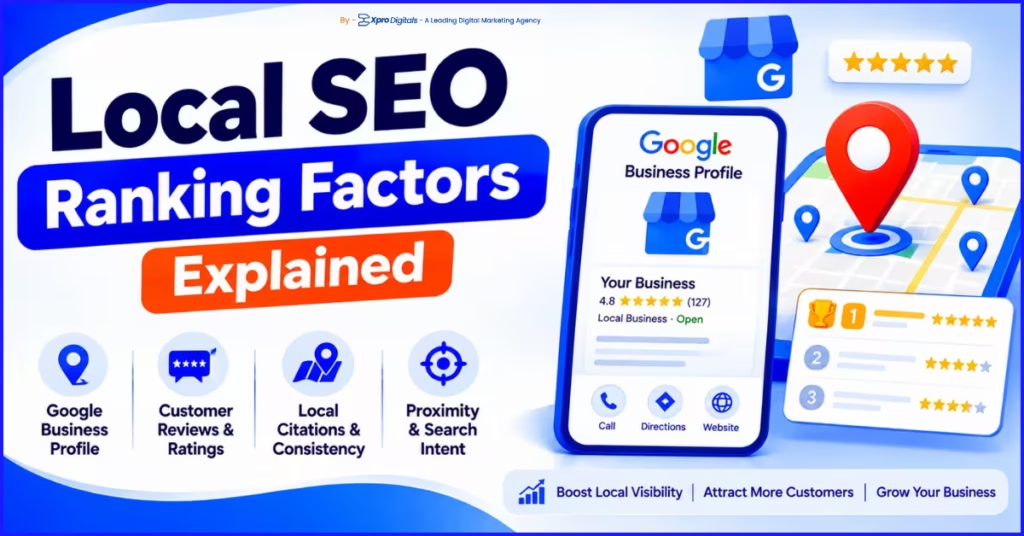
Local SEO Ranking Factors Explained
Written by
Xpro Digitals
Published on
August 22, 2026
Read Time
Table of Contents
ToggleLocal SEO Ranking Factors Explained: The Complete 2026 Guide
Introduction
You set up your Google Business Profile months ago. You filled in the details, uploaded a few photos, and waited. Your competitor three streets away consistently appears in the Google Map Pack. You do not. You are losing customers every day to businesses that may not even be better than yours.
This is the most common frustration in local SEO. The problem is not that local ranking is random. It is that most business owners and marketers do not know which signals Google actually uses to decide who appears in the local pack, and which factors matter most right now.
This guide solves that. It is built from working on local SEO campaigns for 60-plus businesses across healthcare, legal, home services, retail, and hospitality. You will learn every confirmed local SEO ranking factor, how much each one matters, what you can do to improve each signal, and how to prioritise your effort based on your current situation.
What You Will Learn: The three Google local ranking pillars, every major ranking factor with priority weighting, step-by-step improvement actions for each, case study evidence, and a complete local SEO audit checklist.
How Google Ranks Local Businesses: The Three Pillars
Google uses three core pillars to evaluate every local business for local pack and Google Maps rankings. Every individual ranking factor falls under one of these three pillars.
| Pillar | What It Means | Ranking Weight |
| Relevance | How well your business profile and website match what the searcher is looking for | High |
| Distance | How close your business location is to the searcher or the location mentioned in the query | High |
| Prominence | How well known and trusted your business is, based on reviews, links, citations, and online activity | High |
Distance is the one factor you cannot fully control. You cannot move your physical location. Every other factor in this guide falls under relevance or prominence, and you can improve both significantly with the right actions.
Google Business Profile Ranking Factors
Your Google Business Profile (GBP) is the single most influential element in local SEO. Google confirmed that GBP signals are among the top ranking factors for the local pack. Here is every GBP signal that affects your ranking.
Business Category Selection
Your primary business category is the most important GBP field. It directly tells Google what type of business you are and which local searches to show you for. Choosing the wrong primary category is the most common GBP mistake, and it costs businesses significant ranking potential.
Choose the most specific category that accurately describes your core service. “Emergency Plumber” is better than “Plumber” if that is your primary service. “Family Law Attorney” is better than “Attorney“. Add all relevant secondary categories to extend your coverage without diluting your primary focus.
Business Name
Your business name in GBP should match your real-world trading name exactly. Businesses that add keyword phrases to their business name (a practice called keyword stuffing in the name field) gain a short-term ranking advantage, but Google actively filters and suspends listings where the name does not match the verified business name. Use your real business name only.
GBP Profile Completeness
Fully completed profiles rank higher than incomplete ones. Google rewards completeness with better visibility. Every unfilled section is a missed ranking signal.
| GBP Section | Ranking Impact | Action Required |
| Business name | Very High | Use exact legal or trading name |
| Primary category | Very High | Choose most specific accurate category |
| Secondary categories | High | Add all relevant service categories |
| Business description | Medium | Include primary keywords naturally, 750 characters |
| Services and products | High | Add every service with descriptions and prices where applicable |
| Business hours | Medium | Keep accurate including holiday hours |
| Phone number | High | Use local area code, match website and citations |
| Website URL | High | Link to homepage or specific location page |
| Photos | High | Add interior, exterior, team, and product photos regularly |
| Q and A section | Medium | Pre-populate with common questions and keyword-rich answers |
| GBP Posts | Low-Medium | Weekly posts signal active, engaged business |
| Attributes | Medium | Select all applicable attributes (wheelchair accessible, women-led, etc.) |
For a step-by-step walkthrough of setting up and optimising every GBP section, see our complete guide on how to optimise your GMB listing.
GBP Photos and Visual Content
Profiles with photos receive significantly more direction requests and website clicks than those without. Google uses photo quantity and recency as engagement signals. Aim for a minimum of 20 photos across interior, exterior, team, product, and at-work categories. Add new photos at least twice per month. Use geo-tagged images where possible, as the embedded location data reinforces your local relevance signals.
GBP Posts
GBP Posts appear in your Knowledge Panel and give Google a signal that your business is active and engaged. Posts with keywords relevant to your services support relevance signals. Use GBP Posts for offers, events, new services, and seasonal updates. Post at least once per week. Posts older than 7 days no longer display prominently, so consistency matters more than any single post.
For a full posting strategy with timing and content guidance, read our guide on GBP posts: what to post and when.
Google Reviews: The Prominence Signal That Matters Most
Google reviews are one of the strongest prominence signals in local SEO. They affect your ranking in the local pack, your conversion rate from the local pack, and your overall brand trust online. Three review factors contribute to local ranking: review quantity, review rating (average star score), and review recency.
Review Quantity
More reviews generally correlate with higher local pack rankings, but there is no confirmed exact threshold. What matters more is relative review volume compared to competitors in your local area. If the top three Map Pack results in your category have 80, 60, and 45 reviews, having 12 reviews puts you at a significant disadvantage regardless of how good your rating is.
Review acquisition should be a systematic, ongoing process rather than a one-time campaign. The most effective method is a consistent ask after every positive client interaction, delivered through a direct link to your GBP review page. Automate this process through your CRM or booking system where possible.
Review Rating and Recency
A 4.7-star rating with 120 reviews consistently outperforms a 5.0 rating with 8 reviews. Perfect scores with very few reviews signal a small or inactive customer base to both Google and potential customers. A high volume of genuine reviews with a rating between 4.3 and 4.9 is the most credible and highest-ranking combination.
Recency matters. A business with 80 reviews but none in the last six months ranks below a competitor with 50 reviews and 10 in the last 30 days. Google treats recent review activity as a signal of current business operation and customer satisfaction.
How to Respond to Reviews for SEO
Responding to reviews is a confirmed local SEO ranking signal. Businesses that consistently respond to both positive and negative reviews demonstrate active management and customer engagement. Include your primary keyword and location naturally in some responses. For example: “Thank you for choosing our plumbing services in Brighton. We are glad the emergency repair was sorted quickly.” This adds relevance signals without sounding unnatural.
For a complete ethical review acquisition strategy, our guide on how to get more Google reviews ethically walks through every method that is safe and sustainable.
NAP Consistency: Citations and Local Data Signals
What Is NAP Consistency?
NAP stands for Name, Address, and Phone number. NAP consistency means that your business name, address, and phone number appear identically across every online directory, citation source, and your own website. Inconsistencies in NAP data confuse Google and weaken your location relevance signals.
Common NAP inconsistency examples include: “St” in one listing and “Street” in another, slightly different business name spellings, different phone number formats (+44 vs 0), and old addresses from a previous location still appearing on minor directories. Each inconsistency is a weak signal that reduces confidence in your location data.
Priority Citation Sources for Local SEO
| Citation Type | Examples | Priority Level |
| Core data aggregators | Data Axle, Neustar Localeze, Foursquare | Very High |
| Major directories | Yelp, Apple Maps, Bing Places, Yellow Pages, Thomson Local | Very High |
| Industry-specific directories | Checkatrade (trades), Trustpilot (retail), Zocdoc (healthcare) | High |
| Local directories | Chamber of Commerce, local business associations | Medium |
| Social profiles | Facebook, LinkedIn, Instagram business profile | Medium |
Start with the core data aggregators and major directories. A consistent and complete presence across these sources sends strong local authority signals. Add industry-specific and local citations as a second priority. There is no benefit to quantity without accuracy. One inconsistent citation can partially offset several correct ones.
On-Page Local SEO Factors
Your website is the second most important element in local SEO after your GBP. On-page local signals tell Google that your website matches the geographic area you want to rank in.
Local Landing Pages
If you serve multiple locations, each location needs its own dedicated landing page. A single “Contact Us” page with a list of city names is not a local landing page. A proper local landing page includes the city or neighbourhood in the page title, H1 heading, and URL. It contains locally relevant content: local case studies, team members based in that location, a locally embedded Google Map, and a local phone number and address.
Title Tags and Meta Descriptions With Local Keywords
Include your primary service keyword and location in the title tag of every local page. “Emergency Plumber in Manchester | 24-Hour Callout Service” is far more locally relevant than “Emergency Plumber | Fastflow Services“. The location in the title tag is a direct relevance signal that reinforces your GBP category selection.
Schema Markup for Local Businesses
LocalBusiness schema markup is structured data code that explicitly tells Google your business name, address, phone number, business hours, geographic coordinates, and service area. It is one of the clearest local relevance signals you can add to your website. Implement LocalBusiness schema on your homepage and each location-specific page. Validate your schema using Google’s Rich Results Test before publishing.
Key schema properties to include: name, address (with streetAddress, addressLocality, addressRegion, postalCode, addressCountry), telephone, openingHours, geo (latitude and longitude), url, and sameAs (links to your GBP, Facebook, and other verified profiles).
Internal Linking for Local SEO
Internal links from your homepage and service pages to your local landing pages pass authority and signal the importance of those pages to Google. Link from your navigation, your footer (with city names for multi-location businesses), and contextually from relevant service page content to city-specific pages.
For a complete internal linking framework, see our guide on internal linking for ecommerce SEO, which covers the same structural principles applicable to local service sites.
Behavioural Signals as Local Ranking Factors
Behavioural signals are actions users take after seeing your business in Google Maps or the local pack. Google measures these as indicators of real-world business relevance and quality.
Click-Through Rate from the Local Pack
If your listing appears in the local pack but users consistently click on competitors instead of you, Google interprets this as a relevance signal. A higher CTR relative to your position indicates better match with user intent. Improve CTR by adding a compelling primary photo, maintaining a strong review rating, using a descriptive business name, and keeping your hours accurate so searchers can see you are currently open.
Direction Requests and Phone Calls
Direction requests from Google Maps and phone calls initiated through your GBP are direct signals of user engagement with your business. Google tracks these actions through the GBP Insights panel. A business receiving regular direction requests and calls signals active operation and local demand. Regular GBP activity, especially photo uploads, posts, and fresh reviews, drives these engagement events.
Website Clicks from GBP
Website clicks from your GBP listing signal that users want to know more about your business. A higher click rate suggests a strong match between your listing information and the user’s search intent. Improve this metric by ensuring your GBP business description clearly states what you do, who you serve, and what makes you different from competitors in the same area.
Backlinks and Local Authority Signals
Backlinks remain a significant local SEO ranking factor, particularly for competitive local markets. Local backlinks, meaning links from websites that are geographically relevant to your service area, carry more weight than generic links for local pack ranking.
Local Backlink Sources That Matter
- Local news websites and regional press coverage
- Local business association and Chamber of Commerce websites
- Sponsor links from local charities, sports clubs, and community events
- Local blog mentions and regional industry publications
- University and school websites if you have a local educational partnership
- Local supplier and partner websites with reciprocal or editorial links
A single link from a well-regarded local news site can have more local SEO impact than 20 links from generic directories. Focus link building effort on local relevance over domain authority metrics when targeting local pack rankings specifically.
How Many Backlinks Do You Need for Local SEO?
There is no fixed number. The correct benchmark is your local competitors. Check the backlink profiles of the top three Map Pack results in your category using a tool like Ahrefs or Semrush. Match their link volume with comparable quality, then focus on local-specific sources they may have missed. Most local businesses in non-competitive niches rank with 20 to 60 high-quality backlinks. Highly competitive categories like legal, healthcare, and financial services require significantly more.
The Google Map Pack: How It Differs from Local Organic Rankings
The Google Map Pack (also called the Local Pack or 3-Pack) shows the top three local business results in a map format, separate from the standard organic search results below it. Ranking in the Map Pack and ranking in local organic search are related but not identical processes.
| Factor | Map Pack Ranking | Local Organic Ranking |
| Primary signal source | GBP signals, reviews, proximity | Website content, backlinks, on-page SEO |
| Distance dependency | High: proximity heavily weighted | Low: less dependent on searcher location |
| Review impact | Very High | Low-Medium |
| Schema markup | Medium | High |
| Page speed | Low-Medium | High |
| Citation consistency | High | Medium |
| Content depth | Low (via GBP description) | Very High |
For a focused breakdown of Map Pack optimization tactics, read our guide on Google Map Pack optimization strategy.
To understand how local ranking interacts with your overall Google Maps presence, see how Google Maps ranking works.
Common Questions About Local SEO Ranking Factors
What Is the Most Important Local SEO Ranking Factor?
Google Business Profile optimization is consistently the most impactful factor for Map Pack rankings. Specifically, correct primary category selection and a complete profile have the highest individual impact. For local organic rankings, the combination of on-page local signals and backlinks holds the most weight.
How Long Does Local SEO Take to Show Results?
Most businesses see meaningful Map Pack ranking improvement within 60 to 90 days of implementing core GBP and citation fixes. Competitive markets in large cities may take 4 to 6 months for significant movement. Local organic rankings from content improvements typically take 3 to 6 months. Review acquisition is ongoing and compounds in impact over time rather than producing a single uplift event.
For a realistic timeline overview, see our guide on how long SEO takes to show results.
Does Website Speed Affect Local SEO Rankings?
Page speed affects local organic rankings more significantly than Map Pack rankings. Google’s Core Web Vitals (Largest Contentful Paint, Cumulative Layout Shift, and Interaction to Next Paint) are confirmed ranking signals for organic search. For the Map Pack, proximity, reviews, and GBP completeness outweigh page speed in most cases. However, slow pages reduce the website click conversion rate from your GBP listing, which indirectly affects engagement signals.
Does Having a Physical Address Matter for Local SEO?
Yes. A verified physical address is the strongest proximity signal in local SEO. Google uses your address to determine which searches you are shown for based on searcher location. Businesses without a physical address, such as service-area businesses that do not receive customers at their location, can hide their address in GBP and set a service area instead. Service-area businesses typically rank less prominently than physical-address businesses for competitive local searches.
How Do I Rank Higher in Google Maps?
Ranking higher in Google Maps requires improving all three of Google’s local ranking pillars: relevance, distance, and prominence. Relevance is improved through GBP category selection, profile completeness, and local keyword signals on your website. Prominence is improved through review acquisition, citation consistency, backlink building, and GBP engagement. Distance cannot be changed, but you can set a service area that extends your ranking eligibility beyond your immediate postcode.
For a dedicated step-by-step guide, read how to rank higher on Google Maps.
What Is a Local SEO Ranking Factor Audit?
A local SEO ranking factor audit evaluates every signal that affects your local pack and local organic rankings. It covers GBP completeness, NAP consistency across citations, review profile health, on-page local signals, schema markup, backlink profile, and competitor benchmarking. Running this audit identifies the highest-priority improvements for your specific situation.
Use our Google Business Profile audit checklist as the starting point for any local SEO audit.
Do Google Posts Help With Local SEO Rankings?
GBP Posts contribute to local SEO as an engagement and activity signal rather than a direct ranking factor. Consistent posting demonstrates that a business is active and managed. Posts with locally relevant keywords support relevance signals. The indirect impact on ranking through engagement metrics is real, though the effect is modest compared to reviews, categories, and citation consistency.
Does Social Media Affect Local SEO Rankings?
Social media profiles are citation signals. A consistent business name, address, and phone number across your Facebook, Instagram, and LinkedIn profiles contributes to citation consistency. Social engagement and following size are not direct ranking signals in local SEO. However, social media profiles often rank on the first page of brand-name searches, and they send brand signals that support overall online prominence.
How Does Google Verify My Business for Local Ranking?
Google verifies businesses through several methods: postcard sent to the business address with a PIN code, phone or SMS verification, email verification, video verification (increasingly common for new listings), and in some cases instant verification for accounts with verified Google Search Console access. Completing GBP verification is a prerequisite for ranking in the local pack. Unverified listings do not appear in Map Pack results.
Does Adding Keywords to My GBP Description Help Ranking?
The GBP business description is confirmed to have a limited direct ranking impact. However, including your primary service keywords and location in the description contributes to relevance signals and helps users confirm you match their need when they read your profile. Write the description for the reader first, with keywords included naturally. Keyword stuffing in the description does not produce additional ranking benefit and may trigger a quality review.
What Are the Top Citation Sites for Local SEO in the UK?
For UK businesses, the highest-priority citation sources are Google Business Profile, Bing Places, Apple Maps, Yell.com, Thomson Local, Checkatrade (trades), TrustATrader (trades), Trustpilot, FreeIndex, Bark.com, and industry-specific platforms relevant to your sector. Always prioritise accuracy over quantity. An incorrect listing on a high-authority directory does more damage than a missing listing on a smaller one.
Is NAP Consistency Still Important in 2026?
Yes. NAP consistency remains an important local SEO signal. Google cross-references your name, address, and phone number across multiple sources to validate your business location data. Inconsistencies reduce confidence in your location signals. The impact of NAP consistency is most visible in competitive local markets where small ranking advantages compound significantly.
What Are Local SEO Ranking Factors for Service Area Businesses?
Service area businesses (SABs) that do not have a customer-facing physical location rank differently than brick-and-mortar businesses. SABs should set their service area accurately in GBP rather than a pin location. They typically rank within a reasonable radius of their registered business address. Strong review signals, GBP engagement, and website localisation for service area cities support SAB ranking better than proximity can.
How Do I Check My Local SEO Rankings Accurately?
Local rankings vary by searcher location, device, and search history. To check accurate local rankings, use a local rank tracking tool such as BrightLocal, Whitespark Local Rank Tracker, or Semrush with a local grid tracking feature. These tools simulate searches from specific GPS coordinates, giving you an accurate picture of how you rank at street level across your service area rather than from your own browser, which is always biased toward showing your own listing.
What Is the Google Local Justification Feature?
Google local justifications are short snippets that appear under a Map Pack listing explaining why Google chose to show that business for the specific search query. They pull from GBP reviews, website content, GBP posts, and menu or service listings. Justifications include phrases like “They mention [keyword] in their reviews” or “[keyword] found on their website”. Having your target keywords in your reviews and on your website increases the chance of triggering a justification, which improves CTR.
Does Google Business Profile Suspension Affect Local Rankings?
A suspended GBP listing does not appear in the local pack at all. Suspension removes all local visibility until the issue is resolved and the listing is reinstated. Common causes include keyword stuffing in the business name, service area conflicts with proximity guidelines, duplicate listing issues, and unverifiable address claims. If your GBP is suspended, the recovery process requires submitting a reinstatement request with supporting evidence.
For full guidance on recovery, read our guide on GBP suspended: how to recover your listing.
Real Case Study: Local SEO Ranking Improvement in 90 Days
A dental practice in Leeds had a fully claimed GBP profile but ranked outside the top 10 in the local pack for “dentist Leeds” and key service terms. They had 14 Google reviews (average 4.6 stars), incomplete profile sections, and no localised content on their website.
Actions taken across 90 days:
- Primary category changed from “Dentist” to “Dental Clinic” with 6 relevant secondary categories added.
- All GBP service listings added with descriptions and price ranges where applicable.
- 27 new photos uploaded over 8 weeks across interior, team, and procedure categories.
- Systematic review request sent after every appointment via SMS link: 31 new reviews generated.
- LocalBusiness schema markup added to homepage and services pages with correct coordinates.
- Four locally targeted service pages created: “Teeth Whitening Leeds”, “Dental Implants Leeds”, “Invisalign Leeds”, “Emergency Dentist Leeds”.
- NAP corrected across 14 inconsistent citation listings found through a citation audit.
- Weekly GBP Posts published with service keywords and seasonal relevance.
Results after 90 days:
- Map Pack position for “dentist Leeds”: outside top 10 to position 2.
- Total Map Pack keyword rankings: up from 4 to 31 tracked terms.
- GBP direction requests: increased 180 percent month on month.
- GBP phone calls: increased 140 percent month on month.
- New patient enquiries attributed to Google: up 62 percent.
Key Takeaway: No single factor produced this result. The combination of GBP completeness, review volume growth, schema markup, localised content, and NAP correction created compounding ranking improvement across all three Google local ranking pillars.
Local SEO Ranking Factors Audit Checklist
Google Business Profile
- GBP profile fully verified
- Primary category is the most specific accurate option
- All relevant secondary categories added
- Business description uses primary keywords naturally
- All services and products listed with descriptions
- Business hours accurate including holidays
- Minimum 20 photos uploaded, updated regularly
- GBP Posts published at least weekly
- Q and A section pre-populated with common questions
- All attributes selected that apply to the business
Reviews
- Active review acquisition process in place
- Review responses posted for all reviews within 48 hours
- Review rating above 4.3 stars
- New reviews received in the last 30 days
NAP and Citations
- NAP consistent on website, GBP, and all major directories
- Listed on core data aggregators
- Listed on industry-specific directories relevant to business type
- Duplicate GBP listings identified and removed
Website Local SEO
- Local keywords in title tags and H1 headings on all local pages
- LocalBusiness schema markup implemented and validated
- Dedicated landing page for each service area or location
- Embedded Google Map on contact or location pages
- Local phone number and address in website header and footer
- Internal links from homepage to local landing pages
Backlinks and Authority
- Local backlinks from news, directories, and community sites
- No toxic backlinks pointing to the domain
- Consistent brand mentions across the web
Final Thoughts: Building Local SEO Ranking Signals That Compound
Local SEO ranking is not determined by one factor. It is the combined weight of many signals across your GBP, your reviews, your citations, your website, and your online authority. The businesses that rank consistently in the local pack are those that maintain all of these signals, not those that optimise one while ignoring the others.
The highest-return actions for most local businesses in order of priority are: completing and optimising the GBP profile, building a consistent review acquisition process, fixing NAP inconsistencies across citations, implementing LocalBusiness schema, and creating localised content pages for each service and location you target.
Start with the audit checklist in this guide. Identify where your biggest gaps are relative to your current local competitors. Fix the highest-impact gaps first. Measure, adjust, and repeat monthly. Local SEO compounds over time. Businesses that maintain consistent effort for 6 to 12 months build a ranking position that becomes very difficult for newer competitors to displace.
Next Step: Run the audit checklist against your own GBP and website today. Identify your three biggest gaps relative to the businesses currently ranking above you. Address those three gaps before anything else.
Frequently Asked Questions (FAQs)
The most impactful local SEO ranking factors in 2026 are: GBP completeness and category selection, Google review quantity and recency, NAP citation consistency, on-page local signals including localised title tags and LocalBusiness schema, local backlinks, and behavioural signals including CTR and direction requests. GBP signals and reviews hold the highest combined weight for Map Pack ranking.
There is no fixed number. Your review count needs to be competitive relative to the businesses currently ranking in the local pack for your target keywords in your area. Use the top three current Map Pack results as your benchmark. If they have 60, 80, and 45 reviews, you need to be in that range with a rating above 4.3 to compete effectively. Focus on consistent review acquisition rather than a one-time campaign.
Yes, a website is not technically required to appear in the Google Map Pack. GBP alone can produce local pack rankings. However, businesses with optimised local websites consistently outrank GBP-only businesses in competitive markets. A website provides additional relevance signals through localised content, schema markup, and link building opportunities that GBP alone cannot provide.
Google uses your verified GBP address as your primary location signal. It cross-references this with NAP data from citation sources, your website address information, and LocalBusiness schema coordinates. The more consistently your location data appears across all these sources, the stronger your location relevance signal and the more confident Google is in showing you for searches in your area.
Older, established GBP listings generally have stronger signals than new ones because they have accumulated more reviews, engagement history, and citation references over time. A new listing can close this gap by building reviews and citations quickly. However, very new listings may experience a temporary ranking lag while Google builds confidence in the listing through data verification across multiple sources.
Proximity refers to how close your business is to the searcher's location or the location specified in the query. It is one of Google's three local ranking pillars. When someone searches "plumber near me", Google uses their GPS location to rank businesses by distance. When someone searches "plumber in Bristol", Google ranks businesses relevant to Bristol regardless of the searcher's physical location. You cannot directly control proximity, but you can extend your ranking reach by setting an accurate service area in GBP.
Use tools like BrightLocal Citation Tracker, Moz Local, or Whitespark Citation Finder to audit your citations across the web. These tools identify inconsistencies in your name, address, and phone number across directories. Prioritise fixing inconsistencies on high-authority directories first. For minor directories, either update the listing directly or flag it for removal if it is significantly incorrect and cannot be edited.
A small number of negative reviews does not significantly damage rankings if overall volume and rating remain competitive. What matters most to Google is the overall pattern of review signals. A business with 100 reviews averaging 4.4 stars ranks better than a business with 15 reviews averaging 5.0 stars. Respond professionally to negative reviews. This demonstrates active management and often matters more to prospective customers than the negative review itself.
Each physical location needs its own separate GBP listing, its own dedicated website landing page, and its own local citation profile. Do not point all location GBP listings to the same website homepage. Build location-specific pages with unique content, local phone numbers, locally relevant testimonials, and an embedded map for each location. Manage reviews separately for each location to build independent local authority per city or area.
Traditional SEO targets broad keywords without geographic intent and aims to rank in the standard organic search results nationally or globally. Local SEO targets geographically modified keywords or searches with local intent and aims to rank in the Google Map Pack and local organic results for a specific city or region. Local SEO is driven primarily by GBP signals, reviews, and citations, while traditional SEO is driven primarily by website content, technical SEO, and backlinks.
For a full comparison of SEO types and how they interact, read our complete guide on on-page and off-page SEO.
Local SEO is not a one-time activity. Review acquisition should be ongoing. GBP photos and posts require regular additions. Citation audits should happen quarterly. Local landing page content should be refreshed annually or when your services change. Schema markup should be verified after any website update. Treat local SEO as a monthly maintenance activity rather than a project with a completion date.
Our Related Posts