SEO vs PPC: Which Strategy Is Right for Your Business?
Written by
Lakshya Kapoor
Published on
August 24, 2026
Read Time
Table of Contents
ToggleSEO vs PPC: Which Strategy Is Right for Your Business in 2026?
Introduction
Your marketing budget is limited. Someone tells you to invest in SEO for long-term growth. Someone else tells you to run Google Ads for immediate results. A third person says you need both. You are spending time researching instead of generating revenue, and every article you read seems to push you in a different direction depending on who wrote it and what they sell.
This is the most common digital marketing decision businesses get stuck on. The problem is that most comparisons are written to justify one channel over the other rather than to give you an honest framework for your specific situation. The truth is that SEO and PPC are not competitors. They serve different purposes, work on different timelines, and suit different business stages.
This guide gives you the objective comparison you need to make the right decision. It is built from working with over 80 businesses across e-commerce, professional services, healthcare, home services, and SaaS. You will learn exactly what each channel does, how much each costs in practice, which produces better results for which business types, and how to decide which to prioritise or whether to combine them.
What You Will Learn: How SEO and PPC work differently, a full cost and ROI comparison, which channel suits your business stage and goals, real case study data from both channels, a decision framework, and how to use SEO and PPC together for maximum compound growth.
SEO vs PPC: What Each Channel Actually Does
What Is SEO?
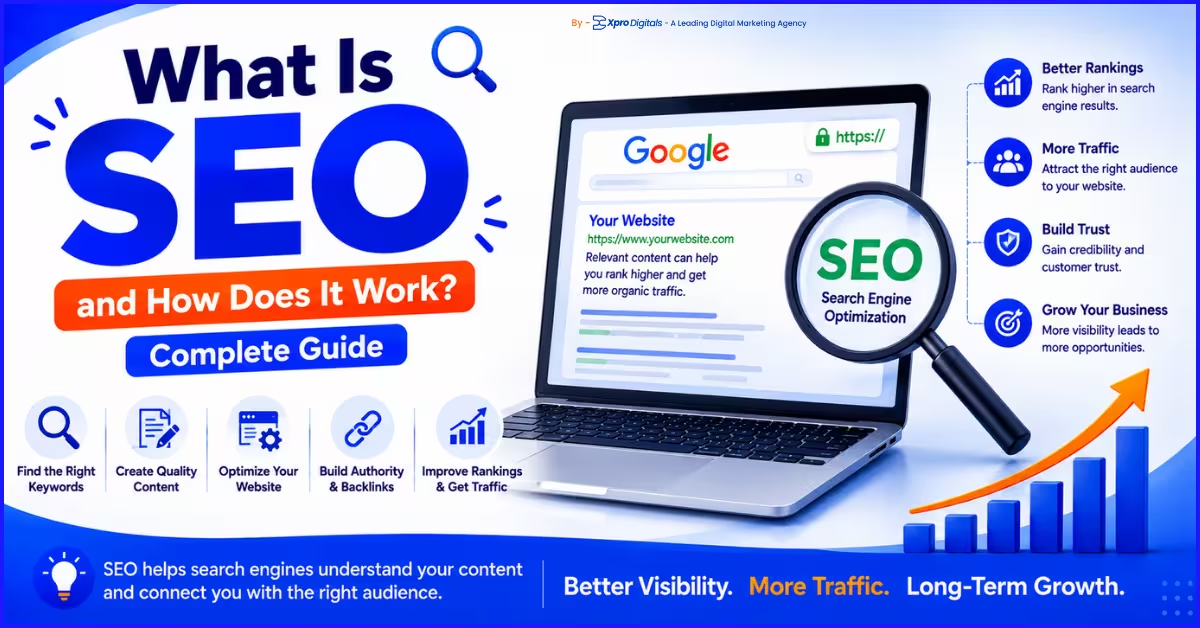
SEO (Search Engine Optimization) is the process of improving your website and its content so that Google and other search engines rank it higher in organic (unpaid) search results. When someone searches a term related to your business and your page appears in the results without you paying for that placement, that is SEO at work.
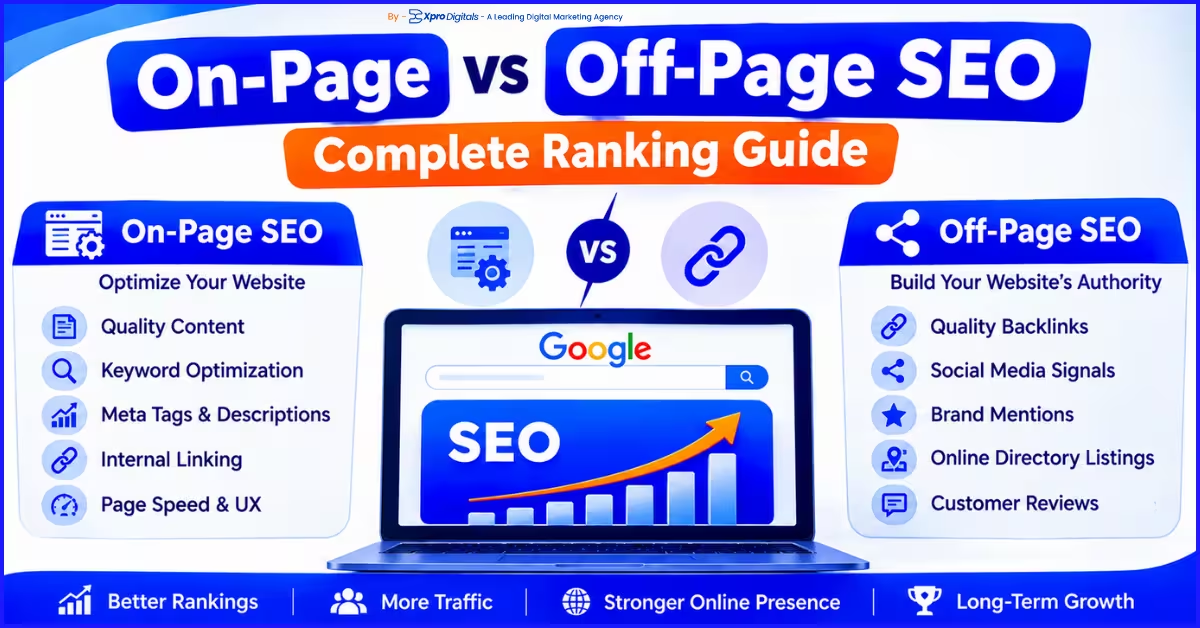
SEO works on three levels. On-page SEO covers what is on your website: title tags, content, headings, internal links, and schema markup. Off-page SEO covers what happens outside your site: backlinks from other websites, brand mentions, and domain authority. Technical SEO covers your site infrastructure: crawlability, indexation, Core Web Vitals, and mobile performance.
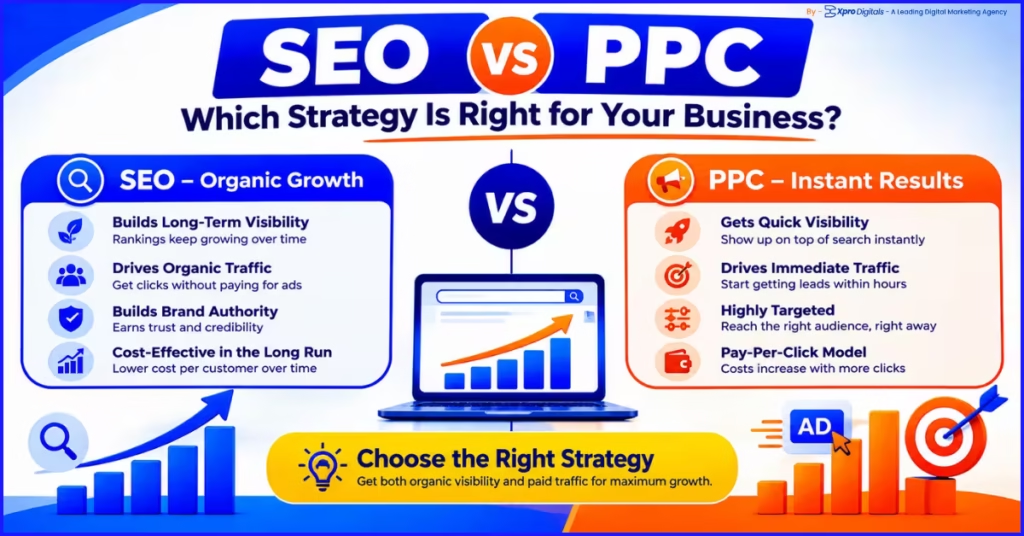
The core characteristic of SEO is that the traffic it generates is free per click and compounds over time. A page that ranks on page one today can continue generating traffic for months or years with minimal ongoing maintenance cost.
What Is PPC?
PPC (Pay-Per-Click) is a paid advertising model where your ads appear at the top and bottom of search results, and you pay each time a user clicks your ad. Google Ads is the dominant PPC platform, but PPC also covers Microsoft Advertising (Bing Ads), Meta Ads, LinkedIn Ads, and Amazon Ads.
In search PPC, you bid on keywords. When a user searches that keyword, Google runs an auction using your bid, your Quality Score (a measure of ad relevance and landing page quality), and your ad rank to determine whether your ad shows and at what position. You pay only when someone clicks your ad, not when your ad is shown.
The core characteristic of PPC is immediacy. A new Google Ads campaign can be live and generating clicks within hours of launch. Traffic stops the moment you stop spending. There is no compounding benefit once a campaign ends.
SEO vs PPC: The Fundamental Difference
| Dimension | SEO | PPC |
| Traffic cost | Free per click once ranking is achieved | Pay every click, every time |
| Time to first results | 3 to 6 months typically | Hours to days after launch |
| Longevity of results | Results persist with maintenance | Stops when budget stops |
| Click-through rates | Higher average CTR in positions 1-3 | Lower CTR than top organic results on same query |
| Trust perception | Users often trust organic results more | Some users avoid clicking ads |
| Visibility control | Limited; Google decides ranking | Full control over when and where ads appear |
| Budget flexibility | Fixed agency or tool costs; no per-click cost | Fully adjustable spend, pause anytime |
| Competitive barrier | Takes time to build; hard to replicate quickly | Immediate entry; any competitor can match spend |
| Data feedback loop | Slow; takes weeks to see keyword ranking shifts | Fast; conversion data available within days |
| Best for | Long-term, sustainable organic traffic and brand authority | Immediate traffic, product launches, seasonal campaigns, and testing |
SEO vs PPC: Real Costs Compared
What Does SEO Actually Cost?
SEO costs vary based on whether you manage it in-house, hire an agency, or use a freelancer. Unlike PPC, there is no direct per-click charge. The cost is in the labour, tools, and time required to build and maintain ranking positions.
| SEO Approach | Typical Monthly Cost | Best For |
| DIY with tools (Ahrefs, Semrush, GSC) | 50 to 200 USD (tools only) | Solo founders with time to learn and implement |
| Freelance SEO consultant | 500 to 2,000 USD/month | Small businesses needing part-time ongoing support |
| SEO agency (small to mid-size) | 1,000 to 5,000 USD/month | Businesses wanting full-service management |
| Enterprise SEO agency | 5,000 to 25,000+ USD/month | Large sites with multiple markets, high competition |
| In-house SEO specialist hire | 4,000 to 8,000 USD/month (salary + tools) | Businesses with consistent, high-volume content needs |
The key financial characteristic of SEO investment is that it builds an asset. A page ranking on page one continues generating free clicks every month. If you invest 2,000 USD per month in SEO for 12 months and achieve 10,000 monthly organic sessions, those sessions continue at minimal ongoing cost even if you reduce investment temporarily. The cost-per-click equivalent of organic traffic is often 80 to 95 percent lower than the same traffic purchased through PPC.
What Does PPC Actually Cost?
PPC costs have two components: the management fee (what you pay an agency or platform to run the campaigns) and the ad spend (what you pay Google or Meta per click). Both are real costs and must be factored into ROI calculations.
| PPC Cost Component | Typical Range | Notes |
| Google Ads average CPC (all industries) | 2 to 5 USD per click | Varies enormously by industry and keyword competition |
| Legal and finance CPCs | 20 to 100+ USD per click | Highest competition categories |
| E-commerce CPCs | 0.50 to 3 USD per click | Shopping ads typically lower than search |
| Local service CPCs | 3 to 15 USD per click | Depends on city size and competition |
| Agency management fee | 500 to 3,000 USD/month | Often 10-20% of ad spend for larger budgets |
| Recommended minimum monthly ad spend | 1,000 USD | Below this, data volume is too low to optimize effectively |
For a clear guide on setting the right PPC budget before you start spending, our PPC budget guide for small businesses walks through budget planning by business type and goal.
SEO vs PPC: Long-Term Cost Comparison
The most important cost comparison is not monthly spend. It is cost per acquisition over 12 to 24 months. PPC delivers traffic from day one but at a fixed ongoing cost per click. SEO takes longer to build but the cost per click drops toward near zero once rankings are achieved. The crossover point, where SEO becomes more cost-efficient than PPC, typically occurs between months 9 and 18 for most businesses.
| Month | PPC Cumulative Cost (1,500/mo spend) | SEO Cumulative Cost (1,500/mo) | PPC Monthly Clicks (CPC 3 USD) | SEO Monthly Clicks (if ranking achieved) |
| Month 1 | 1,500 USD | 1,500 USD | 500 | 0 to 50 |
| Month 3 | 4,500 USD | 4,500 USD | 500 | 100 to 500 |
| Month 6 | 9,000 USD | 9,000 USD | 500 | 500 to 2,000 |
| Month 12 | 18,000 USD | 18,000 USD | 500 | 2,000 to 8,000 |
| Month 18 | 27,000 USD | 27,000 USD | 500 | 5,000 to 15,000+ |
| Month 24 | 36,000 USD | 36,000 USD | 500 | 8,000 to 20,000+ |
This table assumes consistent monthly spend across both channels and illustrates why PPC is not always more expensive and why SEO is not always cheaper. In months 1 through 6, PPC delivers more traffic per dollar. From month 12 onwards, SEO delivers dramatically more traffic per dollar if execution is strong.
When to Choose SEO Over PPC
SEO is the better primary investment in specific business situations. Understanding when these situations apply to you saves significant budget and prevents the frustration of investing in the wrong channel at the wrong stage.
Choose SEO When: You Have Time Before You Need Results
If your business is established and you are planning for growth over the next 12 to 24 months rather than needing customers in the next 30 days, SEO is the stronger long-term investment. The 3 to 6-month ramp-up period is acceptable when you have existing revenue from other channels covering your operating costs. Businesses that invest in SEO early build ranking positions that competitors cannot quickly displace.
Choose SEO When: Your Niche Has High PPC Costs
In legal, finance, insurance, healthcare, and real estate, PPC costs are extremely high. Legal CPCs average 50 to 100 USD per click in competitive markets. A 2,000 USD monthly PPC budget in a legal niche might buy 20 to 40 clicks. The same 2,000 USD in SEO, compounded over 12 months, could generate thousands of organic visits per month from the same keyword categories. High-CPC niches are where SEO produces the highest relative ROI compared to PPC.
Choose SEO When: You Sell Content-Driven Products or Services
Businesses where the buying journey involves significant research benefit disproportionately from SEO. B2B software, financial advisory services, healthcare services, and professional consulting all involve buyers reading multiple pieces of content before making contact. SEO positions you at multiple stages of that research journey. PPC only captures buyers at the bottom of the funnel when they are ready to convert.
Choose SEO When: You Want a Durable Business Asset
A well-optimized website with strong organic rankings is a business asset. It generates revenue without ongoing media spend. It increases the valuation of your business if you sell it. It provides a traffic floor that protects you from sudden ad platform policy changes or CPC inflation. Businesses that build strong SEO foundations are less vulnerable to rising advertising costs than those that depend entirely on paid channels.
For the full picture of how SEO contributes to business growth beyond just traffic, read our guide on how SEO can impact your business and website.
When to Choose PPC Over SEO
PPC is the better primary investment in specific circumstances. These situations are common and clearly defined. Recognising them prevents businesses from waiting months for SEO results when PPC is the strategically correct choice.
Choose PPC When: You Need Revenue Now
A new business with no existing customer base, a seasonal business entering its peak period, or a business launching a new product that needs validation all have one thing in common: they cannot wait 6 months for organic rankings to build. PPC delivers traffic within days of campaign launch. For businesses in their first 6 to 12 months, PPC is often the only viable way to generate sufficient traffic volume to test offers, landing pages, and conversion rates.
Choose PPC When: You Are Testing a New Offer or Market
PPC is the fastest and most controlled way to test whether a new product, service, or market generates interest. Run a 30-day Google Ads campaign targeting your intended keywords. Measure clicks, conversion rate, cost per lead, and lead quality. This data tells you whether the market has demand and whether your offer resonates before you invest 12 months of SEO effort into ranking for keywords that may not convert.
Understanding the different campaign types available in Google Ads is essential to testing effectively. Our guide on different types of Google Ads campaigns explains which campaign format suits which business goal.
Choose PPC When: You Are in a Highly Competitive SEO Market
In some niches, the top organic positions are held by established brands with domain ratings of 70 or above and thousands of referring domains. For a new or small site to displace these brands takes years of SEO investment. PPC allows you to appear at the top of the same results page on day one by competing on bid and Quality Score rather than domain authority. While this costs more per click, it provides market access that organic cannot quickly deliver.
Choose PPC When: Your Product or Service Has Seasonal Peaks
Seasonal businesses, accountants during tax season, retailers during Christmas, garden centres in spring, travel companies in summer booking periods, benefit enormously from PPC. You can scale spend up sharply during peak demand and pause or reduce spend in off-peak periods. SEO cannot be switched on and off with this flexibility. PPC matches seasonal demand curves with precision.
Choose PPC When: You Have Specific Promotional Deadlines
Launches, flash sales, events, and time-limited offers require immediate traffic. SEO cannot guarantee a page will rank before a specific date. PPC can have your promotional landing page visible to your target audience within hours of the campaign going live. For any marketing activity with a fixed window, PPC is the dependable choice.
To understand how to align PPC campaign structure with your customer buying journey, see our guide on PPC funnel strategy, which walks through campaign and ad group structure by funnel stage.
When to Use SEO and PPC Together
The most effective search marketing strategies combine SEO and PPC rather than treating them as an either-or choice. The two channels share data, reinforce each other, and cover each other’s weaknesses. Businesses that run both channels simultaneously typically see better results from each channel individually than when either runs alone.
How SEO and PPC Work Better Together
| Combined Benefit | How It Works |
| PPC data improves SEO keyword selection | PPC conversion data shows which keywords actually convert, not just which keywords get clicks. Use this to prioritise SEO content investment on high-converting terms. |
| SEO content improves PPC Quality Score | Higher-quality landing pages with strong on-page SEO signals improve Quality Scores, which lowers CPC and improves ad position at the same bid level. |
| Double SERP domination | Appearing in both the top paid result and the top organic result for the same query dramatically increases brand visibility and click share. |
| PPC fills the SEO gap | During the 3-6 month SEO ramp-up, PPC ensures you are still visible to searchers while organic rankings are building. |
| Remarketing complements organic visits | Visitors who find your site through organic search can be retargeted with PPC ads, increasing conversion rates from the organic audience. |
| Seasonal flexibility | Use SEO for consistent baseline traffic and PPC for seasonal spikes, covering both time horizons simultaneously. |
Real Case Study: SEO and PPC Combined for a UK Home Services Business
A plumbing and heating company based in Birmingham came to Xpro Digitals with a clear problem. They had been running Google Ads for 14 months at 2,200 GBP per month in spend but had no SEO strategy. They were generating leads, but their cost per lead was 85 GBP, which was unsustainable given their average job value of 320 GBP. They wanted to reduce acquisition cost without losing lead volume.
Phase 1 (months 1 to 3): PPC optimization and SEO foundation
- Negative keywords audit removed 340 GBP per month in wasteful ad spend.
- Ad copy tested: 3 new headline variants. Best performer improved CTR by 34%.
- On-page SEO started: title tags, H1s, and local schema added to all 12 service pages.
- Google Business Profile fully optimized with 8 new service categories and weekly posts.
Phase 2 (months 4 to 9): Local SEO ranking growth
- 4 city-specific service pages built: “Emergency Plumber Birmingham”, “Boiler Repair Birmingham”, “Drain Unblocking Solihull”, “Gas Safety Certificate Birmingham”.
- Local citation audit corrected 23 NAP inconsistencies.
- Review acquisition campaign: 41 new Google reviews in 3 months (up from 12 total).
- Organic rankings achieved: page one for 18 local service keywords by month 9.
Results at month 12:
- PPC cost per lead: reduced from 85 GBP to 52 GBP through better targeting and negative keywords.
- Organic leads (SEO): 34 per month from zero previously, at near-zero per-lead cost.
- Total monthly leads: up from 26 (PPC only) to 61 (combined).
- Total acquisition cost: down 38% despite doubling lead volume.
Key Insight: PPC funded immediate lead generation while SEO was built. SEO reduced dependence on PPC over time. By month 12, the business had a resilient, dual-channel acquisition system rather than a single point of failure in paid advertising.
SEO vs PPC Decision Framework: Which Is Right for You?
Use this framework to identify the right starting point for your business. Answer each question honestly and count your answers to find your recommended channel priority.
Decision Checklist: Answer Yes or No
You should prioritise SEO if you answered Yes to most of these:
- Your business has been operating for more than 12 months with existing revenue.
- You can wait 4 to 6 months before seeing significant traffic growth.
- Your average customer lifetime value is high enough to justify a long acquisition cycle.
- Your target keywords have CPCs above 10 USD, making PPC expensive at scale.
- You want a durable traffic asset that does not stop when budget stops.
- Your competitors have weak or thin website content that you can outproduce.
- Your product or service requires educational content before a purchase decision.
You should prioritise PPC if you answered Yes to most of these:
- Your business is new and needs customers within the next 30 to 60 days.
- You are launching a new product and need rapid market validation.
- Your peak season is within the next 3 months.
- Your target keywords have moderate CPCs that are affordable at your conversion rate.
- You need precise control over budget, audience, and scheduling.
- Your competitors hold dominant, long-established organic positions.
- You have a specific campaign, event, or promotion with a fixed end date.
You should use both SEO and PPC if:
- You have budget for both channels simultaneously.
- You want to reduce long-term paid media dependence while maintaining lead flow.
- You are growing aggressively and need to capture demand at every funnel stage.
- You want to use PPC data to inform SEO keyword and content strategy.
SEO vs PPC by Business Stage
| Business Stage | Recommended Primary Channel | Reason |
| Pre-launch or new (0-6 months) | PPC | No domain authority, no content, need immediate validation and revenue |
| Early stage (6-18 months) | PPC primary, SEO building in parallel | PPC funds operations while SEO foundation is laid |
| Growth stage (18 months to 3 years) | Both channels, SEO increasing share | Organic rankings maturing, PPC for competitive gaps and seasonal peaks |
| Established (3+ years) | SEO primary, PPC for targeted campaigns | Strong organic base, PPC used tactically for launches and gaps |
| Highly seasonal business | PPC dominant in-season, SEO year-round | Organic rankings maintained, paid spend concentrated in peak periods |
| High-CPC niche (legal, finance) | SEO primary from day one | PPC unsustainable at scale; organic ROI dramatically higher long-term |
SEO vs PPC by Business Type
| Business Type | Better Primary Channel | Why |
| Local service business (plumber, dentist) | Local SEO + GBP + some PPC | Google Maps and local organic dominate local searches; GBP is free |
| E-commerce store | Both: SEO for category pages, PPC for Shopping Ads | Shopping Ads convert product intent; SEO builds long-term category authority |
| B2B SaaS or software | SEO primary for informational content, PPC for demo keywords | Long buying cycle benefits from content; high-intent terms justify PPC cost |
| Professional services (law, accounting) | SEO primary due to high CPCs | Legal and finance CPCs make PPC unsustainable for most SMBs |
| News or media | SEO only | Content freshness and volume make organic the only viable strategy |
| Product launch | PPC first, then SEO | Speed to market is critical; organic rankings for new products take time |
| Subscription or recurring revenue | SEO primary | High LTV justifies long acquisition cycle; organic compounds over subscriber lifetime |
Common Questions About SEO vs PPC
Is SEO or PPC Better for Small Businesses?
It depends on the business stage and niche. New small businesses typically need PPC first because they cannot wait 6 months for SEO results. Established small businesses in high-CPC niches like legal or healthcare typically find SEO more cost-effective long-term. Local service small businesses often get the best results from a combination of local SEO (Google Business Profile) and a small targeted Google Ads budget.
What Is the Average Cost per Click in Google Ads?
The average cost per click across all industries on Google Ads is approximately 2 to 5 USD. However, this varies enormously by sector. Legal averages 50 to 100 USD per click. Insurance averages 20 to 50 USD. Finance and real estate average 10 to 30 USD. Home services average 5 to 20 USD. E-commerce and retail average 1 to 5 USD. Always research the CPC for your specific keywords before committing a PPC budget.
Does PPC Help SEO Rankings?
PPC advertising does not directly improve your organic SEO rankings. Google explicitly states that running Google Ads does not influence organic ranking positions. The two systems are evaluated independently. However, PPC helps SEO indirectly by driving traffic to pages that may earn engagement signals, by generating brand search volume as users discover your brand through ads and later search directly for it, and by providing keyword conversion data that makes your SEO strategy more targeted.
Can I Do SEO and PPC at the Same Time?
Yes, and for most growing businesses, running both simultaneously is the most effective strategy. PPC provides immediate traffic and conversion data. SEO builds long-term organic traffic. The data from each channel informs the other. Landing pages optimized for PPC Quality Score also rank better organically. PPC keyword conversion data identifies which terms deserve SEO content investment. The two channels compound each other’s effectiveness.
Which Has a Higher Click-Through Rate: SEO or PPC?
For the same keyword, the top organic result typically achieves a higher click-through rate than the top paid ad. Studies from Sparktoro, Advanced Web Ranking, and similar sources consistently show that organic position one receives between 25 and 40 percent of clicks for a given query, while the top paid ad receives 2 to 10 percent of clicks. However, paid ads dominate for certain commercial intent queries where the ad format, price display, or Shopping image ads are more visually relevant to the search intent.
How Long Does It Take to See Results from SEO?
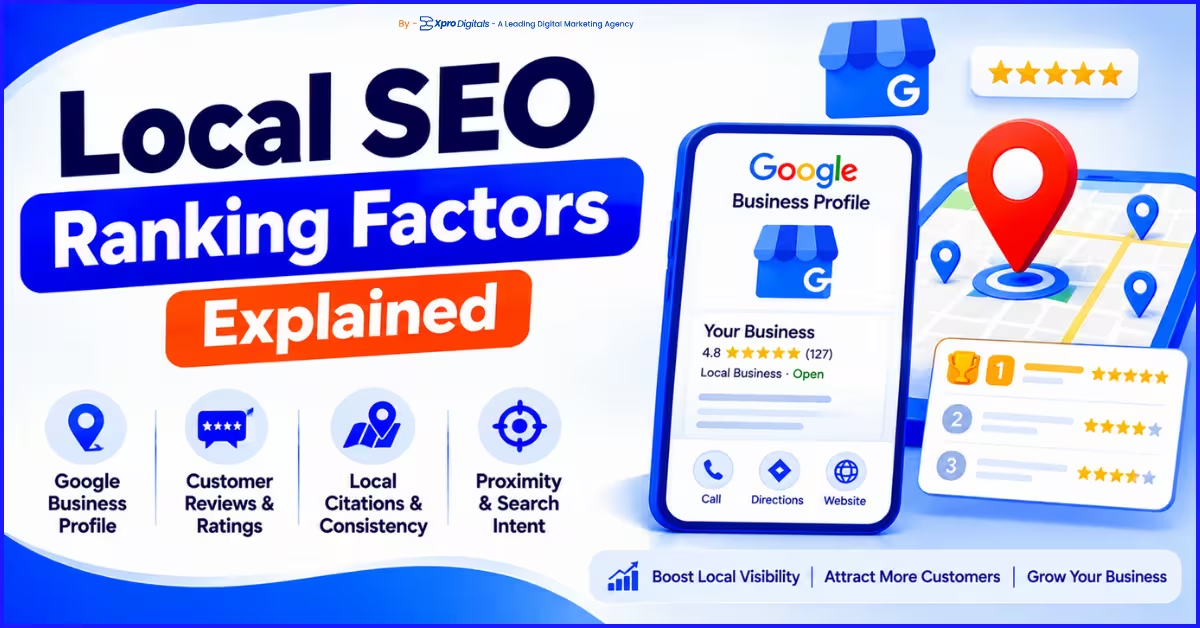
Most businesses see meaningful ranking improvements from SEO within 3 to 6 months for low to medium competition keywords. Highly competitive terms in national or global markets can take 9 to 18 months. New websites may experience a domain age effect where rankings are slower to build in the first 6 months. Local SEO for Google Business Profile rankings can produce visible Map Pack improvements within 60 to 90 days with focused effort.
What Is Quality Score in Google Ads and Why Does It Matter?
Quality Score is Google’s rating of the relevance and quality of your keywords, ads, and landing pages on a scale of 1 to 10. A higher Quality Score reduces your cost per click and improves your ad position for the same bid. The three components are expected click-through rate, ad relevance to the keyword, and landing page experience. Improving Quality Score is one of the most cost-effective PPC optimization actions because it reduces the amount you pay per click without requiring higher bids.
For a practical guide to reducing your CPC through Quality Score and campaign optimization, read our guide on how to reduce CPC in Google Ads.
What Is the Difference Between Search Ads and Display Ads?
Search ads appear in Google search results when users actively search for a keyword. They capture existing demand. Display ads appear on websites across Google’s Display Network as banners and images. They create new awareness among users who are not actively searching for your product. Search ads generally convert better for direct response goals. Display ads are more effective for brand awareness, remarketing, and reaching users earlier in the buying process.
For a detailed breakdown of when each format works best, see our guide on display ads vs search ads.
Is Paid Search the Same as PPC?
Paid search is a subset of PPC. PPC is a broader billing model used across multiple ad formats including search ads, display ads, social media ads, and shopping ads. Paid search refers specifically to the PPC ads that appear in search engine results pages. All paid search is PPC, but not all PPC is paid search. When most people say PPC in a search marketing context, they typically mean paid search on Google or Microsoft Advertising.
What Is ROAS and How Do I Use It to Compare PPC Performance?
ROAS stands for Return on Ad Spend. It is calculated by dividing revenue generated from ads by the total ad spend. A ROAS of 4x means you generated 4 USD in revenue for every 1 USD spent on ads. ROAS benchmarks vary significantly by industry. E-commerce businesses typically target a minimum ROAS of 3 to 5x. Lead generation businesses use cost per lead instead of ROAS, as revenue per lead is harder to attribute directly to ads.
For industry-specific ROAS targets to benchmark your campaigns, our guide on ROAS benchmarks by industry 2026 provides category-level figures you can use to evaluate whether your PPC is performing competitively.
Can I Rank on Page One of Google Without PPC?
Yes. The majority of page one results are organic, not paid. For most keywords, there are 7 to 10 organic results alongside 3 to 4 paid ads. Strong on-page SEO, quality content, relevant backlinks, and technical SEO in good health can achieve page one organic rankings without any PPC spend. The time and effort required depends on keyword competition. For low-competition local and long-tail keywords, organic page one ranking is achievable for most businesses within 3 to 6 months.
Does Google Penalise Websites That Also Run PPC Ads?
No. Running Google Ads has no negative effect on your organic rankings. Google evaluates paid and organic separately. Some concerns arise from misinformation suggesting that stopping PPC causes organic rankings to drop. This is false. If you see a traffic drop after pausing PPC, it is because you have removed the paid traffic, not because organic rankings changed. Organic and paid traffic show separately in Google Analytics 4, making it straightforward to distinguish the two.
What Happens to My Traffic If I Stop PPC?
When you stop PPC, paid traffic stops immediately. If PPC was your primary or only source of website traffic, your overall sessions will drop sharply. If you have strong organic rankings from SEO, those continue generating traffic regardless of PPC status. This is the core argument for building SEO alongside PPC: it creates a traffic floor that protects your business from the sharp revenue impact of pausing paid campaigns due to budget constraints or ad platform changes.
Which Is Better for Brand Awareness: SEO or PPC?
Both channels contribute to brand awareness in different ways. Display and YouTube PPC (part of the broader PPC ecosystem) are specifically designed for awareness, reaching large audiences before they have expressed purchase intent. Search SEO builds brand awareness through consistent presence in organic results for queries related to your industry. Users repeatedly seeing your brand name in search results builds recognition even without a click. For pure brand awareness, PPC display and video formats reach broader audiences faster. For niche authority and credibility, consistent top organic rankings build stronger brand trust over time.
How Do I Track Whether SEO or PPC Is Generating More Revenue?
Use Google Analytics 4 with conversion tracking properly configured. GA4 attributes sessions to channels (Organic Search for SEO, Paid Search for Google Ads). Set up conversion events for purchase completions, contact form submissions, or call tracking. Compare revenue and conversion rates by channel using the Traffic Acquisition report. For e-commerce, link Google Ads to GA4 and Google Search Console to GA4 for complete cross-channel attribution. CRM integration provides the most accurate picture of which channel produces highest-quality leads over the full sales cycle.
What Is the Difference Between SEO and SEM?
SEM (Search Engine Marketing) is the umbrella term for all search-based marketing activity, including both SEO (organic) and PPC (paid). Some sources use SEM and PPC interchangeably, which causes confusion. Strictly defined, SEM covers the full spectrum of search marketing: optimizing for organic rankings (SEO), buying paid search ads (PPC), and managing your overall search presence including Google Business Profile and featured snippets. If someone says they do SEM, ask specifically whether they mean paid, organic, or both.
Which Strategy Has Better ROI: SEO or PPC?
Over a 12 to 24-month horizon, SEO typically delivers better ROI for established businesses because traffic cost per click approaches zero once rankings are achieved. In the first 6 months, PPC often delivers better ROI because it generates traffic immediately while SEO investment has not yet produced ranking results. The correct comparison is not SEO vs PPC ROI in isolation but the combined ROI of running both channels in a coordinated strategy against the ROI of running either channel alone.
Final Thoughts: SEO vs PPC Is the Wrong Question
The most successful businesses we work with do not ask whether SEO or PPC is better. They ask how to use each channel at the right time, in the right proportion, for the right business goal. The decision is not binary. It is a question of sequencing and emphasis based on your current stage, budget, and growth horizon.
If you are in your first year and need revenue now, start with PPC. Run it intelligently, track conversions rigorously, and use the data to build your SEO strategy in parallel. If you are established and paying unsustainably high CPCs, accelerate SEO investment to build the organic traffic base that reduces paid media dependence over 12 to 18 months. If you are growing aggressively, run both channels in a coordinated system where data flows from PPC into SEO and vice versa.
The businesses that win in search marketing in 2026 are not those that pick the right channel. They are those that build both systems with patience, measure rigorously, and compound the returns from each channel into the other. Start where your situation dictates. Build toward where the data leads you.
Your Next Step: Use the decision checklist in this guide to identify your priority channel. If you are unsure, run a 60-day PPC test on your most valuable keywords, measure cost per conversion, and use that data to validate both your PPC strategy and your SEO keyword priorities simultaneously.
Frequently Asked Questions (FAQs)
Most new businesses should start with PPC. The reason is simple: a new website has no domain authority, no content, and no backlinks. SEO will take 6 to 12 months to generate meaningful traffic. A new business that needs customers to survive cannot wait that long. Run PPC to generate immediate leads and revenue. Use the first 3 to 6 months of PPC to identify which keywords convert best. Then invest in SEO content and optimization for those proven keywords so you build long-term organic rankings while PPC sustains short-term lead flow.
For e-commerce specific on-page implementation, read our guides on product page SEO optimization and category page SEO.
Yes, this is one of the most valuable cross-channel benefits. Run a PPC campaign for 60 to 90 days across a broad set of relevant keywords. Download your Search Terms report from Google Ads. Identify which specific search terms generated the most conversions and the lowest cost per conversion. These high-converting terms are your best SEO targets because you have proof of commercial intent from real user behaviour, not just keyword tool estimates of search volume.
Benchmark your PPC performance against three metrics: cost per conversion (how much you pay for each lead or sale), ROAS or return on ad spend (revenue relative to cost), and conversion rate (what percentage of clicks become customers). Compare these against industry benchmarks for your category. If your cost per conversion is below your acceptable acquisition threshold and your ROAS meets your margin requirements, campaigns are performing well. Declining CTR, rising CPC, and falling conversion rate are the primary warning signs of deteriorating performance.
For a structured review process, see our guide on PPC audit: what to look for in your campaigns.
SEO is not free. The clicks you earn through organic rankings are free per click, but producing those rankings requires investment in time, content creation, technical optimisation, link building, and tools. DIY SEO using free tools like Google Search Console, Google Analytics 4, and Google's own documentation reduces financial cost but requires significant time investment. Agency SEO services cost 1,000 to 5,000 USD per month for most small to medium businesses. Compared to PPC where you pay for every click, SEO is dramatically more cost-efficient per click at scale, but it is not free to build.
Reduce PPC dependence when your organic traffic from SEO is consistently covering a significant portion of your monthly lead or revenue targets. A practical trigger point is when organic traffic exceeds 40 percent of your total search traffic with stable conversion rates. At this point, you can reduce PPC spend on keywords where you rank organically in positions 1 through 3, because you are paying for clicks you would receive for free. Maintain PPC for keywords where organic ranking is below position 5 or where seasonal demand spikes exceed your organic capacity.
Yes. Sending PPC traffic to your homepage is one of the most common and costly PPC mistakes. A dedicated landing page designed specifically for the ad's keyword and offer dramatically improves conversion rate. It also improves Quality Score by giving Google clear relevance signals between the ad and the destination. A landing page focused on a single call to action, with a headline that matches the ad copy, typically converts at 2 to 5 times the rate of a generic homepage.
For landing page design principles that improve both PPC conversion and Quality Score, see our guide on landing page design best practices.
Negative keywords are search terms you add to your Google Ads campaigns to prevent your ads from showing on irrelevant searches. For example, a plumber running Google Ads for "boiler repair" might add "DIY" and "how to fix" as negative keywords to avoid paying for clicks from people trying to fix their own boiler rather than hire a professional. Without a well-maintained negative keyword list, PPC budgets are routinely wasted on traffic that will never convert, inflating cost per lead significantly.
For a complete negative keyword strategy guide, read the negative keywords complete guide.
For low-competition keywords, particularly long-tail queries and local searches in non-competitive markets, SEO can work without active link building. Strong on-page content, technical SEO, and Google Business Profile optimization can rank a website for these terms based on relevance signals alone. For competitive commercial keywords where established brands with high domain authority hold the top positions, link building is generally required to build the off-page authority needed to compete. The more competitive the keyword, the more important link building becomes.
The five most common SEO mistakes that waste budget are: targeting keywords with no commercial intent, creating thin content that does not fully answer the search query, ignoring technical SEO issues that prevent Google from crawling and indexing pages correctly, failing to build internal links between related pages, and publishing content without a clear keyword strategy. Businesses that fix these five areas typically see 40 to 80 percent improvement in organic traffic within 3 to 6 months without any additional content investment.
For a comprehensive list of mistakes and how to fix each one, see our guide on common SEO mistakes businesses make.
Effective PPC ad copy does three things: matches the user's search intent precisely, communicates a clear and specific benefit, and includes a strong call to action. Use the primary keyword in the headline. Lead with a specific benefit rather than a generic feature. Include proof elements where the ad format allows: ratings, number of customers served, or a specific result. Test at least 3 headline variants per ad group simultaneously and allow 30 days of data before declaring a winner. The ad copy that gets the most clicks is not always the one that generates the most conversions.
For a full framework with headline and description templates, read our guide on how to write Google Ads copy that converts.
Our Related Posts